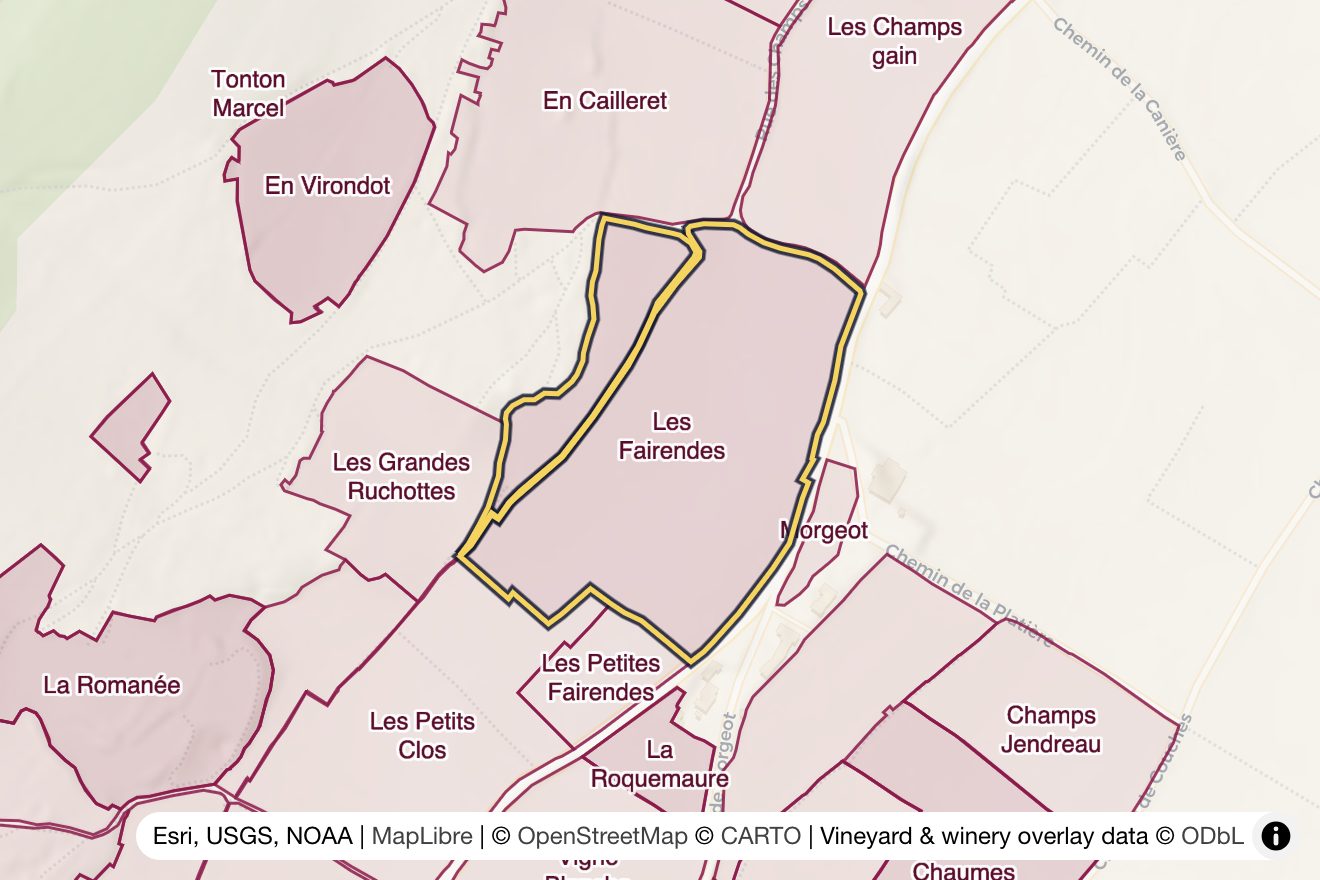
Overview & Location
The climat extends along the mid-slope of the Côte de Beaune escarpment, south of Beaune and occupying an elevation band that captures optimal sun exposure while maintaining the cooling influences essential for Chardonnay cultivation. Les Fairendes forms part of the Morgeot premier cru in the southern part of the commune.
Within Chassagne-Montrachet's complex vineyard mosaic, Les Fairendes holds particular significance as one of the climats that demonstrates the commune's capacity to produce Chardonnay wines of exceptional refinement and longevity. The vineyard's position places it within the geological and climatic sweet spot that has established Chassagne-Montrachet's reputation as a producer of some of Burgundy's most distinctive and age-worthy white wines.
Size
Les Fairendes is one of the many named climats within Morgeot, Chassagne-Montrachet's largest premier cru.
The vineyard's dimensions reflect the typical fragmentation pattern of Burgundy's finest sites, where centuries of inheritance divisions have created a patchwork of small parcels held by different domaines. This fragmentation, while creating complexity in terms of vineyard management and wine production, also ensures that Les Fairendes' terroir characteristics are interpreted through multiple viticultural and winemaking philosophies, contributing to the climat's overall reputation and market presence.
Terroir & Geology
The geological foundation of Les Fairendes reveals the complex sedimentary history that defines the Côte de Beaune's exceptional terroir characteristics. The vineyard sits upon Jurassic limestone formations, specifically Bathonian-stage deposits that provide the mineral backbone essential for premium Chardonnay production. The bedrock consists primarily of hard limestone with significant marl content, creating a geological matrix that offers both excellent drainage and sufficient water retention capacity.
The soils are described as shallow red clay and clay-gravel over limestone bedrock, with thin topsoil on the higher slope.
The vineyard's aspect faces predominantly east-southeast, capturing the beneficial morning sun exposure that proves crucial for Chardonnay ripening while avoiding the potentially excessive heat of late afternoon sun. This orientation, combined with the site's mid-slope elevation, creates optimal conditions for the slow, even maturation that characterizes the finest white wines of the Côte de Beaune.
The slope gradient in Les Fairendes ranges from 8-12%, steep enough to ensure excellent drainage and prevent water stagnation, yet gentle enough to maintain soil stability and allow for practical vineyard management. This moderate slope also contributes to the site's mesoclimatic characteristics, promoting air circulation that reduces disease pressure while moderating temperature extremes.
Geological analysis reveals the presence of fossilized marine organisms throughout the limestone matrix, evidence of the ancient Jurassic sea that covered this region approximately 150 million years ago. These fossil inclusions contribute trace minerals that many vignerons believe influence the distinctive mineral character found in wines from Les Fairendes.
Climate & Microclimate
Les Fairendes benefits from a mesoclimate that exemplifies the conditions that make Chassagne-Montrachet exceptional for Chardonnay cultivation. The climat experiences the continental climate typical of the Côte d'Or, with cold winters, warm summers, and the crucial diurnal temperature variations that preserve acidity while allowing for phenolic ripeness in the grapes.
The vineyard's position on the mid-slope creates specific microclimate advantages, including enhanced air drainage that reduces frost risk during spring and minimizes humidity levels that could promote fungal diseases. The east-southeast exposure ensures that Les Fairendes receives approximately 6-7 hours of direct sunlight during the growing season, with morning sun exposure beginning early and extending through the crucial midday ripening period.
Wind patterns play a significant role in Les Fairendes' microclimate, with prevailing westerly winds providing natural ventilation through the vine canopy while occasional north winds from the Plateau de Langres contribute cooling influences during the hottest summer periods.
Temperature moderation represents perhaps the most critical microclimate characteristic of Les Fairendes. The vineyard's mid-slope position and limestone-rich soils create thermal regulation that prevents extreme temperature spikes while maintaining sufficient warmth for complete ripening. Night-time cooling, enhanced by air drainage down the slope, preserves the acidity levels that give wines from Les Fairendes their characteristic freshness and aging potential.
Viticulture
Chardonnay dominates Les Fairendes, planted across approximately 95% of the climat's surface area, with small parcels of Pinot Noir occupying the remaining vineyard area. The Chardonnay vines in Les Fairendes typically range from 25-45 years in age, with some exceptional parcels containing vines planted in the 1960s and 1970s that produce fruit of exceptional concentration and complexity.
Planting density in Les Fairendes follows traditional Burgundian practices, with approximately 10,000-12,000 vines per hectare. This high density, combined with the climat's limestone-rich soils, encourages deep rooting and natural competition among vines, leading to reduced yields and increased flavor concentration. Most producers employ the Guyot simple or Guyot double training systems, adapted to the specific topographical characteristics of their individual parcels.
Viticultural practices in Les Fairendes reflect the premium quality expectations associated with Premier Cru classification. Mechanical harvesting is rare, with most producers insisting on hand-picking to ensure optimal grape selection and prevent premature extraction. Yield management through green harvesting typically occurs in July, with target yields ranging from 35-45 hectoliters per hectare, significantly below the maximum permitted levels.
Soil management practices vary among producers but generally emphasize sustainable approaches that preserve soil structure and promote biodiversity. Many vignerons employ light tillage combined with controlled grass cover in the vine rows, allowing for natural competition while preventing soil erosion on the sloped terrain. Organic and biodynamic viticulture has gained adoption among several domaines working in Les Fairendes, reflecting broader trends toward environmental sustainability in Premier Cru vineyards.
The climat presents specific viticultural challenges, including managing water stress during dry summers and preventing over-vigor in wet years. The limestone-rich soils can create iron deficiency (chlorosis) in some vineyard sections, requiring careful monitoring and occasional soil amendments. Spring frost protection has become increasingly important, with some producers installing wind machines or employing other protective measures during vulnerable periods.
Wine Character & Style
Wines from Les Fairendes exhibit the refined minerality and structural complexity that define exceptional Chassagne-Montrachet Chardonnay. The climat produces wines characterized by a distinctive combination of richness and elegance, with a mineral backbone that provides both immediate appeal and long-term aging potential.
The aromatic profile of Les Fairendes Chardonnay typically opens with white flower notes (acacia, hawthorn, and elderflower) accompanied by citrus elements including lemon zest, grapefruit, and occasionally lime. As the wines develop, orchard fruit characteristics emerge, particularly green apple, pear, and white peach, often with subtle tropical hints of pineapple and mango in warmer vintages.
The mineral character that defines Les Fairendes manifests as wet limestone, crushed seashells, and flint-like notes that provide textural interest and aromatic complexity. This minerality integrates seamlessly with the fruit characteristics, creating wines that express both their varietal identity and their specific terroir origins.
On the palate, Les Fairendes Chardonnay demonstrates remarkable balance between richness and freshness. The wines typically show medium to medium-plus body, with a glycerol content that provides textural weight without overwhelming the palate. Acidity levels remain vibrant, usually ranging from 6.0-6.8 g/L, providing the structural framework necessary for food compatibility and aging development.
The texture of Les Fairendes wines reveals the climat's limestone-rich terroir through a distinctive chalk-like minerality that appears in the mid-palate and extends through a long, persistent finish. Oak integration varies among producers but generally emphasizes subtlety, with the best examples showing seamless integration of wood-derived spice and vanilla notes that complement rather than dominate the terroir expression.
Vintage variation in Les Fairendes follows predictable patterns related to climatic conditions, with cooler years producing wines of greater mineral precision and aging potential, while warmer vintages tend toward richer, more immediately accessible styles. Regardless of vintage character, the climat consistently produces wines with the structural integrity and complexity expected from Premier Cru classification.
Comparison to Surrounding Crus
Les Fairendes occupies a distinctive position within Chassagne-Montrachet's Premier Cru hierarchy, producing wines from the highest, most limestone-rich part of the Morgeot premier cru.
The contrast with Les Caillerets, one of Chassagne-Montrachet's most renowned Premier Crus, reveals Les Fairendes' particular character strengths. While Les Caillerets wines often display more immediate elegance and complexity, Les Fairendes produces wines with greater structural density and mineral depth, requiring additional cellaring time to reach full expression but ultimately achieving comparable quality levels.
When compared to Grand Cru sites, Les Fairendes demonstrates quality levels that approach but do not quite match the complexity and intensity found in Bâtard-Montrachet or Criots-Bâtard-Montrachet. However, the climat consistently produces wines that surpass many Grand Cru sites in other Burgundy regions, confirming the exceptional terroir quality that defines Chassagne-Montrachet's finest vineyards.
Notable Producers
Several distinguished domaines produce wines from Les Fairendes, each bringing different viticultural and winemaking approaches that highlight various aspects of the climat's terroir potential. Producers bottling Les Fairendes include Jean-Marc Pillot, Henri Germain, Domaine Jouard, Morey-Coffinet, Benoît Moreau and Coffinet-Duvernay.
Historical Background & Classification
Les Fairendes is classified as a premier cru within the Chassagne-Montrachet appellation, which was created by decree in 1937. However, the site had been recognized for its superior quality for centuries prior to this official classification, with historical records indicating premium pricing for wines from Les Fairendes as early as the 18th century.
During the 19th century, Les Fairendes gained particular recognition through the work of négociant houses based in Beaune and Meursault, who identified the climat as a source of exceptional Chardonnay that could compete with wines from the most prestigious sites in Burgundy. This recognition helped establish the market reputation that continues to define Les Fairendes today.
The phylloxera crisis of the late 19th century affected Les Fairendes similarly to other Côte d'Or vineyards, requiring complete replanting on American rootstocks. However, the site's recovery proved particularly successful, with replanted vineyards quickly reestablishing the quality levels that had made Les Fairendes famous before the crisis.
Post-World War II development in Les Fairendes reflected broader changes in Burgundy, with increased domain-bottling replacing négociant sales and greater focus on terroir expression through improved viticultural and winemaking techniques. This evolution has continued through the present day, with Les Fairendes now recognized as one of Chassagne-Montrachet's most reliable and distinctive Premier Cru sites.
Aging Potential & Quality Level
Wines from Les Fairendes demonstrate exceptional aging potential, typically requiring 5-7 years of cellaring to reach initial maturity and continuing to develop positively for 15-20 years in optimal vintages. The climat's limestone-rich terroir provides the mineral structure necessary for long-term development, while natural acidity levels ensure that wines maintain freshness throughout extended aging periods.
Young wines from Les Fairendes often appear tight and mineral-driven, with fruit characteristics initially subdued by the strong terroir expression. This phase typically lasts 3-5 years, during which careful cellaring in consistent, cool conditions allows the wines to gradually integrate their various components and begin showing the complexity that defines mature Premier Cru Chardonnay.
The optimal drinking window for Les Fairendes wines generally begins around the 7-10 year mark, when the initial mineral austerity has softened and the fruit characteristics have achieved full expression. During this period, the wines display the complete range of aromatic and flavor complexity that makes Les Fairendes exceptional, including developed orchard fruit notes, complex mineral undertones, and the subtle oak integration that provides textural interest without overwhelming the terroir expression.
Quality consistency in Les Fairendes ranks among the highest in Chassagne-Montrachet, with even challenging vintages typically producing wines that meet Premier Cru expectations. This consistency reflects both the inherent quality of the terroir and the high standards maintained by producers working in this climat.
The secondary market performance of Les Fairendes wines confirms their quality level and aging potential, with mature bottles commanding prices that reflect both scarcity and proven development capacity. Collectors particularly value wines from exceptional vintages, which demonstrate the climat's ability to produce wines that rival Grand Cru sites in complexity and longevity.
Investment potential for Les Fairendes wines remains strong, supported by limited production quantities, proven aging capacity, and growing international recognition of Chassagne-Montrachet's quality potential. As global demand for authentic terroir expression continues to increase, Les Fairendes represents one of Burgundy's most reliable sources of age-worthy Chardonnay at Premier Cru pricing levels.