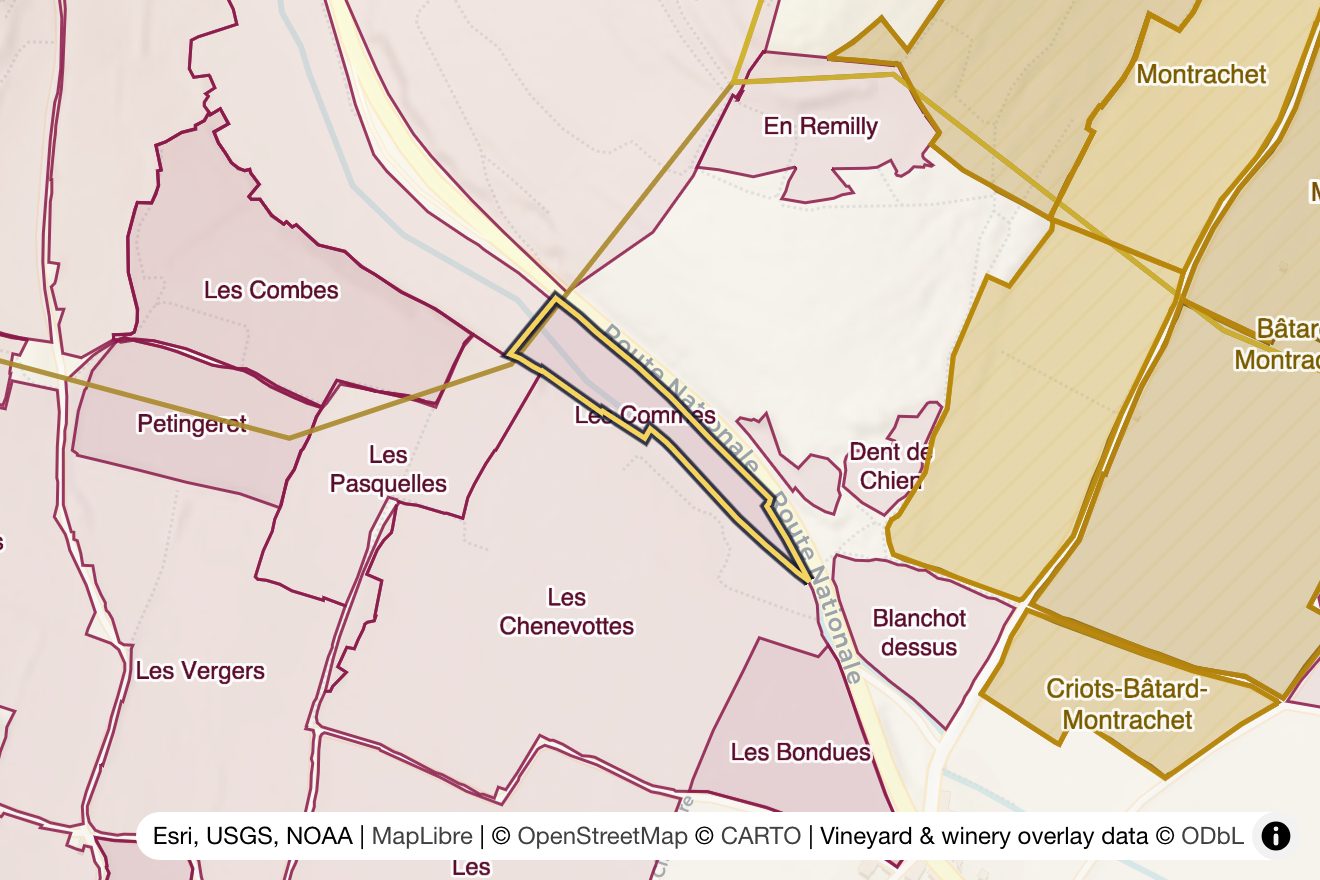
Overview & Location
The vineyard sits in the northern part of Chassagne-Montrachet's Premier Cru holdings, within Les Chenevottes, close to the Le Montrachet grand cru. This placement grants Les Commes optimal exposure and protection while maintaining the essential drainage characteristics that distinguish Burgundy's finest vineyard sites. The climat forms part of the continuous band of Premier Cru vineyards that stretches along the Côte de Beaune's mid-slope, sharing geological continuity with some of Burgundy's most celebrated terroirs.
Within the broader context of the Côte de Beaune, Les Commes occupies a transitional zone between the powerful, mineral-driven wines of Puligny-Montrachet to the north and the more structured, sometimes earthier expressions found in Chassagne's southern sectors. This geographical positioning contributes significantly to the vineyard's distinctive character, combining elegance with underlying power in a manner that exemplifies Chassagne-Montrachet's finest expressions.
The climat's boundaries are precisely delineated according to the traditional Burgundian system, with parcels distributed among multiple proprietors following patterns established over centuries of inheritance and land division. These boundaries, codified in the official appellation regulations, reflect not arbitrary decisions but rather the accumulated wisdom of generations who recognized the specific characteristics that distinguish Les Commes from its neighboring sites.
Size
Les Commes encompasses only a part of the roughly 11-hectare Les Chenevottes premier cru, making it a moderately sized Premier Cru within Chassagne-Montrachet's portfolio of classified vineyards. This size places it within the typical range for Burgundy Premier Cru climats, large enough to encompass meaningful terroir variation while remaining small enough to maintain the site's distinctive characteristics throughout.
The vineyard's modest scale reflects the fragmented nature of Burgundian vineyard ownership, with multiple producers holding parcels of varying sizes within the climat's boundaries. This division creates a complex mosaic of ownership that contributes to the diversity of expressions emerging from Les Commes, as different proprietors bring varying approaches to viticulture and winemaking while working with the same fundamental terroir.
Terroir & Geology
The geological foundation of Les Commes reveals the complex interplay of limestone formations that defines the Côte de Beaune's greatest vineyard sites. The soils are clay-limestone with some marl.
The soil composition shows remarkable complexity, with the upper sections containing higher proportions of active limestone and marl, while lower-lying areas display increased clay content mixed with limestone debris. This variation creates distinct microzones within the climat, each contributing different characteristics to the wines produced from specific parcels. The limestone component provides essential minerality and pH buffering, while clay elements contribute to water retention and nutrient availability during the growing season.
Soil depth varies significantly across Les Commes, with shallower and deeper zones. These variations in soil depth profoundly influence vine behavior, with shallow areas producing more concentrated, mineral-driven fruit, while deeper soils yield wines with greater volume and textural richness.
The climat's slope orientation faces primarily east-southeast, providing optimal morning sun exposure while protecting vines from the harsh afternoon heat that can compromise aromatic development. The slope gradient ranges from gentle to moderate, approximately 8-12%, ensuring excellent drainage while maintaining sufficient soil retention for vine nutrition. This aspect proves particularly beneficial for Chardonnay cultivation, allowing for gradual ripening that preserves acidity while developing complex flavors.
Les Commes lies within the Chassagne-Montrachet appellation's elevation range of roughly 220 to 325 meters. This elevation provides the perfect balance between warmth necessary for full ripening and coolness essential for maintaining the tension and minerality that characterize great white Burgundy.
The geological formation underlying Les Commes connects it to the broader Côte de Beaune limestone spine, with fault lines and erosional patterns that have shaped the slope's contours over millions of years. These geological processes have created the drainage channels and soil deposits that define the climat's contemporary terroir characteristics.
Climate & Microclimate
Les Commes benefits from a continental climate moderated by the protective influence of the Côte de Beaune's forested plateau above and the opening of the Saône Valley below. This positioning creates a unique mesoclimate that combines adequate warmth for ripening with the cool conditions necessary for aromatic retention and structural development.
The climat's eastern exposure ensures early morning warming, which proves crucial during Burgundy's often challenging growing seasons. Morning sunlight helps dry dew and reduce humidity-related disease pressure while initiating photosynthesis early in the day. The slope's orientation also provides protection from prevailing westerly winds while allowing beneficial air circulation that prevents stagnation and maintains healthy growing conditions.
Frost risk in Les Commes remains moderate due to the slope's drainage characteristics and elevation above the valley floor where cold air accumulates. However, spring frost events can still pose challenges, particularly in lower-lying sections of the climat where cold air tends to pool. The limestone soils' heat retention properties help moderate temperature fluctuations, providing thermal stability during critical growing periods.
Precipitation patterns affect Les Commes similarly to other Chassagne-Montrachet Premier Crus, with the vineyard receiving adequate but not excessive rainfall in most vintages. The slope's excellent drainage prevents waterlogging while the limestone's water retention capabilities ensure vine access to moisture during dry periods. This balance proves essential for maintaining consistent fruit quality across varying vintage conditions.
The mesoclimate of Les Commes shows subtle but important differences from neighboring climats, with slightly earlier budbreak and harvest timing compared to sites with different exposures. These temporal variations, though measured in days rather than weeks, can significantly impact fruit development and final wine character, particularly in marginal vintages where timing becomes critical.
Viticulture
Chardonnay dominates Les Commes plantings, representing approximately 85% of the climat's surface area. This proportion reflects both the site's exceptional suitability for white grape cultivation and market demand for Premier Cru white Chassagne-Montrachet. The remaining 15% consists primarily of Pinot Noir, planted in parcels where microclimate and soil characteristics favor red grape development.
Vine age varies considerably across Les Commes, reflecting different proprietors' planting schedules and replacement strategies. Average vine age ranges from 25-40 years, with some parcels containing vines exceeding 50 years of age. These older vines contribute significantly to wine quality, producing lower yields while delivering greater concentration and complexity. Younger plantings, typically 10-20 years old, show increasing quality as they reach full maturity.
Planting density follows traditional Burgundian norms, averaging 10,000-12,000 vines per hectare. This high density encourages competition among vines while limiting individual vine productivity, concentrating flavors and enhancing terroir expression. Row orientation generally follows slope contours to optimize drainage and sun exposure while facilitating mechanization where terrain permits.
Viticultural practices in Les Commes emphasize sustainable approaches that preserve soil health and vine balance. Some producers employ organic or biodynamic methods, avoiding synthetic chemicals while maintaining vineyard health through careful canopy management and soil cultivation. Cover cropping between rows helps prevent erosion while adding organic matter to the soil.
Pruning follows the Guyot system predominantly, with careful attention to bud selection and cane positioning to optimize fruit exposure and air circulation. Canopy management throughout the growing season involves selective leaf removal around fruit clusters to enhance ripening while maintaining sufficient foliage for photosynthesis and sun protection.
Harvest timing in Les Commes requires careful consideration of ripeness parameters beyond simple sugar accumulation. Producers monitor phenolic maturity, acid retention, and aromatic development to determine optimal picking dates. Hand harvesting remains standard practice, allowing selective picking and gentle fruit handling essential for Premier Cru quality.
Site-specific viticultural challenges include managing vigor variations across different soil depths and compositions within the climat. Areas with deeper, richer soils may require more aggressive canopy management to prevent excessive vegetative growth, while shallow, poor soils need careful attention to vine stress levels and water management.
Wine Character & Style
Les Commes Premier Cru wines exhibit a distinctive personality that combines power with finesse, reflecting the climat's unique terroir characteristics. The Chardonnays display remarkable complexity, with pronounced mineral backbone derived from the limestone-rich soils complemented by layers of fruit and floral aromatics that develop with proper cellar aging.
Aromatic profiles typically begin with citrus elements (lemon zest, lime, and occasionally grapefruit) accompanied by white orchard fruits including pear, apple, and quince. As wines mature, these primary aromatics evolve toward more complex notes including honey, hazelnut, brioche, and subtle spice elements. The limestone terroir contributes distinctive mineral notes often described as wet stone, chalk, or oyster shell, providing an underlying thread that unifies the aromatic spectrum.
Structural qualities of Les Commes wines demonstrate the climate's ability to balance ripeness with freshness. Acidity levels remain vibrant and well-integrated, providing backbone for aging while supporting the wine's fruit components. Alcohol levels typically range from 12.5-13.5%, reflecting the site's ability to achieve full ripeness without excessive concentration that might compromise elegance.
Textural characteristics show remarkable sophistication, with wines displaying both richness and precision. The mouthfeel combines creamy elements derived from lees aging with crystalline minerality that provides focus and definition. This textural complexity develops through proper élevage techniques that respect the terroir while enhancing the wine's natural qualities.
The wines demonstrate exceptional length and persistence, with flavors that evolve and expand across the palate before concluding with mineral-driven finishes that can extend for 30-45 seconds in outstanding examples. This persistence reflects both terroir quality and careful winemaking that preserves the site's essential characteristics.
Pinot Noir from Les Commes, though less common, displays elegance and restraint characteristic of Chassagne-Montrachet reds. These wines show bright red fruit aromatics with underlying earthy minerality, medium body with silky tannins, and the capacity for graceful aging over 10-15 years.
Comparison to Surrounding Crus
Within Chassagne-Montrachet's Premier Cru hierarchy, Les Commes occupies a distinctive position that differentiates it from neighboring climats through subtle but important variations in terroir expression. Compared to Morgeot, Chassagne's largest and most famous Premier Cru, Les Commes wines typically show greater minerality and tension, with less overt richness but potentially greater aging complexity.
The contrast with Caillerets, another highly regarded Premier Cru, reveals Les Commes' more structured character and mineral-driven profile compared to Caillerets' reputation for elegance and floral aromatics. While both sites produce exceptional wines, Les Commes tends toward greater power and aging potential, reflecting its specific geological characteristics and slope position.
Compared to Chaumées, located in a similar slope position but with different soil compositions, Les Commes wines display more pronounced limestone character and typically greater concentration. The differences, while subtle, become apparent through direct comparison and reflect the precision of Burgundy's climat classification system.
When compared to Chassagne-Montrachet's portion of Bâtard-Montrachet Grand Cru, Les Commes wines show related mineral character but with less immediate power and richness. However, the Premier Cru offers exceptional value and can achieve remarkable quality levels that approach Grand Cru standards in outstanding vintages with top producers.
The relationship with neighboring Puligny-Montrachet Premier Crus reveals Les Commes' position in the stylistic spectrum between Chassagne's earthier character and Puligny's more ethereal expressions. Les Commes wines typically show more body and mineral intensity than most Puligny Premier Crus while maintaining comparable finesse and aging potential.
Notable Producers
Several distinguished producers craft wines from Les Commes, each bringing unique approaches to viticulture and winemaking while respecting the terroir's fundamental character. Domaine Ramonet is one of Burgundy's most respected white wine producers.
Marc Colin et Fils represents another benchmark producer, bottling a Les Chenevottes premier cru from the wider zone that includes Les Commes. Their wines consistently demonstrate the terroir's mineral backbone while showcasing different stylistic approaches to oak usage and lees aging.
Domaine Jean-Noël Gagnard maintains traditional approaches to Les Commes cultivation, producing wines that emphasize terroir expression over winemaking intervention. Their holdings in the climat produce wines of remarkable longevity and authentic character that reflect the site's geological foundations.
Bernard Moreau et Fils contributes another perspective on Les Commes terroir, with parcels located in different sections of the climat that provide insight into microterrroir variations. Their wines often display exceptional mineral precision and aging potential.
Smaller producers including Vincent Dancer also work parcels in the wider Les Chenevottes premier cru, bringing contemporary techniques to traditional terroir expression. These producers often achieve remarkable quality levels that demonstrate the climat's exceptional potential when handled with appropriate care and respect.
The variation among producers working Les Commes parcels provides valuable insight into the climat's flexibility and response to different winemaking approaches, while consistently maintaining the fundamental character that defines this Premier Cru.
Historical Background & Classification
Les Commes' history as a distinguished vineyard site extends back several centuries, with documentation indicating continuous viticulture since at least the medieval period. The climat name derives from local geographical terminology, reflecting the site's position and characteristics as recognized by generations of vignerons.
The vineyard's Premier Cru classification was formalized by decree in the 1970s, decades after the Chassagne-Montrachet appellation was created in 1937, when authorities recognized Les Commes' consistent quality and distinctive terroir characteristics. This classification reflected not arbitrary designation but rather centuries of accumulated knowledge about the site's exceptional potential for producing wines of Premier Cru caliber.
Historical records indicate that Les Commes wines commanded premium prices throughout the 19th and early 20th centuries, suggesting market recognition of the site's quality long before official classification. This commercial success reflected the wines' reputation among négociants and consumers who recognized the climat's distinctive character and aging potential.
The vineyard's boundaries, as established in the official classification, reflect traditional recognition of terroir boundaries based on soil characteristics, drainage patterns, and microclimate variations. These boundaries have remained essentially unchanged since classification, testifying to the precision of the original delimitation process.
Throughout its documented history, Les Commes has maintained its reputation as one of Chassagne-Montrachet's most reliable Premier Cru sites, producing wines of consistent quality across varying vintage conditions while expressing distinctive terroir characteristics that distinguish it from neighboring climats.
Aging Potential & Quality Level
Les Commes Premier Cru wines demonstrate exceptional aging potential, with properly stored examples developing complexity and refinement over 15-25 years or more. The wines' evolution follows predictable patterns, with primary fruit aromatics gradually giving way to more complex secondary and tertiary characteristics while maintaining freshness and mineral backbone.
During the first 3-5 years after vintage, Les Commes wines typically display primary fruit and floral characteristics with emerging mineral notes. This period represents optimal drinking for those preferring younger wine styles, though the wines show clear potential for extended development.
The 5-12 year period marks the wines' classical drinking window, when primary aromatics have integrated with oak and lees influences while complex mineral and secondary characteristics emerge. During this phase, Les Commes wines display their full personality while retaining freshness and vitality.
Extended aging beyond 12-15 years reveals the climat's true greatness, as wines develop honeyed richness, complex nutty and spice notes, and profound mineral depth while maintaining remarkable freshness. The limestone terroir's influence becomes most apparent during this mature phase, providing structure and longevity that distinguishes great terroir from merely good vineyard sites.
Quality consistency across vintages remains high for Les Commes, with the terroir's drainage characteristics and aspect providing resilience during challenging growing seasons. Even in difficult vintages, competent producers craft wines that maintain the climat's essential character while reflecting vintage conditions.
The investment quality of Les Commes wines continues growing as collectors and consumers recognize the climat's exceptional terroir and aging potential. Values appreciate steadily, reflecting both limited production and increasing recognition of the site's place among Chassagne-Montrachet's finest Premier Cru holdings.
This comprehensive examination of Les Commes reveals a Premier Cru of exceptional quality and distinctive character, representing the intersection of outstanding terroir, centuries of viticultural wisdom, and contemporary winemaking excellence that defines Burgundy's greatest vineyard sites.