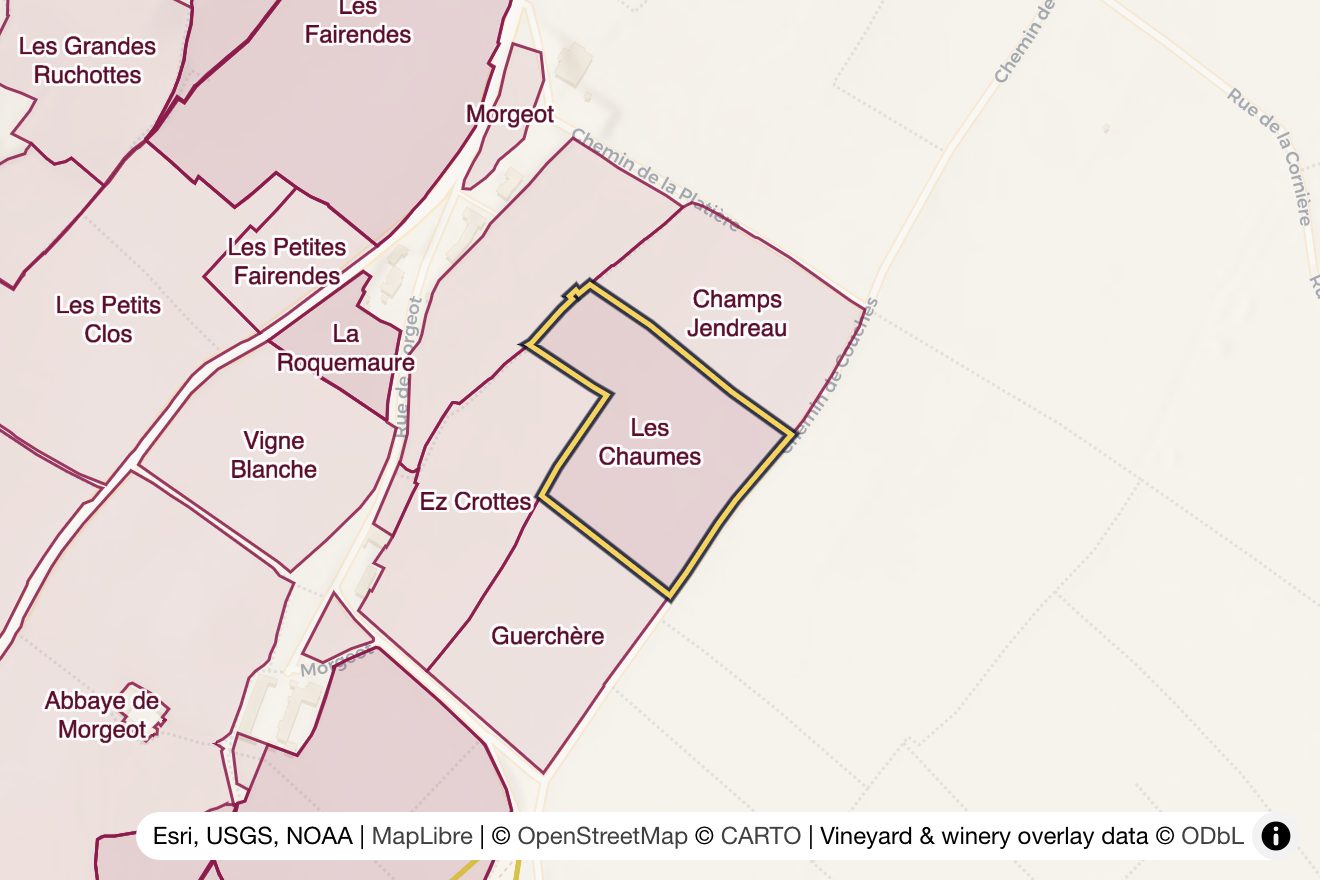
Overview & Location
The vineyard is situated approximately 250 meters above sea level, located in the southern part of the commune, among the Morgeot climats. Les Chaumes benefits from an eastern exposure that captures the morning sun while being protected from the harsh afternoon heat, creating optimal conditions for both Pinot Noir and Chardonnay cultivation.
The name "Chaumes" derives from the French word meaning "stubble" or "thatch," historically referring to the practice of leaving crop residue on fields after harvest. This nomenclature reflects the agricultural heritage of the site and its long-standing cultivation history, dating back several centuries when the land served multiple agricultural purposes before its exclusive dedication to viticulture.
Within the broader context of Chassagne-Montrachet, Les Chaumes represents a small fraction of the commune's Premier Cru vineyard area, making it a relatively intimate site that allows for focused, artisanal winemaking approaches. The vineyard's positioning within the appellation's hierarchy places it among the respected Premier Cru sites, though it maintains a more accessible profile compared to some of its more celebrated neighbors.
Size
Les Chaumes encompasses a small planted area, making it a modest-sized Premier Cru within the Chassagne-Montrachet appellation. This modest scale allows for intimate vineyard management and enables producers to maintain close attention to individual parcels within the climat.
The vineyard's compact nature facilitates consistent terroir expression across its boundaries, as the geological and climatic conditions remain relatively uniform throughout the site. This homogeneity contributes to the wine's characteristic consistency and allows producers to develop a clear understanding of the vineyard's potential and requirements.
Ownership of Les Chaumes is distributed among several producers, with holdings of differing sizes. This fragmented ownership structure, typical of Burgundy's historical inheritance patterns, ensures diverse winemaking approaches and interpretations of the terroir while maintaining the overall character integrity of the site.
The vineyard's boundaries are clearly delineated by traditional stone walls and natural topographical features, creating distinct microclimatic conditions that differentiate Les Chaumes from adjacent Premier Cru sites. The relatively modest size allows for hand-harvesting across the entire vineyard, ensuring optimal fruit selection and handling practices that preserve the terroir's delicate characteristics.
Terroir & Geology
Les Chaumes sits atop a complex geological foundation that exemplifies the Côte de Beaune's renowned terroir diversity. The underlying bedrock consists primarily of Jurassic limestone from the Bathonian period, approximately 165 million years old, which provides the fundamental mineral structure that defines Chassagne-Montrachet's exceptional wine character.
The topsoil composition varies between 30-60 centimeters in depth, featuring a mixture of clay, limestone debris, and fossilized marine materials. This shallow soil profile forces vine roots to penetrate deeply into the limestone bedrock, accessing essential minerals while naturally limiting yields and concentrating flavor compounds in the fruit.
The soil's clay content, typically ranging between 25-35%, provides adequate water retention during dry periods while ensuring proper drainage during wet seasons. This clay component is particularly beneficial for Pinot Noir cultivation, contributing to the wine's structure and aging potential. The limestone debris scattered throughout the soil profile enhances drainage and contributes to the characteristic mineral backbone found in wines from Les Chaumes.
Erosion patterns over millennia have created subtle variations in soil depth and composition across the vineyard, with the upper slopes featuring thinner soils over limestone bedrock, while the lower sections contain slightly deeper, more clay-rich profiles. These variations allow producers to adapt their viticultural practices to specific parcels, optimizing grape quality according to each section's unique characteristics.
The presence of fossilized marine materials, including ancient oyster shells and other sea creature remnants, reflects the area's prehistoric oceanic origins and contributes to the soil's exceptional mineral complexity. These fossil deposits slowly decompose over time, releasing trace minerals that vines absorb and translate into the distinctive mineral profile that characterizes Les Chaumes wines.
Iron oxide deposits scattered throughout the soil contribute to the distinctive reddish hues visible in certain sections of the vineyard and may influence the color development and tannic structure of Pinot Noir produced from these areas. The soil's pH levels typically range between 7.8-8.2, creating alkaline conditions that favor both Chardonnay and Pinot Noir development while contributing to the wines' longevity and aging potential.
Climate & Microclimate
Les Chaumes experiences a continental climate tempered by maritime influences from the west, creating optimal conditions for premium grape cultivation. The vineyard's eastern exposure captures beneficial morning sunlight while avoiding excessive afternoon heat, promoting steady ripening throughout the growing season.
The site's elevation at approximately 250 meters above sea level positions it within the optimal thermal zone for both Chardonnay and Pinot Noir cultivation. This elevation provides sufficient warmth for complete ripening while maintaining the acidity levels essential for age-worthy wines. Cool nighttime temperatures, particularly during the late summer and early autumn, preserve aromatic compounds and prevent excessive sugar accumulation.
Natural wind patterns flowing through the Saône Valley create beneficial air circulation that reduces humidity levels around the vine canopy, minimizing disease pressure and promoting healthy grape development. These winds also help moderate temperatures during hot summer days, preventing heat stress that could compromise fruit quality.
The vineyard's position on the hillside creates natural drainage patterns that prevent water stagnation while ensuring adequate moisture retention during dry periods. The slope's gradient, typically ranging between 8-15%, promotes excellent drainage while preventing excessive erosion that could compromise soil integrity.
Frost risk in Les Chaumes is generally minimal due to the elevation and air circulation patterns, though late spring frosts can occasionally affect bud break in lower-lying sections. The vineyard's aspect and elevation create a natural thermal inversion effect that provides protection during most frost events.
Rainfall patterns typically provide 650-750mm annually, with the majority occurring during winter months when vines are dormant. Summer precipitation is usually sufficient to maintain vine health without promoting excessive vigor that could dilute fruit concentration.
The harvest period in Les Chaumes typically occurs 2-3 days later than lower-elevation sites within Chassagne-Montrachet, allowing for extended hang time that develops complex flavor profiles while maintaining essential acidity levels. This extended ripening period contributes to the characteristic depth and complexity found in wines from this Premier Cru site.
Viticulture
Viticultural practices in Les Chaumes reflect centuries of accumulated knowledge adapted to the site's specific terroir characteristics. Vine density typically ranges between 10,000-12,000 vines per hectare, promoting competition among individual plants while ensuring adequate space for mechanized cultivation where terrain permits.
Rootstock selection focuses primarily on SO4 and 161-49C varieties, chosen for their compatibility with the limestone-rich soils and their ability to regulate vigor in the fertile terroir. These rootstocks provide adequate drought resistance while limiting excessive vegetative growth that could compromise fruit concentration.
Pruning follows traditional Burgundian methods, with Guyot simple being the predominant system employed across most parcels. This pruning approach limits yield potential while promoting even fruit distribution and optimal sun exposure. Producers typically maintain 6-8 buds per vine, adjusting according to vine age and vigor.
Canopy management practices emphasize early shoot positioning and selective leaf removal to optimize sun exposure and air circulation around fruit clusters. Leaf removal is typically performed on the east-facing side of the canopy during early summer, promoting morning sun exposure while protecting fruit from harsh afternoon heat.
Green harvesting, or crop thinning, is practiced selectively based on seasonal conditions and individual vine vigor. Producers typically remove 15-25% of clusters during veraison, concentrating energy into remaining fruit and ensuring complete ripening by harvest time.
Soil management varies among producers, with some employing traditional plowing techniques while others adopt sustainable cover crop systems. Cover crops, when used, typically include leguminous plants that fix nitrogen naturally while preventing erosion and improving soil structure.
Organic and biodynamic practices have gained increasing adoption in Les Chaumes, with several producers transitioning away from synthetic inputs in favor of natural alternatives. These approaches emphasize soil health and biodiversity, promoting long-term vineyard sustainability while potentially enhancing terroir expression.
Harvest timing requires careful monitoring of sugar accumulation, acidity retention, and phenolic development. Producers typically harvest Chardonnay first, followed by Pinot Noir 7-10 days later, adjusting timing according to seasonal conditions and desired wine style.
Hand-harvesting remains the preferred method across most parcels, ensuring optimal fruit selection and minimal oxidation during transport to the winery. Small harvest bins, typically 20-25kg capacity, preserve fruit integrity and allow for additional selection at the winery.
Wine Character & Style
Wines from Les Chaumes exhibit distinctive characteristics that reflect the Premier Cru's unique terroir expression within Chassagne-Montrachet. The site produces both exceptional Chardonnay and Pinot Noir, each displaying site-specific attributes that distinguish them from other Premier Cru vineyards in the appellation.
Chardonnay from Les Chaumes demonstrates remarkable mineral complexity, with pronounced chalky and limestone-derived notes that form the backbone of the wine's structure. The mineral profile is complemented by subtle citrus flavors, typically featuring lemon zest, green apple, and occasionally white peach characteristics. Oak integration varies by producer but generally remains restrained, allowing the terroir's mineral expression to dominate.
The texture of Les Chaumes Chardonnay exhibits medium to full body with distinctive chalky minerality that provides both weight and freshness. Acidity levels are typically well-balanced, providing structure for aging while maintaining approachability in youth. The finish demonstrates notable persistence, with mineral notes lingering long after initial tasting.
Pinot Noir from Les Chaumes displays elegant fruit expression combined with structured tannins that reflect the limestone-rich terroir. Color intensity is typically medium to medium-plus, with ruby hues that develop garnet highlights with age. The aromatic profile features red berry fruits, particularly cherry and raspberry, complemented by subtle spice and mineral undertones.
The palate structure of Les Chaumes Pinot Noir emphasizes finesse over power, with silky tannins that provide framework without overwhelming the delicate fruit expression. Earth and mineral components become more prominent with bottle age, developing complex secondary and tertiary characteristics that showcase the terroir's influence.
Both varietals from Les Chaumes demonstrate excellent vintage variation, reflecting seasonal conditions while maintaining consistent site characteristics. Cool vintages tend to emphasize mineral and earth components, while warmer years develop more pronounced fruit expression without losing essential elegance.
The wines typically require 3-5 years to reach optimal drinking condition, allowing integration of oak influences and development of complex tertiary characteristics. Peak drinking windows extend 8-12 years for Chardonnay and 10-15 years for Pinot Noir, depending on vintage conditions and winemaking approach.
Comparison to Surrounding Crus
Les Chaumes occupies a distinctive position within Chassagne-Montrachet's Premier Cru hierarchy, displaying characteristics that both complement and contrast with surrounding vineyard sites. Understanding these relationships provides insight into the nuanced terroir variations that define individual climats within the appellation.
Compared to Clos Saint-Jean, Les Chaumes typically produces wines with more pronounced mineral expression and slightly higher acidity levels. This difference reflects Les Chaumes' eastern exposure and marginally higher elevation, which promotes slower ripening and enhanced mineral development. Clos Saint-Jean, with its more protected position, often develops greater fruit concentration and slightly softer acidity.
La Grande Montagne, set higher up the slope, generally produces wines with more structured tannins and greater aging potential in Pinot Noir, while its Chardonnay tends toward richer, more opulent styles. The differing soil compositions and microclimatic variations between these sites create complementary rather than competing wine styles.
The relationship with Morgeot, one of Chassagne-Montrachet's largest and most diverse Premier Cru sites, reveals Les Chaumes' more focused terroir expression. While Morgeot's extensive area encompasses multiple soil types and exposures, creating diverse wine styles, Les Chaumes maintains more consistent characteristics across its smaller boundaries.
Compared to the prestigious Caillerets vineyard, Les Chaumes produces wines with similar mineral intensity but typically less concentration and power. Caillerets' superior exposure and soil composition generally result in more structured wines with greater aging potential, positioning it higher in the quality hierarchy.
The contrast with Chenevottes, another Premier Cru site within Chassagne-Montrachet, demonstrates different approaches to elegance. While both sites produce refined wines, Les Chaumes tends toward greater mineral expression, while Chenevottes often displays more pronounced fruit character and slightly softer structure.
When compared to Premier Cru sites in neighboring Puligny-Montrachet, Les Chaumes Chardonnay demonstrates the characteristic Chassagne style of enhanced mineral expression and slightly more structured character. The limestone influence remains prominent in both communes, but Chassagne sites like Les Chaumes often display more pronounced earthy undertones.
Notable Producers
Several distinguished producers have established reputations for exceptional wines from Les Chaumes, each bringing unique winemaking philosophies and techniques to express the Premier Cru's distinctive terroir characteristics.
Domaine Marc Morey is a long-established Chassagne family estate, though no Les Chaumes bottling from it is documented, developing intimate knowledge of the vineyard's requirements and potential. Their approach emphasizes traditional Burgundian techniques combined with selective modern innovations, producing wines that showcase both fruit purity and terroir expression. Marc Morey's Les Chaumes typically demonstrates excellent balance between power and finesse.
Domaine Michel Niellon, renowned for exceptional Chardonnay production throughout Chassagne-Montrachet, makes a Premier Cru from Les Chaumées (Clos de la Truffière), a different climat, rather than from Les Chaumes. Niellon's winemaking approach emphasizes minimal intervention, allowing the terroir to express itself through careful vineyard management and precise vinification techniques.
Domaine Vincent Dancer is certified organic, but no Les Chaumes bottling from it is documented; its Chassagne premier crus include La Romanée and Tête du Clos. Dancer's wines from this site typically demonstrate exceptional purity and mineral complexity, reflecting the producer's commitment to sustainable viticulture and traditional winemaking methods.
Bernard Morey et Fils is not documented as a Les Chaumes producer, maintaining traditional approaches while incorporating selective modern techniques. Their wines demonstrate the classic Chassagne-Montrachet characteristics while showcasing the specific nuances that distinguish Les Chaumes from other Premier Cru sites.
Domaine Jean-Noël Gagnard, with extensive Premier Cru holdings throughout Chassagne-Montrachet, makes a village-level white Chassagne-Montrachet Les Chaumes rather than a Premier Cru from this site. Gagnard's approach emphasizes terroir expression through careful vineyard management and traditional winemaking, producing wines that age gracefully while displaying youthful appeal.
Several emerging producers have also gained recognition for exceptional Les Chaumes wines, bringing fresh perspectives while respecting traditional practices. These producers often emphasize organic or biodynamic approaches, contributing to the ongoing evolution of winemaking practices within the appellation.
Historical Background & Classification
Les Chaumes' viticultural history extends back several centuries, with documented wine production dating to the medieval period when monastic communities first established systematic vineyard cultivation throughout the Côte de Beaune. The site's name appears in historical records from the 16th century, indicating its recognition as a distinct vineyard area well before modern classification systems.
The vineyard's inclusion in the Premier Cru classification system reflects its consistent quality potential and distinctive terroir characteristics recognized over generations of cultivation. The formal classification, rooted in the Chassagne-Montrachet AOC created in 1937, codified centuries of empirical knowledge regarding the site's exceptional wine-producing capabilities.
During the 19th century, Les Chaumes gained recognition among Burgundian négociant houses who sought fruit from the site for premium cuvées. This commercial interest helped establish the vineyard's reputation beyond local markets and contributed to its eventual Premier Cru classification.
The phylloxera crisis of the late 19th century affected Les Chaumes along with other Burgundian vineyards, requiring complete replanting on American rootstocks. The replanting period provided opportunities to optimize vine spacing and selection, contributing to improved wine quality in subsequent decades.
Post-World War II developments in viticulture and winemaking technology have enhanced the expression of Les Chaumes' terroir potential while respecting traditional practices. Modern understanding of soil science, vine nutrition, and fermentation processes has enabled producers to achieve more consistent quality while maintaining the site's distinctive character.
The classification system continues to evolve, with ongoing discussions regarding potential revisions to reflect current understanding of terroir hierarchies within Burgundy. Les Chaumes' position within the Premier Cru category remains secure, supported by consistent quality demonstration and market recognition.
Recent decades have seen increased recognition of Les Chaumes among international wine collectors and critics, contributing to enhanced reputation and market positioning. This recognition reflects both improved winemaking techniques and better understanding of the site's unique characteristics.
Aging Potential & Quality Level
Les Chaumes wines demonstrate excellent aging potential that reflects the Premier Cru's terroir characteristics and the inherent longevity associated with limestone-derived minerality. The aging trajectory varies between varietals and vintages, but both Chardonnay and Pinot Noir from the site develop complex secondary and tertiary characteristics over extended periods.
Chardonnay from Les Chaumes typically reaches peak expression between 5-8 years after vintage, though exceptional vintages may continue developing for 12-15 years. The wine's evolution emphasizes mineral development and textural complexity, with initial fruit characteristics gradually integrating with oak influences and developing honey, hazelnut, and brioche notes.
Early aging stages (1-3 years) showcase primary fruit characteristics and oak integration, with mineral undertones providing structural backbone. Mid-term aging (4-8 years) develops complex interactions between fruit, oak, and mineral components, creating layered complexity that defines Premier Cru quality levels.
Extended aging periods (8+ years) reveal the wine's ultimate potential, with fully integrated components creating harmonious expressions that showcase terroir characteristics above individual elements. The limestone influence becomes increasingly prominent, providing both structure and distinctive flavor development.
Pinot Noir aging potential extends longer than Chardonnay, with peak drinking periods typically occurring 7-12 years after vintage. Exceptional vintages may continue developing for 15-20 years, though optimal drinking periods depend on storage conditions and individual vintage characteristics.
Quality levels from Les Chaumes consistently achieve Premier Cru standards while occasionally approaching Grand Cru complexity in exceptional vintages. The site's terroir provides sufficient depth and complexity to support extended aging while maintaining elegant character throughout development.
Vintage variation influences aging potential significantly, with cooler years producing wines requiring longer development periods while warmer vintages may reach peak expression earlier. Storage conditions prove crucial for realizing full aging potential, with consistent temperature and humidity control essential for optimal development.
The investment potential of Les Chaumes wines reflects their aging capacity and limited production, with mature vintages from respected producers commanding premium prices in secondary markets. This market recognition validates the quality level achieved by careful terroir expression and traditional winemaking approaches.
Modern winemaking techniques have enhanced the aging potential of Les Chaumes wines through improved hygiene, better sulfur management, and optimized oak programs. These improvements allow the terroir's characteristics to develop more fully while maintaining wine stability throughout extended aging periods.