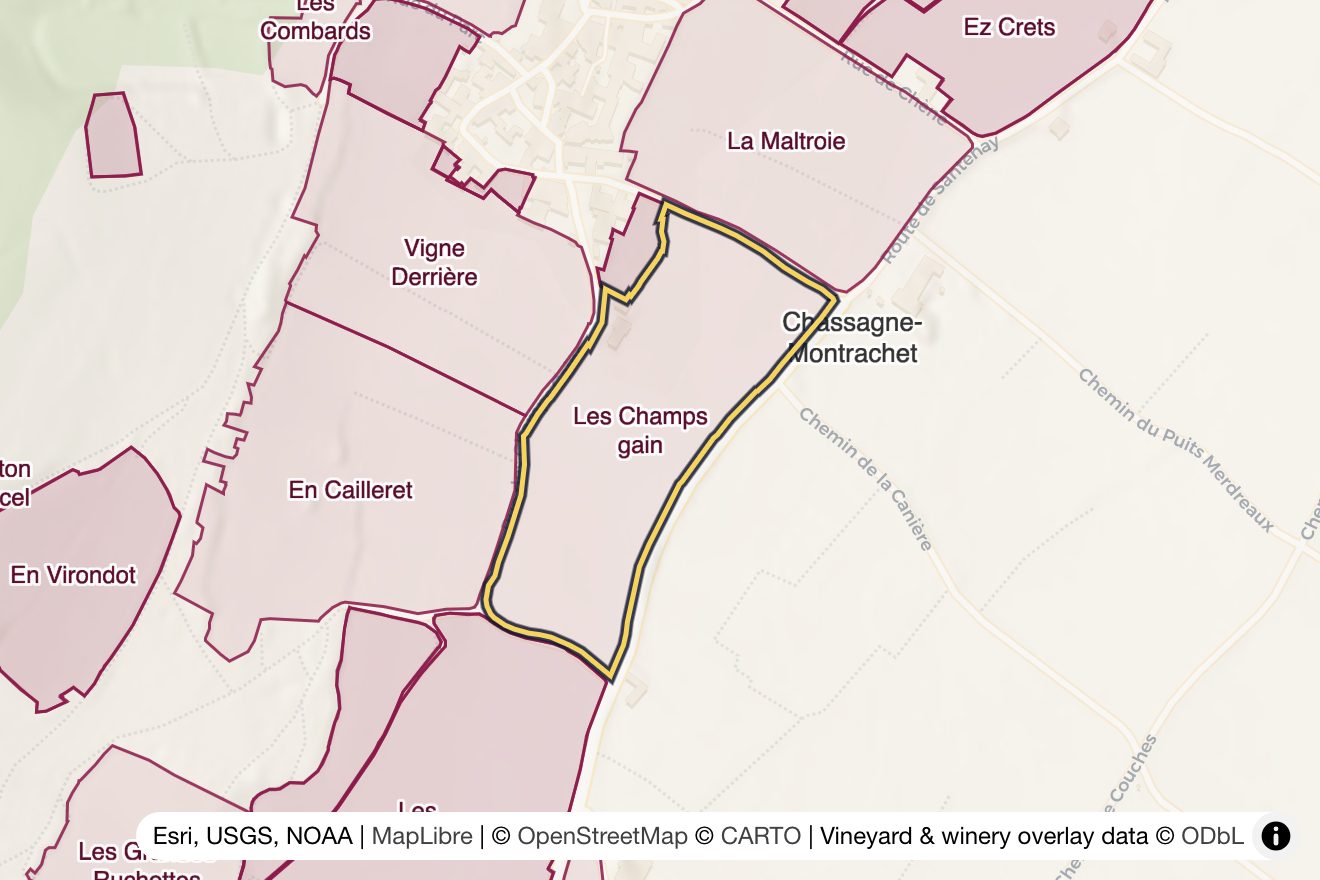
Overview & Location
The climat sits in the centre of Chassagne-Montrachet's Premier Cru zone, close to the village and just below Les Caillerets, positioned along the mid-slope elevation that characterizes many of Burgundy's finest vineyard sites.
Within the broader context of the Côte de Beaune, Les Champs Gain occupies the limestone-rich slopes that form the eastern face of the Côte d'Or escarpment. The vineyard's elevation and aspect provide optimal conditions for Chardonnay cultivation, while its specific geological composition contributes to the distinctive mineral character that defines Premier Cru Chassagne-Montrachet at its finest.
Size
Les Champs Gain encompasses approximately 4.6 hectares (11.4 acres), making it a moderately sized climat within Chassagne-Montrachet's Premier Cru landscape. This scale allows for sufficient diversity in soil expression and microclimate variation while maintaining the cohesive character that defines the vineyard's identity. The vineyard's compact size has historically enabled careful management and selective harvesting practices that maximize quality potential.
The relatively modest scale of Les Champs Gain means that vineyard holdings are distributed among a limited number of producers, with individual parcels varying significantly in size. This fragmentation, typical of Burgundy's inheritance-based ownership patterns, creates opportunities for stylistic variation while maintaining the fundamental terroir characteristics that unite all wines bearing the Les Champs Gain designation.
Terroir & Geology
The geological foundation of Les Champs Gain reflects the complex limestone formations that characterize the Côte de Beaune's premier vineyard sites. The vineyard sits on Jurassic limestone and marl, which provide good drainage while maintaining sufficient moisture retention for vine health during dry periods.
The soil profile reveals a sophisticated layering system beginning with a thin topsoil layer of brown limestone-clay mixture, typically measuring 30-40 centimeters in depth. This surface layer contains a moderate clay content of approximately 25-30%, providing adequate water retention without compromising drainage efficiency. Beneath this active soil zone lies the crucial limestone bedrock, fractured sufficiently to allow root penetration while contributing the mineral complexity that distinguishes Premier Cru Chassagne-Montrachet.
The vineyard's slope orientation faces southeast to east, capturing optimal morning sunlight exposure while benefiting from afternoon protection during the hottest summer months. The gradient varies between 8-12% across different sections of the climat, creating subtle variations in drainage patterns and soil depth that contribute to the wine's complexity. Elevation ranges from 260 to 290 meters above sea level, positioning the vineyard within the ideal elevation band for Chardonnay ripening in Burgundy's continental climate.
Stone content throughout Les Champs Gain remains consistently high, with limestone fragments and pebbles comprising 40-50% of the soil volume. This rocky composition enhances drainage efficiency while providing heat retention that aids ripening during cooler vintages. The limestone fragments also contribute directly to the wine's mineral character through root contact and gradual weathering processes that release calcium carbonate and other mineral compounds into the soil solution.
Climate & Microclimate
Les Champs Gain experiences the continental climate characteristic of the Côte d'Or, modified by specific topographical features that create distinctive microclimatic conditions. The vineyard benefits from the rain shadow effect created by the Côte d'Or escarpment, resulting in annual precipitation levels of approximately 650-750mm, distributed relatively evenly throughout the growing season.
The southeast-facing exposition ensures optimal sun exposure during critical morning hours when photosynthetic activity reaches peak efficiency. This orientation allows the vineyard to capture maximum solar energy during spring and early summer while providing natural protection from excessive afternoon heat during peak summer months. The slope gradient creates natural air drainage, minimizing frost risk and reducing humidity levels that could promote fungal diseases.
Diurnal temperature variation plays a crucial role in maintaining acidity levels and aromatic development in Les Champs Gain Chardonnay. Summer nights typically cool to 12-15°C, providing the thermal contrast necessary for flavor compound development and acid retention. The vineyard's elevation and exposure create conditions that extend the growing season by approximately 7-10 days compared to valley floor sites, allowing for enhanced phenolic maturity while preserving freshness.
Wind patterns significantly influence Les Champs Gain's microclimate, with prevailing westerly winds providing natural ventilation that reduces disease pressure and moderates temperature extremes. The vineyard's position relative to surrounding topography creates beneficial air circulation patterns that prevent stagnant conditions while avoiding excessive desiccation during dry periods.
Viticulture
Chardonnay dominates Les Champs Gain's plantings, comprising approximately 95% of the vineyard area. The remaining 5% consists of Pinot Noir plantings in specific parcels where soil composition and microclimate conditions favor red wine production. However, the climat's reputation rests primarily on its exceptional Chardonnay expressions, which demonstrate the full potential of Chassagne-Montrachet's white wine terroir.
Vine age across Les Champs Gain varies considerably, reflecting different replanting cycles and management philosophies among proprietors. Vine age varies considerably by parcel, from vines several decades old to recent plantings. Average vine age across the climat approximates 35-40 years, representing an optimal balance between yield and quality for Premier Cru production.
Planting density follows traditional Burgundian practices, with approximately 10,000-12,000 vines per hectare depending on the specific parcel and clonal selection. This density promotes competition among individual vines while ensuring adequate canopy development for photosynthetic efficiency. Row spacing typically measures 1.2-1.4 meters, with vine spacing of 0.8-1.0 meters, allowing for mechanization where soil conditions permit.
Viticultural practices in Les Champs Gain emphasize sustainable approaches that preserve soil health and encourage natural terroir expression. Most producers employ organic or biodynamic principles, minimizing chemical interventions while maintaining vine health through careful canopy management and selective treatments when necessary. Pruning follows the traditional Guyot system, typically utilizing single Guyot training to control yields and concentrate flavor development.
Yield management represents a critical quality factor, with appellation regulations capping yields for white wine. Leading producers often restrict yields further, targeting 35-38 hectoliters per hectare to maximize concentration and terroir expression. Green harvesting during summer months removes excess clusters, ensuring optimal ripening conditions for remaining fruit.
Harvesting timing varies according to vintage conditions and producer philosophy, generally occurring during the third or fourth week of September. Hand harvesting predominates, allowing for careful selection and preservation of fruit integrity. Multiple sorting passes, both in the vineyard and winery, ensure that only premium fruit contributes to final wines.
Wine Character & Style
Les Champs Gain Chardonnay exhibits the sophisticated mineral complexity and structured elegance that defines Premier Cru Chassagne-Montrachet at its finest. The wines display a distinctive aromatic profile combining citrus precision with subtle tropical fruit nuances, anchored by the characteristic limestone minerality that reflects the vineyard's geological foundation.
Primary fruit characteristics typically include Meyer lemon, white grapefruit, and green apple notes in cooler vintages, evolving toward ripe pear, white peach, and subtle pineapple expressions during warmer years. These fruit elements integrate seamlessly with floral components, particularly white flowers, acacia, and honeysuckle, creating aromatic complexity that evolves significantly with bottle age.
The mineral dimension of Les Champs Gain Chardonnay provides its most distinctive characteristic, expressing itself through wet stone, limestone dust, and subtle saline qualities that reflect the vineyard's terroir. This minerality becomes more pronounced with age, often developing into complex gunflint and oyster shell notes that add sophistication and depth to mature wines.
Oak integration varies among producers, but the finest examples demonstrate seamless wood incorporation that enhances rather than dominates the wine's natural character. Subtle vanilla, toast, and spice elements complement the fruit and mineral components without overwhelming the terroir expression. Premium producers typically employ 25-35% new French oak, with the remainder consisting of one and two-year-old barrels that provide controlled oxygen exchange without excessive wood flavor.
Structural characteristics include medium to full body with excellent balance between alcohol, acidity, and extract. Natural acidity levels typically range from 6.5-7.5 g/L, providing freshness and aging potential while supporting the wine's mineral framework. Alcohol levels generally fall between 13-13.5%, contributing to textural richness without compromising elegance.
The textural profile of Les Champs Gain Chardonnay reveals medium weight with notable mineral tension and a distinctive chalky quality on the finish. The wine's mouthfeel combines creamy richness with vibrant acidity, creating complexity that evolves throughout the tasting experience. Extended lees contact employed by many producers enhances textural depth while adding subtle yeasty complexity.
Comparison to Surrounding Crus
Les Champs Gain occupies a distinctive position within Chassagne-Montrachet's Premier Cru hierarchy, expressing characteristics that differentiate it from neighboring climats while maintaining the commune's signature style. Compared to the more powerful and structured wines from Premier Cru Morgeot, Les Champs Gain demonstrates greater finesse and aromatic complexity, with enhanced floral elements and more pronounced minerality.
The contrast with Premier Cru Caillerets reveals Les Champs Gain's more structured profile, as Caillerets typically produces wines with greater immediate charm and fruit-forward character. Les Champs Gain requires more time to develop its full potential, ultimately achieving greater complexity and aging potential than its more approachable neighbor.
Relative to Premier Cru La Romanée, Les Champs Gain shows more consistent quality across different producers, with less variation in style and character. La Romanée's steeper slopes and more varied soil composition create greater stylistic diversity, while Les Champs Gain maintains more uniform terroir expression across its various parcels.
The comparison with Premier Cru Chenevottes highlights Les Champs Gain's superior aging potential and mineral complexity. Chenevottes produces more immediately accessible wines with emphasised fruit character, while Les Champs Gain develops greater tertiary complexity with bottle age, particularly in the mineral and floral dimensions.
Within the broader context of Chassagne-Montrachet's white wine production, Les Champs Gain represents an ideal balance between power and elegance, avoiding the sometimes excessive richness of lower-slope sites while maintaining more body and structure than higher-elevation climats.
Notable Producers
Several distinguished producers craft exceptional wines from Les Champs Gain parcels, each contributing unique stylistic interpretations while respecting the climat's fundamental character. Domaine Marc-Antonin Blain holds significant parcels within the vineyard, producing wines that emphasize mineral precision and long-term aging potential through traditional winemaking techniques and extended lees contact.
Domaine Jean-Marc Pillot's Les Champs Gain consistently demonstrates the climat's capacity for elegant complexity, utilizing minimal intervention techniques that allow terroir expression to dominate. Their parcels, located in the vineyard's central section, benefit from optimal drainage and sun exposure, resulting in wines of notable consistency across different vintages.
Domaine Jean-Marc Morey and Domaine Caroline Morey also produce a Champs Gain.
Smaller producers including Domaine Lamy-Caillat, Domaine Bernard Moreau and Domaine Michel Niellon also bottle a Champs Gain.
Historical Background & Classification
Les Champs Gain is classified Premier Cru in its entirety within the Chassagne-Montrachet appellation.
The climat's boundaries were precisely defined during the 19th century cadastral surveys, establishing the vineyard limits that remain largely unchanged today. This historical continuity reflects the site's consistent quality potential and the recognition of specific geological and topographical features that distinguish it from surrounding areas.
Their detailed record-keeping preserved knowledge of optimal vineyard management techniques and harvest timing that influenced subsequent generations of vignerons.
The phylloxera crisis of the late 19th century necessitated complete replanting, providing opportunities to optimize vine selection and spacing for the specific terroir characteristics. This replanting period established many of the viticultural practices that continue to define quality production in the climat.
Aging Potential & Quality Level
Les Champs Gain Chardonnay demonstrates exceptional aging potential, with premium examples developing complexity over 15-20 years under proper storage conditions. The wine's evolution follows a predictable trajectory, beginning with primary fruit and floral characteristics during its first 2-3 years, then transitioning through a development phase where mineral elements become more prominent.
The wine's peak drinking window typically occurs between 5-12 years of age, when fruit, mineral, and tertiary characteristics achieve optimal integration. However, exceptional vintages and producer examples can continue developing for decades, gaining additional complexity through slow oxidative processes that enhance the wine's mineral and honeyed characteristics.
Quality consistency across different vintages remains remarkably high, reflecting the climat's stable terroir characteristics and the expertise of its various producers. Even challenging vintage conditions rarely result in poor wines, though stylistic variations occur based on seasonal weather patterns.
The wine's aging trajectory reveals increasing mineral complexity and textural sophistication, with young wines' citrus and floral notes evolving toward honey, nuts, and complex stone fruit characteristics. Extended aging often develops additional dimensions including truffle, mushroom, and exotic spice elements that add layers of complexity.
Storage conditions significantly influence development patterns, with consistent cool temperatures and minimal light exposure essential for optimal aging. Properly stored examples maintain vibrant acidity and fresh mineral characteristics even after extended cellaring, avoiding the premature oxidation that can affect less well-balanced wines.
The investment potential of Les Champs Gain reflects its consistent quality and aging potential, with premium producer examples appreciating steadily over time. The climat's limited production and growing international recognition contribute to strong market demand that supports price stability and growth potential.
Les Champs Gain represents the sophisticated terroir expression and winemaking excellence that define Premier Cru Chassagne-Montrachet, offering wine enthusiasts and collectors access to one of Burgundy's most consistently rewarding white wine expressions.