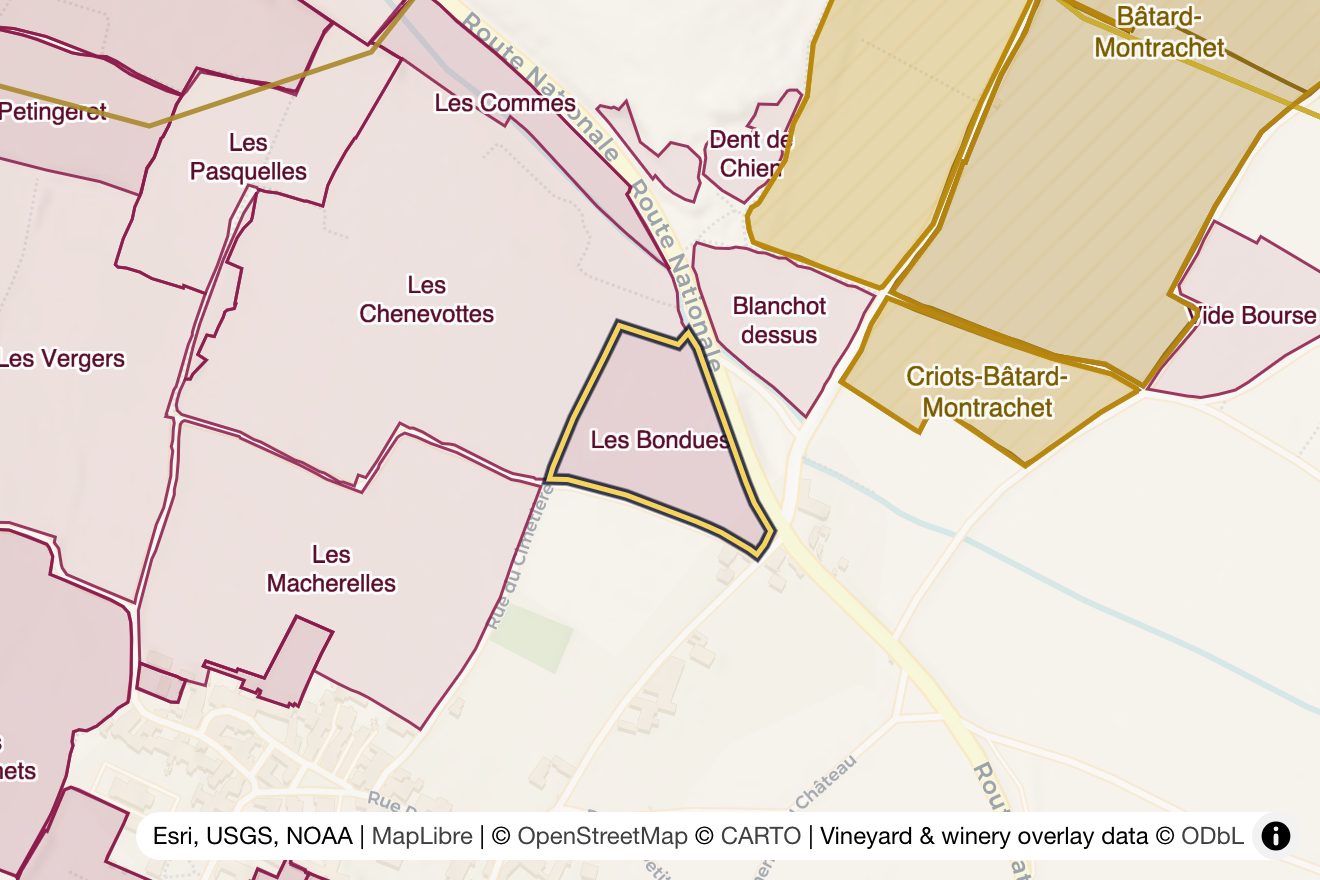
Overview & Location
The vineyard's location places it within the broader context of the Côte de Beaune's golden slope, that legendary escarpment running north-south through Burgundy's heartland. Chassagne-Montrachet itself forms part of the triumvirate of great white wine communes alongside Meursault and Puligny-Montrachet, though it uniquely produces both exceptional Chardonnay and distinguished Pinot Noir. Les Bondues benefits from this dual heritage, occupying terrain that exemplifies the geological and climatic conditions that have made Chassagne-Montrachet synonymous with Burgundian excellence.
The climat sits at an elevation that captures the optimal balance between the valley floor's fertility and the upper slopes' mineral austerity. This positioning within Chassagne-Montrachet's amphitheater-like valley provides natural protection from harsh winds while maintaining excellent drainage and sun exposure. The vineyard's placement relative to the commune's other Premier Crus creates a microenvironment that produces wines of distinctive character, contributing to the remarkable diversity that defines Chassagne-Montrachet's Premier Cru portfolio.
Size
Les Bondues encompasses approximately 3.8 hectares (9.4 acres), making it a moderately-sized climat within Chassagne-Montrachet's Premier Cru hierarchy. This scale represents a significant enough surface area to encompass meaningful terroir variation while remaining compact enough to maintain relative homogeneity in its fundamental geological and climatic characteristics.
The vineyard's boundaries have remained largely unchanged since the formal classification system was established, reflecting the historical recognition of this specific terroir unit's distinct identity. The parcellation within Les Bondues follows traditional Burgundian patterns, with multiple proprietors holding various-sized plots that create the complex mosaic of ownership typical throughout the Côte d'Or.
Terroir & Geology
The geological foundation of Les Bondues reflects the complex sedimentary history that defines the entire Côte de Beaune, with specific characteristics that distinguish this climat from its neighbors. The underlying bedrock consists primarily of Jurassic limestone formations, specifically the Bathonian and Bajocian stages that provide the mineral backbone for Burgundy's greatest vineyards.
The soil profile in Les Bondues reveals a fascinating complexity that directly influences wine character. The topsoil layer consists of brown limestone-clay mixtures with varying proportions depending on the specific parcel location within the climat. The clay content generally ranges from 25-35%, providing sufficient water retention during dry periods while maintaining the drainage characteristics essential for quality viticulture. This clay component, derived from the weathering of limestone and marl formations, contributes to the wines' structural depth and aging potential.
Beneath this surface layer lies a subsoil rich in limestone fragments and fossilized marine deposits, remnants of the ancient Tethys Sea that once covered this region. These limestone elements provide crucial drainage while contributing mineral complexity to the wines. The presence of iron-rich deposits in certain areas of the vineyard adds another layer of geological diversity, often correlating with sections that produce wines of particular intensity and longevity.
The slope characteristics of Les Bondues are particularly favorable, with a gradient that typically ranges from 8-12 degrees. This incline ensures optimal drainage while preventing excessive erosion, creating conditions where vines must develop deep root systems to access water and nutrients. The aspect is predominantly east-southeast, providing morning sun exposure that gently warms the vineyard after cool nights, while offering some protection from the intense afternoon heat that can stress vines during hot summers.
The elevation of Les Bondues varies across the climat, generally ranging from 240-280 meters above sea level. This positioning places the vineyard within the optimal elevation band for both Chardonnay and Pinot Noir, high enough to benefit from cool air circulation and temperature moderation, yet low enough to avoid the excessive exposure and thin soils found on the highest slopes.
Climate & Microclimate
The climatic conditions in Les Bondues reflect the broader continental climate of Burgundy, modified by specific topographical features that create distinctive microclimatic effects. The climate is characterized by warm, dry summers and cold winters, with spring and autumn providing the transitional conditions crucial for proper vine development and fruit maturation.
The vineyard's east-southeast exposure creates a particularly favorable microclimate for grape development. Morning sun exposure allows for gentle warming after cool nights, promoting steady photosynthesis while minimizing heat stress. The slight protection from the most intense afternoon sun helps preserve acidity levels in the grapes, a crucial factor in producing wines with the balance and aging potential expected from Premier Cru vineyards.
Wind patterns play a significant role in Les Bondues' microclimate. The vineyard's position provides natural protection from harsh northerly winds while allowing beneficial air circulation that reduces disease pressure and helps moderate temperature extremes. The slope's orientation facilitates cold air drainage, preventing frost pockets from forming during vulnerable periods in spring and autumn.
Compared to surrounding sites, Les Bondues tends to experience slightly cooler nighttime temperatures due to its elevation and exposure, contributing to the retention of natural acidity that characterizes wines from this climat. The diurnal temperature variation, particularly during the crucial ripening period from August through harvest, promotes the development of complex aromatic compounds while maintaining the structural integrity essential for long-term aging.
Viticulture
Les Bondues is planted predominantly to Chardonnay, with small sections devoted to Pinot Noir, reflecting the traditional varietal mix that has characterized Chassagne-Montrachet for centuries. The Chardonnay vines represent various clones selected for their compatibility with the site's specific terroir characteristics, including traditional Burgundian selections that produce small berries with concentrated flavors and high-quality clones developed for their ability to express mineral terroir.
Vine age across the climat varies considerably among different proprietors, with some parcels containing vines planted in the 1960s and 1970s, while others feature more recent replantings using refined clonal selections and rootstock combinations optimized for the site's soil and climate conditions. The older vines, particularly those approaching 40-50 years of age, typically produce the most concentrated and complex wines, their deep root systems accessing mineral resources unavailable to younger plantings.
Planting density in Les Bondues follows traditional Burgundian practices, typically ranging from 10,000-12,000 vines per hectare. This high density forces individual vines to compete for resources, resulting in lower yields per vine but higher quality fruit with greater concentration and complexity. The spacing allows for proper mechanization while maintaining the vine-to-vine competition essential for terroir expression.
Viticultural practices in Les Bondues reflect both traditional Burgundian methods and modern sustainable approaches. Most producers employ careful canopy management to optimize sun exposure and air circulation, particularly important given the site's moderate slopes and the need to prevent disease in Burgundy's sometimes humid conditions. Pruning follows the traditional Guyot system, with spur pruning occasionally employed in specific situations.
Yields are carefully controlled through green harvesting and cluster thinning, with most quality-focused producers targeting yields of 40-45 hectoliters per hectare for Chardonnay, significantly below the appellation maximum. This yield limitation is crucial for achieving the concentration and terroir expression expected from Premier Cru fruit.
The site presents specific viticultural challenges that require careful management. The clay component in the soils can create compaction issues in wet years, requiring attention to soil health and structure. The elevation and exposure can lead to irregular ripening in challenging vintages, necessitating selective harvesting to ensure optimal fruit quality.
Wine Character & Style
Chardonnay from Les Bondues displays a distinctive character that sets it apart within Chassagne-Montrachet's Premier Cru spectrum. The wines typically exhibit excellent minerality derived from the limestone-rich soils, expressing themselves through precise, focused flavors that develop complexity with age. In their youth, these wines often show citrus notes (particularly lemon zest and lime) combined with white flower aromas and a characteristic chalky minerality that speaks to the geological foundation.
The aromatic profile frequently includes subtle stone fruit elements, with white peach and pear notes emerging as the wines develop. Oak integration varies among producers, but the finest examples show seamless wood integration that enhances rather than masks the terroir expression. The mineral backbone provides a framework that supports both primary fruit flavors and the complex secondary aromas that develop with cellar aging.
Structurally, Les Bondues Chardonnay demonstrates the balance characteristic of quality Chassagne-Montrachet, with natural acidity levels that provide freshness and aging potential. The wines typically show medium to medium-full body, with a texture that combines richness with precision. The finish often displays pronounced mineral notes with subtle saline qualities that reflect the ancient marine origins of the vineyard's geology.
The Pinot Noir produced from Les Bondues, while less common, shows the refined character expected from Chassagne-Montrachet's red wines. These wines typically display red fruit aromatics (cherry, raspberry, and cranberry) supported by mineral undertones and subtle earthy notes. The tannin structure tends to be refined rather than aggressive, with sufficient backbone for medium-term aging while maintaining approachability in their youth.
Textural elements in both the white and red wines from Les Bondues reflect the site's specific terroir characteristics. The clay component in the soils contributes to wines with good mid-palate density, while the limestone drainage ensures maintained freshness and mineral precision. This combination creates wines that balance richness with elegance, a hallmark of successful Premier Cru Burgundy.
Comparison to Surrounding Crus
Within Chassagne-Montrachet's Premier Cru hierarchy, Les Bondues occupies a distinctive position that becomes apparent when compared to neighboring climats. Relative to Caillerets, perhaps the most celebrated Premier Cru in the commune, Les Bondues typically produces wines with slightly less power but often greater mineral precision and finesse. The differences reflect variations in soil composition and microclimate, with Caillerets' deeper clay content generally yielding wines of greater concentration.
Compared to Morgeot, the largest Premier Cru in Chassagne-Montrachet, Les Bondues shows more consistent character due to its smaller size and more homogeneous terroir. Morgeot's diverse geological zones create significant variation in wine style, while Les Bondues maintains more predictable characteristics that allow for clearer terroir expression.
The relationship to Chaumées, another respected Premier Cru, reveals interesting contrasts in elevation and exposure effects. Chaumées' slightly higher position and different aspect typically result in wines with more austere minerality in their youth, while Les Bondues often shows greater accessibility and charm in young wines while maintaining serious aging potential.
When considering the red wines, Les Bondues Pinot Noir generally displays more finesse compared to the reds from Clos Saint-Jean, which tend toward greater structure and power. This difference reflects the specific terroir characteristics that make certain Premier Crus more suitable for expressing Pinot Noir's elegant potential rather than its more robust character.
While Chassagne-Montrachet contains portions of the Montrachet and Bâtard-Montrachet Grand Crus, Les Bondues represents a different style paradigm. The Grand Crus typically show greater concentration, complexity, and aging potential, but Les Bondues offers more immediate accessibility while still providing the mineral complexity and terroir expression that define quality Chassagne-Montrachet.
Notable Producers
Several distinguished producers craft wines from Les Bondues, each bringing different philosophical approaches and winemaking techniques that reveal various facets of the climat's potential. The fragmented ownership typical of Burgundy means that multiple interpretations of this terroir exist, providing wine enthusiasts with opportunities to explore stylistic variations while maintaining the fundamental character derived from the site's geological and climatic conditions.
Traditional producers with holdings in Les Bondues often emphasize techniques that have proven successful over generations, typically employing longer fermentation periods and extended lees contact to maximize texture and complexity. These approaches often result in wines that require several years of cellaring to fully integrate their components but reward patience with exceptional longevity and development.
More modernist producers may employ temperature-controlled fermentation and carefully selected oak regimens to craft wines that show their terroir character while maintaining freshability and earlier accessibility. These wines often display pristine fruit expression in their youth while retaining the mineral backbone necessary for medium to long-term development.
The diversity of approaches among Les Bondues producers reflects the climat's versatility and the various ways skilled winemakers can interpret its terroir. Some focus on maximizing mineral expression through minimal intervention techniques, while others emphasize textural development through careful lees stirring and oak integration.
Estate bottling versus négociant production also influences the expression of Les Bondues terroir, with estate producers often having more intimate knowledge of specific parcels within the climat, allowing for vineyard-specific winemaking decisions that can enhance terroir expression.
Historical Background & Classification
The history of Les Bondues extends back centuries, with documented viticulture in this area dating to medieval times when monastic orders first recognized the quality potential of Chassagne-Montrachet's slopes. The specific climat name "Bondues" appears in historical records from the 18th century, indicating the long-standing recognition of this site as a distinct terroir unit worthy of individual identification.
The formal classification of Les Bondues as Premier Cru occurred with the establishment of Burgundy's appellation system in the 1930s, when decades of empirical knowledge about site quality were codified into the legal framework that continues to govern Burgundian wine production. This classification represented the official recognition of what local vignerons had understood for generations: that Les Bondues consistently produced wines of superior quality that expressed distinctive terroir characteristics.
Historical reputation for Les Bondues was built gradually through the 19th and early 20th centuries, as improved winemaking techniques and better transportation allowed Chassagne-Montrachet wines to reach broader markets. The climat's wines earned recognition for their balance of power and elegance, characteristics that made them appealing to both domestic and international wine enthusiasts.
The classification process involved careful evaluation of soil composition, climate conditions, and historical wine quality, with Les Bondues meeting all criteria established for Premier Cru status. The boundaries defined during this process have remained largely unchanged, reflecting the clear geographical and geological factors that define this terroir unit.
Throughout the 20th century, Les Bondues maintained its reputation as a reliable source of quality Premier Cru wine, contributing to Chassagne-Montrachet's overall reputation while developing its own identity within the commune's hierarchy of sites.
Aging Potential & Quality Level
The aging potential of wines from Les Bondues varies depending on grape variety, vintage conditions, and winemaking approach, but generally falls within the range expected from quality Premier Cru Burgundy. Chardonnay from this climat typically shows excellent development potential over 8-15 years from vintage, with exceptional examples from outstanding years capable of graceful evolution for two decades or more.
The evolution trajectory for Les Bondues Chardonnay follows classic Burgundian patterns, beginning with primary fruit and mineral expression in the first 2-3 years after release, then developing secondary characteristics including honey, hazelnut, and complex mineral notes as the wines mature. The limestone-derived acidity provides the structural backbone necessary for this extended development, while the clay component in the soils contributes to the wine's ability to develop textural complexity over time.
Pinot Noir from Les Bondues generally shows good aging potential over 10-18 years, developing tertiary aromatics including earth, leather, and dried fruit notes while maintaining the refined tannin structure characteristic of quality Chassagne-Montrachet reds. The evolution tends toward elegance rather than power, with successful examples maintaining freshness while gaining complexity.
Quality consistency in Les Bondues is generally high, though vintage variation affects expression as it does throughout Burgundy. Warm, dry years tend to produce wines with greater concentration and immediate appeal, while cooler vintages often yield wines with higher acidity and greater aging potential, requiring more time to achieve optimal drinking condition.
The quality level of Les Bondues places it firmly within the upper tier of Chassagne-Montrachet Premier Crus, offering wines that provide authentic terroir expression combined with the complexity and aging potential expected from classified vineyard sites. The climat's ability to produce both accessible wines for earlier consumption and age-worthy examples for long-term cellaring makes it particularly valuable for wine collectors seeking Burgundian diversity and development potential.
Market recognition of Les Bondues quality has grown steadily, with wines from established producers commanding prices that reflect their Premier Cru status while often providing better value than the most famous climats in neighboring communes. This combination of quality, character, and relative accessibility makes Les Bondues an important representative of Chassagne-Montrachet's terroir diversity and winemaking excellence.