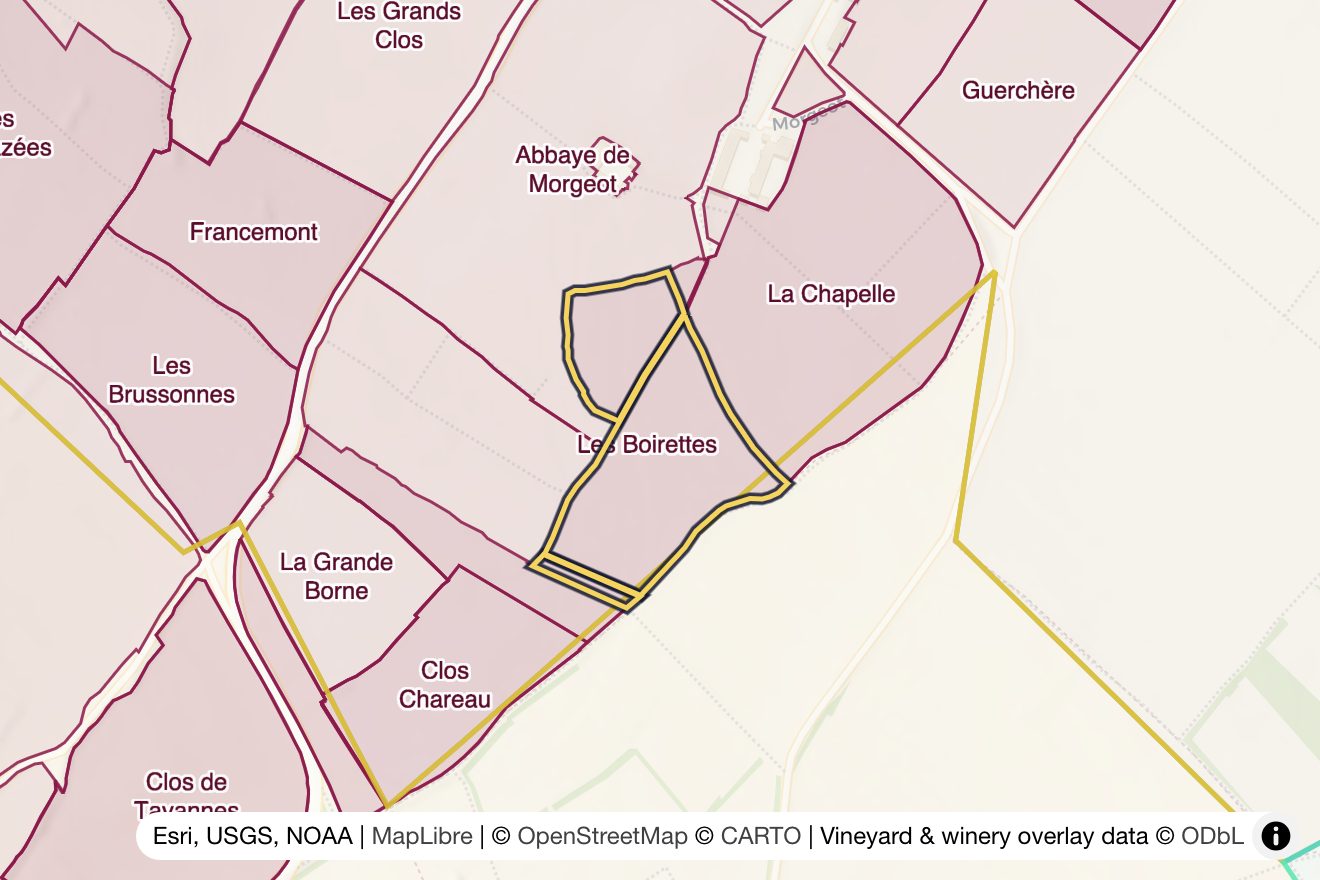
Overview & Location
The vineyard lies in the southern sector of Chassagne-Montrachet, positioned strategically between the village center and the commune's border with Santenay. This location places Les Boirettes within the broader context of the Côte de Beaune's limestone-rich escarpment, where the interplay of geology, topography, and climate creates some of the world's most expressive terroirs for both Chardonnay and Pinot Noir.
Chassagne-Montrachet itself occupies a unique position within Burgundy's hierarchy, serving as the southernmost commune of the Côte de Beaune's white wine heartland while maintaining significant red wine production. Les Boirettes exemplifies this duality, producing wines that capture both the mineral precision associated with the commune's white wines and the elegant complexity that characterizes its reds.
The climat's boundaries are precisely defined within Burgundy's intricate patchwork of vineyard parcels, bordered by other Premier Cru sites and village-level appellations that collectively contribute to Chassagne-Montrachet's reputation for diversity and quality. This positioning provides Les Boirettes with the environmental conditions necessary for producing wines of exceptional character and longevity.
Size and Scale
Les Boirettes is a single lieu-dit within the larger Morgeot sector, making it a moderately sized Premier Cru within Chassagne-Montrachet's portfolio of classified vineyards. This scale allows for both intimacy and diversity, providing sufficient area for multiple producers to maintain parcels while ensuring that each section of the vineyard can be managed with the attention to detail that Premier Cru viticulture demands.
The vineyard's size reflects the careful delineation that characterizes Burgundy's classification system, where boundaries are drawn based on subtle but significant differences in terroir rather than administrative convenience. Within these 4.2 hectares, variations in soil depth, drainage, and microclimate create distinct zones that experienced vignerons recognize and manage accordingly.
This moderate scale also contributes to Les Boirettes' market presence, providing enough wine to establish recognition among collectors and connoisseurs while maintaining the scarcity that defines Burgundy's most sought-after appellations.
Terroir and Geology
The geological foundation of Les Boirettes reflects the complex limestone-based terroir that defines the Côte de Beaune's finest sites. The vineyard sits atop a mixture of Jurassic limestone formations, primarily composed of Bathonian and Bajocian limestone dating back approximately 160-170 million years. This ancient bedrock provides both the mineral complexity and drainage characteristics essential for producing wines of distinction.
The topsoil is a brown limestone clay with marl over the underlying limestone bedrock. This shallow soil profile forces vine roots to penetrate deeply into the fractured limestone, accessing both nutrients and trace minerals that contribute to the wines' distinctive character. The clay content, generally comprising 25-35% of the soil composition, provides sufficient water retention during dry periods while allowing excess moisture to drain effectively.
The vineyard's slope orientation faces predominantly east-southeast. This exposure ensures optimal morning sun exposure while providing some protection from the intense afternoon heat that can compromise grape quality during warm vintages. The Morgeot sector in which it lies is cited by producers at roughly 230 to 250 meters above sea level, positioning Les Boirettes within the optimal altitude band for both Chardonnay and Pinot Noir cultivation in Burgundy.
Limestone scree and fossil fragments are commonly found throughout the vineyard, evidence of the ancient marine environment that formed these soils. These fragments contribute to soil porosity and provide additional mineral elements that influence wine character. The presence of iron-rich deposits in certain sections adds complexity to the soil profile, manifesting in subtle differences in wine style across various parcels within the climat.
Climate and Microclimate
Les Boirettes benefits from the continental climate that characterizes the Côte de Beaune, moderated by its position within the protective embrace of the Côte d'Or escarpment. The vineyard's east-southeast exposure creates a distinctive microclimate that influences both grape ripening patterns and wine style.
Morning sun exposure is particularly beneficial, allowing for gentle warming of the vineyard as temperatures rise throughout the day. This gradual heating helps preserve acidity in the grapes while ensuring adequate sugar accumulation. The afternoon positioning provides some natural shading during the hottest part of the day, preventing over-ripening and maintaining the freshness that characterizes high-quality Burgundian wines.
The vineyard's elevation and slope create air circulation patterns that help prevent fungal diseases while moderating temperature extremes. Cool air drainage from the higher elevations of the Côte flows through the vineyard during evening hours, creating the diurnal temperature variation essential for maintaining grape acidity and developing complex aromatic compounds.
Rainfall patterns typically provide adequate moisture during the growing season, though the well-draining limestone soils prevent waterlogging during wet periods. The vineyard's position offers some protection from harsh westerly winds while remaining open to beneficial air movement that reduces humidity and disease pressure.
Frost risk is generally moderate, with the vineyard's elevation and air circulation providing natural protection during vulnerable spring periods. However, climate change has increased weather volatility, requiring vineyard managers to implement adaptive strategies for extreme weather events.
Viticulture
Les Boirettes is planted to Chardonnay and produces white wine.
Vine ages across the vineyard vary considerably, with many parcels containing vines between 30-50 years old, while some sections feature newer plantings from recent decades. Older vines, particularly those approaching or exceeding 40 years of age, produce the most concentrated and complex fruit, contributing to the wines' reputation for depth and longevity.
Planting density typically ranges from 9,000-10,500 vines per hectare, following traditional Burgundian practices that balance vine competition with sustainable yields. This density encourages deep root penetration while ensuring adequate fruit concentration for Premier Cru quality standards.
Viticultural practices emphasize sustainable approaches, with many producers implementing organic or biodynamic methods. Canopy management focuses on optimizing sun exposure while preventing excessive heat stress, requiring careful attention to leaf removal timing and crop thinning decisions.
Harvest timing is critical in Les Boirettes, as the vineyard's terroir characteristics can produce exceptional results when grapes achieve optimal physiological ripeness. Producers typically harvest in multiple passes, selecting fruit at peak maturity for their highest-quality cuvées.
These moderate yields require careful vineyard management but result in wines with the intensity and complexity expected from Premier Cru classification.
Wine Character and Style
Wines from Les Boirettes exhibit distinctive characteristics that reflect both the climat's specific terroir and the broader stylistic signature of Chassagne-Montrachet. The Chardonnay wines combine richness and finesse, with the limestone-driven tension typical of Chassagne-Montrachet.
The aromatic profile typically features orchard and citrus fruit complemented by distinctive mineral undertones. Limestone-derived minerality provides a backbone that supports fruit expression while adding complexity and aging potential. Subtle spice elements, including white pepper, clove, and dried herbs, contribute additional layers of aromatic interest.
On the palate, Les Boirettes wines demonstrate remarkable balance between concentration and refinement. The structure is generally firm but refined, providing framework without overwhelming the fruit character. Acidity levels are typically well-integrated, contributing freshness and supporting the wines' aging potential without creating harsh or angular impressions.
The wines exhibit excellent mid-palate density, a characteristic that distinguishes quality Premier Cru sites from village-level appellations. This concentration allows the wines to develop complexity through aging while maintaining their essential character and terroir expression.
Textural qualities include a silky mouthfeel that develops with proper cellaring, transforming from initially firm structure to elegant smoothness over time. The finish is characteristically long and mineral-driven, with limestone-derived salinity providing distinctive terroir expression that separates Les Boirettes from neighboring sites.
Vintage variation is notable but generally consistent in style, with cooler years producing more linear, mineral-driven wines and warmer vintages yielding richer, more immediately approachable expressions while maintaining the site's fundamental character.
Comparison to Surrounding Crus
Les Boirettes occupies a distinctive position within Chassagne-Montrachet's Premier Cru hierarchy, producing wines that differ notably from neighboring climats in both character and style. Compared to Clos Saint-Jean, located nearby, Les Boirettes typically shows greater power and concentration, with more pronounced mineral characteristics and firmer tannin structure.
The wines contrast sharply with those from Morgeot, Chassagne-Montrachet's largest Premier Cru, which tends to produce more accessible, fruit-forward wines with softer tannins and earlier drinking appeal. Les Boirettes maintains greater aging potential and develops more complex secondary characteristics through cellaring.
When compared to La Boudriotte, another neighboring Premier Cru, Les Boirettes demonstrates superior concentration and mineral precision, though perhaps with less immediate charm in youth. The limestone influence is more pronounced in Les Boirettes, creating wines with distinctive salinity and longer, more persistent finishes.
Relative to Les Caillerets, widely considered among Chassagne-Montrachet's finest Premier Cru sites, Les Boirettes produces wines of similar quality though with different stylistic emphasis. While Caillerets tends toward greater elegance and finesse, Les Boirettes offers more substantial structure and mineral expression.
The climat's wines share the mineral characteristics and limestone-derived salinity of Chassagne-Montrachet's other white Premier Crus. This commonality reflects the underlying geological unity that characterizes the commune's finest sites.
Notable Producers
Several distinguished producers maintain parcels within Les Boirettes, each bringing distinctive winemaking approaches that highlight different aspects of the climat's terroir potential. These producers collectively demonstrate the versatility and quality consistency that elevate Les Boirettes within Chassagne-Montrachet's Premier Cru hierarchy.
Their approach emphasizes traditional winemaking methods, including indigenous yeast fermentation and extended aging in French oak, resulting in wines that require patience but reward careful cellaring with exceptional development.
Domaine Jean-Noël Gagnard produces elegant interpretations that highlight the site's mineral characteristics while maintaining accessibility in youth. Their vineyard management emphasizes sustainable practices and selective harvesting, contributing to wines that balance immediate appeal with aging potential.
Domaine Blain-Gagnard bottles its Chassagne-Montrachet Morgeot from its parcel in Les Boirettes. Their winemaking style emphasizes purity of fruit expression balanced with appropriate oak integration.
Their wines from Les Boirettes demonstrate excellent consistency across vintages while developing the complex secondary characteristics that distinguish Premier Cru quality.
Each producer's interpretation varies in oak usage, extraction levels, and aging protocols, creating a spectrum of styles that collectively demonstrate Les Boirettes' versatility and quality potential. These stylistic variations allow consumers to explore different expressions of the same terroir while maintaining confidence in overall quality standards.
Historical Background and Classification
Les Boirettes' history as a distinguished vineyard site extends back several centuries, with documented evidence of viticultural activity dating to the medieval period. The climat's name likely derives from local dialect references to soil characteristics or topographical features, though exact etymological origins remain subject to scholarly debate.
The vineyard gained formal recognition as a Premier Cru during the establishment of Burgundy's modern classification system in the 1930s, when Institut National des Appellations d'Origine conducted comprehensive terroir assessments throughout the Côte d'Or. Les Boirettes' classification reflected both historical reputation and demonstrated quality consistency that distinguished it from surrounding village-level appellations.
During the classification process, extensive soil analysis and historical production records confirmed Les Boirettes' terroir quality and wine character distinctiveness. The climat's boundaries were carefully delineated based on geological surveys and traditional usage patterns that reflected centuries of viticultural experience.
The vineyard survived the phylloxera crisis of the late 19th century through replanting on American rootstock, a transition that maintained terroir expression while ensuring vine health and productivity. Post-phylloxera replanting allowed for some optimization of grape varieties and vine spacing while preserving the essential character that had established the site's reputation.
Throughout the 20th century, Les Boirettes maintained its reputation for quality production despite challenges including two world wars, economic disruption, and changing market conditions. The vineyard's Premier Cru status provided both recognition and responsibility, encouraging producers to maintain quality standards worthy of the classification.
Aging Potential and Quality Level
Wines from Les Boirettes demonstrate exceptional aging potential, with properly cellared examples developing complexity and refinement over 15-25 years or more in favorable vintages. This longevity reflects both the climat's terroir characteristics and the structural qualities that distinguish Premier Cru wines from lesser appellations.
Young wines typically require 3-5 years of bottle aging to integrate tannins and develop secondary characteristics, though drinking windows vary by vintage conditions and winemaking style. During this initial aging period, the wines evolve from primary fruit expression toward more complex aromatic profiles that include earth, leather, and dried fruit elements.
Peak drinking periods generally occur between 8-15 years after vintage for most examples, when fruit characteristics remain vibrant while secondary complexity provides additional layers of interest. However, exceptional vintages and careful storage can extend this peak period considerably, with some wines continuing to improve for two decades or more.
Quality consistency across vintages is notably high, with even challenging weather years typically producing wines of Premier Cru caliber. This consistency reflects both terroir advantages and producer expertise, as established vignerons understand how to manage Les Boirettes' specific characteristics across varying conditions.
The wines' evolution trajectory typically follows predictable patterns, with initial firmness giving way to greater integration and complexity. Color development shows gradual deepening from pale gold toward deeper gold hues, while aromatic complexity increases through the development of tertiary characteristics including forest floor, truffle, and mature fruit elements.
Storage requirements remain standard for quality Burgundy, with consistent temperature, humidity control, and protection from light and vibration essential for optimal development. Properly stored examples maintain their essential character while gaining the complexity and refinement that justify Premier Cru classification and pricing.
Les Boirettes represents the synthesis of terroir, tradition, and expertise that defines Burgundy's greatest vineyard sites, producing wines that honor both their specific climat and the broader heritage of Chassagne-Montrachet's viticultural excellence.