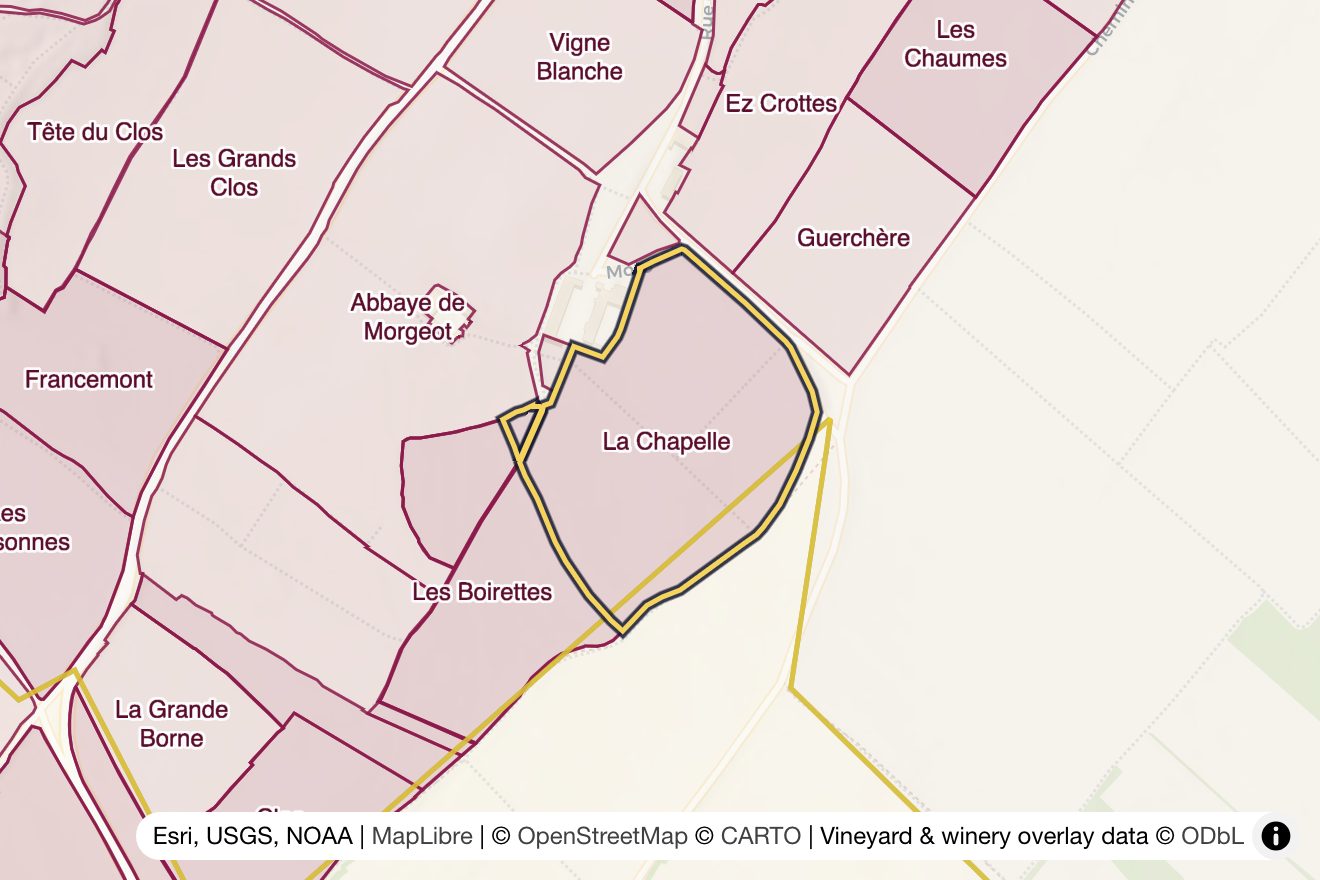
The Chapel, and the Abbey Behind It
Morgeot is a hamlet at the southern end of the commune, on the road running down towards Santenay. Cistercians were working vines here by around 1150, and the appellation's own regulatory text records that by the fifteenth century the grange de Morgeot belonged to the abbey of Maizières, which cleared and improved the surrounding land. The chapel that gives the climat its name did not survive. According to the estate that still occupies the abbey buildings, the settlement was wrecked in the fifteenth century when its inhabitants held out for Mary of Burgundy against the French king's forces, and only ruins of the chapel are left, standing at the foot of the Morgeot slope. The climat lies immediately around them.
The name travels badly. Auxey-Duresses has its own premier cru called La Chapelle, and Volnay has a premier cru Clos de la Chapelle. Neither has anything to do with this ground.
Slope Position, Soil and the Single-Parcel Anomaly
The delimitation this site works from measures La Chapelle at 4.59 hectares across one parcel, centred near 46.9236 N, 4.7233 E. That single-block structure is worth pausing on, because it is unusual for Chassagne. Neighbouring climats in the same sector are scattered across many detached pieces: Abbaye de Morgeot is recorded across sixteen parcels, La Boudriotte seventeen, Les Brussonnes fifteen. La Chapelle is one piece because it is enclosed by a wall.
Its neighbours place it precisely. Guerchère lies about 225 metres to the north-east, Ez Crottes some 290 metres to the north-north-east, Vigne Blanche a little over 300 metres north, and the scattered parcels of Abbaye de Morgeot begin barely 200 metres to the west-north-west. The lieu-dit called Morgeot itself sits roughly 600 metres further north, and the Santenay boundary is under a kilometre to the south-west. Altitude in this sector runs at about 230 to 240 metres, with the ground tipping gently to the east and south-east.
This is the piedmont, not the mid-slope. The AOC's terroir description for Chassagne sets out a substrate of alternating Middle Jurassic limestones and marls, masked on the hillside by scree mixed with clays and silts. Those deposits are thin and very stony at the top of the slope and become finer-textured and thicker towards the bottom, reaching around half a metre at the piedmont and decarbonated at the surface. La Chapelle sits squarely in that lower band. Descriptions of the Morgeot sector consistently report reddish clay-limestone marl, coloured by iron oxide, over Bathonian limestone debris; Louis Jadot's notes for the wine describe the soil as deep, with marl and clay. Depth of that order is why Morgeot gives weight and breadth rather than the racy cut of the sites higher up the hill.
One Wall, One Owner
The wall makes the Clos de la Chapelle, a monopole. The Mac Mahon family, Ducs de Magenta, bought the Abbaye de Morgeot and the clos in 1967 and vinified in the abbey's medieval cellars. From the late 1970s Louis Jadot handled much of the domaine's production under a long-running contract, and the Jadot bottling, labelled Domaine du Duc de Magenta, Chassagne-Montrachet 1er Cru Morgeot Clos de la Chapelle, ran through to the 2020 vintage. The Boisset family then took the clos on for Domaine de la Vougeraie, 2021 being the first vintage under that label. Merchants variously date the purchase to 2021 and to 2022, and published material does not settle which.
Stated sizes for the clos vary, which is normal for Burgundy monopoles where planted and delimited surfaces differ. The current owner gives 0.9888 hectares to Pinot Noir and importers give around 3.5 hectares to Chardonnay, which sums close to the measured 4.59 hectares of the climat; Allen Meadows has been cited at 4.48 hectares for the monopole, and Berry Bros give 3.66 hectares with 2.87 in Chardonnay. Vines were planted in stages between 1934 and 1989 at 10,000 per hectare, and the vineyard has been in Ecocert organic conversion and worked biodynamically since 2021.
Three Legal Names for the Same Ground
Chassagne permits a plot to be sold under the name of its climat, and in this corner of the commune the delimited areas stack. Reference works consistently describe Abbaye de Morgeot, about 8.56 hectares, as taking in the lieu-dit Morgeot together with La Chapelle, and Morgeot itself as an umbrella of roughly 58 hectares covering some twenty lieux-dits, making it cumulatively the largest premier cru holding in the village. The practical result is that a wine grown in La Chapelle can go out as La Chapelle, as Abbaye de Morgeot, or as plain Morgeot. Growers choose the name buyers recognise, which is why La Chapelle is a climat you will find on the map and struggle to find on a shelf.
The Wine
Both colours are made. The whites are the Morgeot type in a fairly pure form: ripe orchard and citrus fruit rather than the tighter lemon-and-flint register of the mid-slope crus, a broad palate with real phenolic grip, and a saline pull on the finish that keeps the weight from turning heavy. They tend to shut down early and reward patience; the sector's better bottles hold ten to fifteen years in strong vintages. Jasper Morris, reviewing the 2022 from Vougeraie, found a proper weight of fruit and a tannic feel behind the ripe white flavours, with a substantial wine still waiting to emerge. The red, from the Pinot planted inside the clos, is firmer and more earthy than most Chassagne rouge, which is consistent with the clay depth here.