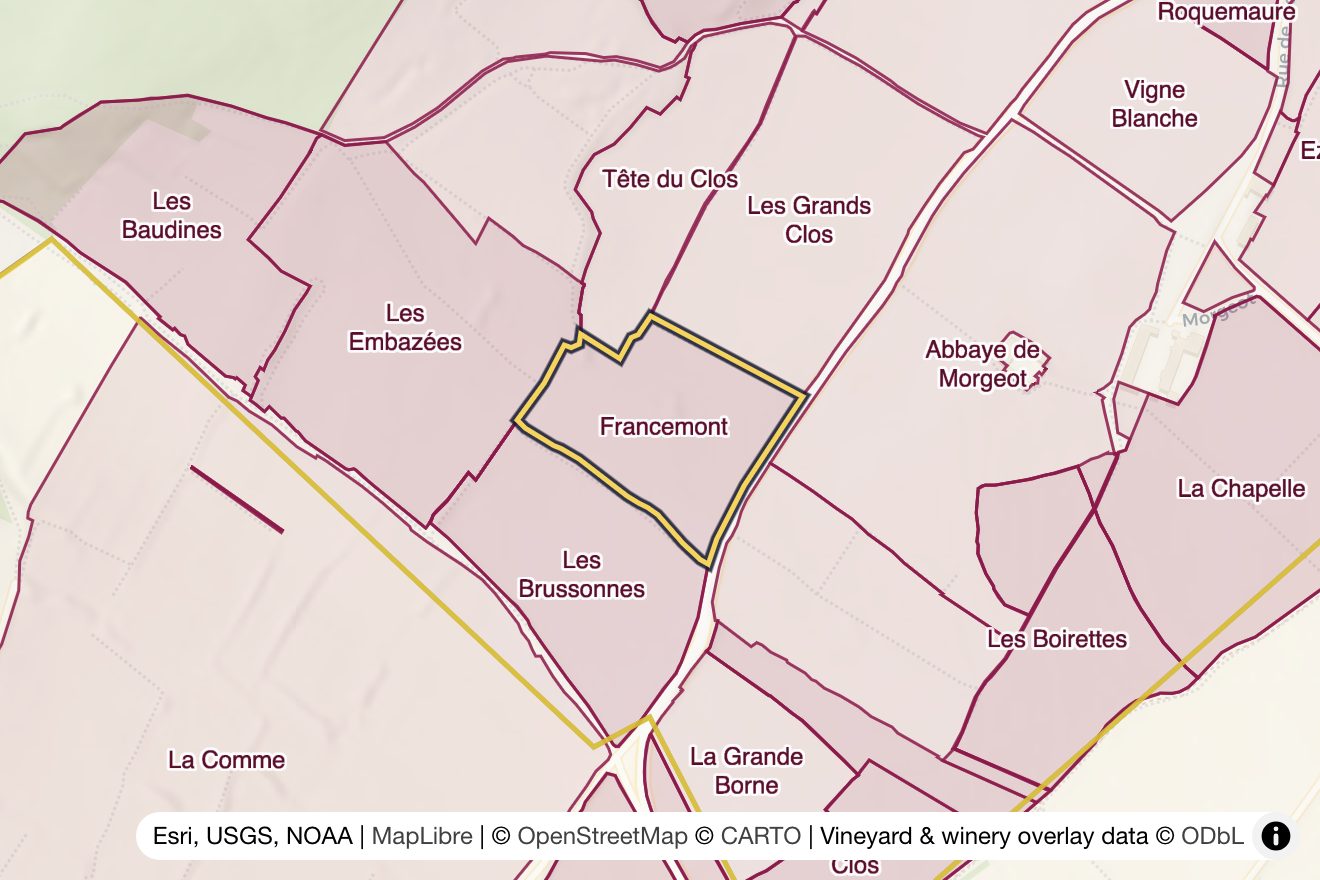
Overview & Location
The vineyard sits within the southern portion of Chassagne-Montrachet's Premier Cru hierarchy, on the southern side of the appellation, within the Morgeot climat, near the border with Santenay. Francemont benefits from its placement along the famous limestone ridge that defines the Côte de Beaune's eastern slope, where the transition from the Saône plain to the higher plateau creates the optimal conditions that have made Burgundian wines legendary for over a millennium.
Within the broader context of Chassagne-Montrachet's roughly 150 hectares of Premier Cru vineyards, Francemont represents a significant and well-respected climat that contributes to the commune's reputation as one of Burgundy's most versatile appellations, producing exceptional wines from both Chardonnay and Pinot Noir. The vineyard's position places it within the Morgeot climat, alongside lieux-dits such as Clos Pitois, La Cardeuse and Les Boirettes, creating a mosaic of terroirs that showcase the remarkable diversity possible within a single commune.
Size
Francemont encompasses a share of the Morgeot climat's roughly 58 hectares, making it a moderately-sized climat within Chassagne-Montrachet's Premier Cru portfolio. This size allows for meaningful production while maintaining the intimacy and precision that characterizes Burgundy's finest sites. The vineyard's compact nature ensures relatively consistent geological and microclimatic conditions throughout the climat, though subtle variations in slope angle, soil depth, and drainage create nuanced differences that experienced vignerons recognize and exploit.
The vineyard's boundaries are clearly delineated according to traditional Burgundian cadastral divisions, with parcels distributed among several domaines. This fragmentation, typical of Burgundy's inheritance patterns, means that multiple producers work within Francemont, each bringing their own viticultural philosophy and winemaking approach to this singular terroir expression.
Terroir & Geology
The geological foundation of Francemont exemplifies the complex limestone-based terroir that defines the Côte de Beaune's finest sites. The vineyard sits on clay-limestone soils over a base of calcareous marl, as described for the wider Morgeot climat. This hard limestone bedrock, formed approximately 168 million years ago in shallow tropical seas, provides the mineral backbone that gives Burgundian wines their distinctive character and aging potential.
The topsoil composition varies subtly across the climat but generally consists of a thin layer of brown limestone-derived earth mixed with weathered marl and scattered limestone fragments. Clay content ranges from 15-25% throughout the vineyard, with slightly higher concentrations in the lower portions where centuries of erosion have deposited finer particles. This clay component provides essential water retention during dry periods while the limestone ensures excellent drainage during heavy rains.
Soil depth varies considerably across Francemont, ranging from as little as 30 centimeters over bedrock in the steepest sections to over one meter in areas where sediment has accumulated. The vineyard's eastern orientation and mid-slope position, at elevations between 250-280 meters above sea level, create a slope gradient of approximately 8-12%, optimal for both drainage and sun exposure while preventing excessive erosion.
The aspect faces primarily east-southeast, capturing the gentle morning light while avoiding the potentially harsh afternoon sun of full southern exposure. This orientation proves particularly beneficial for Chardonnay, allowing for slow, even ripening that preserves the grape's natural acidity while developing complex flavors. The slight southeast tilt also provides adequate warmth for Pinot Noir cultivation in favorable years.
Beneath the visible soil lies a complex network of fractured limestone that facilitates deep root penetration and provides access to mineral-rich groundwater. These geological fissures, combined with the natural porosity of the limestone, create the excellent drainage that prevents waterlogging while maintaining sufficient moisture reserves during dry spells.
Climate & Microclimate
Francemont experiences the classic continental climate of the Côte de Beaune, characterized by cold winters, warm summers, and significant diurnal temperature variation during the growing season. However, the vineyard's specific topographical position creates distinct microclimatic conditions that influence wine character and quality.
The eastern aspect provides protection from the prevailing westerly winds while capturing maximum benefit from morning sunshine. This orientation allows for gentle warming throughout the day without the stress of intense afternoon heat, particularly crucial during the final ripening phase in September and early October. The slope angle ensures cold air drainage on frost-prone spring nights, providing natural protection for budding vines.
Average annual rainfall in the area approximates 750mm, with the vineyard's excellent drainage preventing waterlogging issues that can plague flatter sites. The limestone bedrock's thermal mass moderates temperature extremes, storing heat during warm days and releasing it gradually during cool nights, extending the growing season and promoting phenolic maturity.
Compared to neighboring vineyards, Francemont tends to ripen slightly earlier than sites with full eastern exposure due to its southeast tilt, while maintaining better acidity retention than vineyards with southern aspects. The site's elevation provides cooler nighttime temperatures than lower-lying vineyards, preserving the aromatic compounds that distinguish Premier Cru wines from their village-level counterparts.
Wind patterns play a crucial role in the vineyard's mesoclimate, with gentle air circulation helping to prevent fungal diseases while avoiding the desiccating effects of strong winds. The natural amphitheater formed by the Côte d'Or escarpment creates air currents that moderate extreme temperatures and promote even ripening across the climat.
Viticulture
Francemont supports cultivation of both Chardonnay and Pinot Noir, though Chardonnay predominates with approximately 70% of plantings. The vineyard's terroir characteristics prove particularly well-suited to Chardonnay production, yielding wines of exceptional elegance and longevity that rank among Chassagne-Montrachet's finest white wines.
Vine age varies significantly across different parcels, with some sections containing vines over 50 years old while others feature more recent plantings from the past two decades. Older vines, particularly those planted in the 1960s and 1970s, produce lower yields but demonstrate greater concentration and complexity, their deep root systems accessing mineral reserves unavailable to younger plants.
Planting density follows traditional Burgundian patterns, typically ranging from 10,000-12,000 vines per hectare depending on the specific parcel and producer preferences. This high density encourages competition among vines, limiting individual vine vigor while promoting deeper rooting and more concentrated fruit production.
Viticultural practices in Francemont reflect both respect for tradition and adaptation to modern understanding of vine physiology. Most producers employ some form of sustainable viticulture, with several parcels farmed organically or biodynamically. Canopy management proves crucial given the site's vigor, with careful shoot positioning, leaf removal, and green harvesting employed to optimize fruit exposure and concentration.
The vineyard's slope presents both opportunities and challenges for mechanical cultivation. While tractors can operate on much of the terrain, the steeper sections require careful management to prevent soil erosion. Many producers have implemented grass cover crops between rows to stabilize soil and improve organic matter content, while others practice regular plowing to control weeds and encourage deep rooting.
Harvest timing in Francemont typically occurs during the third week of September for Chardonnay and slightly earlier for Pinot Noir, though vintage variation can shift these dates significantly. The vineyard's excellent drainage allows for extended hang time in favorable years, enabling full physiological ripeness while maintaining essential acidity.
Disease pressure varies with vintage conditions, but the site's good air circulation and drainage generally minimize fungal issues. Producers must remain vigilant regarding powdery mildew and botrytis, particularly during humid periods, while the limestone soils help prevent root diseases that can affect vines in heavier soils.
Wine Character & Style
Wines from Francemont exhibit the refined elegance and mineral complexity that distinguish Chassagne-Montrachet's finest Premier Crus. The Chardonnays display a distinctive profile that balances richness with precision, showcasing the limestone terroir's influence through pronounced minerality and exceptional aging potential.
The white wines typically present pale gold color with greenish highlights in youth, evolving to deeper gold with age. Aromatic profiles feature citrus fruits, particularly lemon and grapefruit, complemented by white flowers, acacia honey, and subtle spice notes. The limestone influence manifests as a distinctive mineral note often described as wet stone or crushed shells, providing backbone and complexity throughout the wine's evolution.
On the palate, Francemont Chardonnays demonstrate remarkable balance between concentration and freshness. The wines exhibit medium to full body with silky texture and fine acidity that provides both immediate appeal and long-term aging potential. Flavors range from citrus and stone fruits in youth to more complex notes of toasted nuts, butter, and honey with bottle age, while the mineral component remains constant throughout evolution.
The site's terroir imparts distinctive textural qualities, with wines showing both richness and precision. The limestone influence creates a particular mouth-feel often described as "saline" or "chalky," providing counterpoint to the wine's fruit and oak-derived flavors. This mineral tension prevents the wines from becoming heavy or monotonous, maintaining interest and complexity throughout lengthy finishes.
Pinot Noir from Francemont, while less common, exhibits the elegant style typical of Chassagne-Montrachet's red wines. These wines show medium color intensity with bright ruby hues, aromatic profiles emphasizing red fruits, earth, and floral notes, and palates combining delicacy with sufficient structure for aging. The limestone terroir contributes finesse and minerality, distinguishing these wines from the more powerful expressions found in neighboring communes.
The oak treatment varies among producers, but the vineyard's inherent character seems to integrate well with judicious use of French oak. The limestone terroir's natural acidity and mineral content provide framework that supports oak aging without being overwhelmed, allowing for extended élevage that enhances complexity without masking terroir expression.
Comparison to Surrounding Crus
Francemont's character distinguishes it clearly from neighboring Premier Crus within Chassagne-Montrachet, each climat expressing unique terroir characteristics despite their proximity.
The wines from Francemont generally exhibit more elegance and restraint compared to those from Caillerets, which often display greater concentration and weight. Caillerets' slightly different geological composition, with more clay content, produces wines with different textural qualities and aging curves, typically requiring longer cellaring to reach full expression.
In comparison to Chenevottes, another neighboring Premier Cru, Francemont produces wines with more pronounced mineral character and typically better aging potential. Chenevottes tends to yield wines that are more immediately accessible but may not develop the same complexity over extended bottle aging that characterizes the finest Francemont examples.
While Francemont wines cannot match the sheer power and concentration of Bâtard-Montrachet, they often display similar mineral complexity and aging potential, representing exceptional value within Burgundy's hierarchy. The limestone influence in both vineyards creates stylistic similarities, though Bâtard-Montrachet's superior exposition and soil depth provide additional concentration and longevity.
Compared to Premier Crus in neighboring Puligny-Montrachet, Francemont wines typically show more immediate richness and weight while maintaining similar mineral complexity. Puligny's Premier Crus often emphasize finesse and aromatic complexity, while Chassagne-Montrachet's sites, including Francemont, tend toward greater body and concentration.
Notable Producers
Several distinguished domaines cultivate parcels within Francemont, each bringing distinct approaches to expressing this terroir. Domaine Bruno Colin's Chassagne-Montrachet Morgeot comes from old vines it holds in Francemont, producing wines that exemplify the vineyard's potential for both power and elegance. Their approach emphasizes traditional winemaking techniques combined with modern precision, resulting in wines that age gracefully over decades.
Their Francemont bottlings demonstrate the vineyard's ability to produce wines with both immediate appeal and long-term development potential, showcasing careful viticulture and restrained winemaking that allows terroir expression.
His approach emphasizes terroir purity and natural wine development, producing examples that clearly express the vineyard's limestone character and mineral complexity.
Their older vine cuvées demonstrate the additional complexity and concentration possible from mature plantings, while their younger vine selections show the vineyard's inherent quality even from recently planted parcels.
Each producer's stylistic interpretation varies based on viticultural practices, harvest decisions, and winemaking techniques, but the underlying character of Francemont's terroir remains recognizable across different approaches. Some emphasize power and concentration through low yields and extended lees aging, while others focus on finesse and mineral expression through more restrained extraction and earlier bottling.
Historical Background & Classification
Francemont's history as a distinguished vineyard site extends back several centuries, with documented wine production from the climat dating to the medieval period when Cistercian monks first established systematic viticulture throughout the Côte d'Or.
The climat lies within the Chassagne-Montrachet appellation, recognized by decree of 31 July 1937, recognition that codified centuries of empirical knowledge regarding site quality and distinctive character. This classification acknowledged Francemont's consistent ability to produce wines superior to village-level appellations while recognizing its position within Chassagne-Montrachet's hierarchy of terroirs.
Historical records indicate that wines from Francemont commanded premium prices during the 18th and 19th centuries, particularly those destined for export markets in northern Europe. The vineyard's reputation survived the phylloxera crisis of the late 19th century, with replanting on American rootstock preserving both the site's viticultural potential and its market recognition.
During the 20th century, Francemont gradually gained recognition among Burgundy enthusiasts and critics as one of Chassagne-Montrachet's most reliable Premier Crus, producing wines of consistent quality across varying vintage conditions. This reputation attracted investment from serious domaines, leading to improved viticultural practices and more precise winemaking that enhanced the vineyard's natural potential.
The site's historical development reflects broader patterns in Burgundian viticulture, from monastic origins through aristocratic ownership to the current system of small family domaines. Each era contributed to understanding of the vineyard's optimal cultivation and vinification, creating the knowledge base that enables today's exceptional wine production.
Aging Potential & Quality Level
Francemont produces wines with exceptional aging potential, particularly the Chardonnay expressions that can develop for two decades or more under proper storage conditions. The vineyard's limestone terroir provides the mineral backbone necessary for long-term evolution, while natural acidity levels ensure the wines maintain freshness throughout extended bottle aging.
Young wines from Francemont typically require 3-5 years of bottle aging to integrate fully and begin showing their complexity. During this period, primary fruit flavors evolve into more complex expressions while oak influence becomes better integrated with terroir character. The wines' mineral components become more pronounced with time, creating the distinctive character that separates Premier Cru quality from lesser appellations.
Peak drinking windows generally occur between 8-15 years for most vintages, though exceptional years can continue developing for two decades or longer. The wines' evolution follows predictable patterns, with initial citrus and stone fruit flavors gradually giving way to nuts, honey, and complex mineral expressions that reflect the limestone terroir's influence.
Quality consistency across vintages remains remarkably high, with even challenging years producing wines that clearly express Francemont's distinctive character. The vineyard's excellent drainage and optimal exposition provide natural protection against many vintage difficulties, while skilled producers can adapt their techniques to maximize each year's potential.
The site's elevation and limestone composition provide natural acidity retention that proves crucial for aging potential. Even in warm vintages, Francemont wines typically maintain sufficient freshness to age gracefully, avoiding the premature oxidation that can affect wines from sites with inadequate natural acidity.
Storage conditions significantly influence development trajectory, with consistent cool temperatures and appropriate humidity allowing the wines to reach their full potential. Properly stored bottles continue showing development and improvement well beyond their predicted peak periods, rewarding patient collectors with extraordinary drinking experiences that justify Premier Cru pricing and reputation.
The vineyard's quality level places it firmly within Chassagne-Montrachet's Premier Cru elite, producing wines that compete favorably with examples from more famous climats while often representing superior value. This quality consistency, combined with distinctive terroir expression and aging potential, establishes Francemont as one of Burgundy's most reliable Premier Cru sources for collectors and enthusiasts seeking authentic expressions of limestone terroir and traditional Burgundian winemaking excellence.