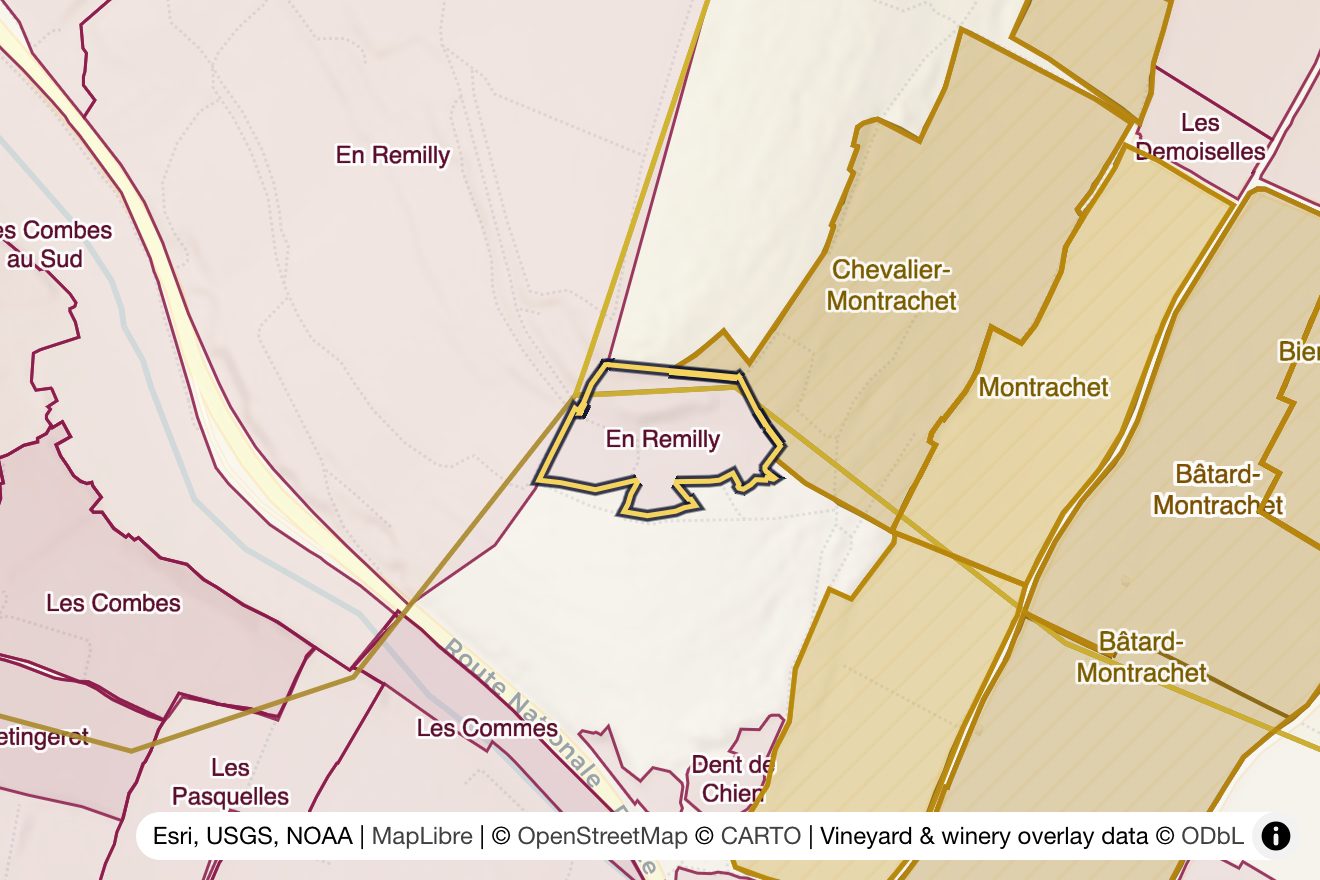
1. Overview & Location
The vineyard is situated on the upper slopes of Chassagne-Montrachet, positioned at an elevation that captures the optimal balance of sun exposure, drainage, and soil composition. En Remilly lies within the complex mosaic of Premier Cru sites that define this appellation, bordered by other distinguished climats that collectively contribute to Chassagne-Montrachet's reputation as one of Burgundy's premier white wine communes.
The precise positioning of En Remilly demonstrates the meticulous nature of Burgundy's terroir classification system. The vineyard benefits from the gentle slopes that characterize much of the Côte de Beaune, with gradients that promote excellent drainage while preventing excessive erosion. This geographical situation places En Remilly within the optimal viticultural zone where the interplay of elevation, aspect, and soil composition creates conditions conducive to producing wines of exceptional complexity and longevity.
The vineyard's location within the broader context of Chassagne-Montrachet places it among an elite group of sites that have been recognized for centuries as capable of producing wines that transcend ordinary quality levels. The careful delineation of En Remilly's boundaries reflects generations of viticultural observation and understanding of how subtle variations in terroir can profoundly impact wine character and quality.
2. Size
En Remilly encompasses approximately 1.56 hectares, making it one of the smallest Premier Crus within the Chassagne-Montrachet appellation. This scale places it among the smallest climats in the commune.
The vineyard's size allows for meaningful production volumes while maintaining the focused terroir expression that defines Premier Cru quality. The 1.56-hectare footprint is shared by only about six producers, contributing to a diverse range of interpretations of the En Remilly terroir while maintaining the essential characteristics that define wines from this site.
Within the context of Chassagne-Montrachet's Premier Cru hierarchy, En Remilly's size represents a practical balance. Its very small size means production is limited.
The division of En Remilly among various proprietors reflects the traditional Burgundian system of vineyard ownership, where individual holdings within a single climat may range from small parcels of a few rows to more substantial blocks. This ownership structure contributes to the diversity of winemaking approaches applied to En Remilly fruit, while the underlying terroir provides the unifying thread that connects all wines produced from this site.
3. Terroir & Geology
The geological foundation of En Remilly reflects the complex sedimentary history that defines the Côte de Beaune. The vineyard sits upon layers of limestone and marl that were deposited during the Jurassic period, creating the calcareous-clay matrix that has proven ideal for Chardonnay cultivation. The soil composition demonstrates the subtle variations that distinguish one Premier Cru site from another, with En Remilly exhibiting particular characteristics that contribute to its distinctive wine profile.
The topsoil in En Remilly consists primarily of brown limestone-rich earth with varying proportions of clay and decomposed limestone fragments. This composition provides excellent drainage during periods of excessive rainfall while retaining sufficient moisture during dry spells to prevent vine stress. The presence of limestone actively contributes to wine character, providing the mineral backbone that defines great Chassagne-Montrachet whites and influencing pH levels in ways that promote wine longevity.
Beneath the topsoil lies the crucial bedrock formation that ultimately defines En Remilly's terroir. The underlying geology consists of Middle Jurassic limestone formations, specifically Bathonian limestone that provides both structural support for proper drainage and a steady supply of mineral elements that vines access through their deep root systems. This geological foundation creates the conditions necessary for vines to develop the complex root networks that contribute to wine complexity and terroir expression.
The soil depth in En Remilly varies across the vineyard, with some areas featuring relatively shallow topsoil over limestone bedrock, while other sections offer deeper soil profiles. These variations contribute to the complexity found in wines from this climat, as vines growing in different soil depths develop varying stress levels and nutrient access patterns that influence fruit character and concentration.
The presence of fossilized marine organisms within the limestone substrate provides additional mineral complexity, contributing trace elements that subtly influence wine character. The slow weathering of limestone over millennia has created the fine-grained soil particles that give En Remilly its distinctive texture and drainage characteristics, while the continuous geological processes ensure ongoing mineral availability for vine nutrition.
4. Climate & Microclimate
En Remilly benefits from the continental climate that characterizes the Côte de Beaune, with distinct seasonal variations that promote proper vine development and fruit maturation. The vineyard's southerly exposure gives it ample sun.
The microclimate within En Remilly reflects its specific topographical position and elevation. The vineyard sits at an altitude that captures the ideal balance of temperature moderation and sun exposure, high on the slope, next to Chevalier-Montrachet. This elevation places En Remilly within the optimal viticultural zone where temperatures remain warm enough to ensure complete fruit maturation while avoiding the excessive heat that can lead to overripe or cooked fruit characters.
Air circulation patterns within En Remilly contribute significantly to vine health and fruit quality. The vineyard's position allows for natural air movement that helps prevent fungal diseases while moderating temperature extremes. The slope gradient facilitates cold air drainage during cool nights, preventing frost damage while maintaining the diurnal temperature variations that promote aromatic complexity and acidity retention in the developing fruit.
Rainfall patterns affect En Remilly similarly to other Côte de Beaune sites, with annual precipitation typically ranging from 700 to 800 millimeters. The vineyard's drainage characteristics become crucial during wet periods, as the limestone-rich soils efficiently channel excess water away from vine roots while retaining adequate moisture for vine needs. The timing of rainfall throughout the growing season significantly impacts vintage character, with spring moisture supporting vine growth and summer drought stress concentrating flavors.
The frost risk in En Remilly remains manageable due to the vineyard's elevation and slope position, though spring frosts can occasionally affect bud break and flowering. The site's natural air drainage helps minimize frost damage compared to lower-lying areas, contributing to more consistent annual production levels.
5. Viticulture
Viticultural practices in En Remilly reflect generations of accumulated knowledge specific to this terroir, with techniques adapted to maximize the site's natural advantages while addressing its particular challenges. The predominant grape variety is Chardonnay, which has proven exceptionally well-suited to the limestone-rich soils and climatic conditions of this climat.
Vine density in En Remilly typically ranges from 10,000 to 12,000 vines per hectare, following traditional Burgundian spacing that promotes competition among vines while ensuring adequate sun exposure and air circulation. This density requires careful canopy management to prevent overcrowding while maintaining the vine stress levels that contribute to concentrated fruit and terroir expression.
Pruning systems employed in En Remilly primarily utilize the Guyot method, which allows for precise yield control while maintaining vine balance. The limestone-rich soils provide natural vigor control, but careful pruning remains essential to prevent overcropping that could dilute wine quality. Winter pruning decisions significantly impact the subsequent vintage, requiring detailed knowledge of individual vine performance and site-specific growing conditions.
Harvest timing in En Remilly demands careful monitoring of fruit development to capture optimal physiological ripeness while preserving the acidity levels that define great Chassagne-Montrachet. The exposure of the vineyard influences fruit development patterns, often allowing for harvest dates that fall within the optimal window for balancing sugar accumulation with acid retention.
Sustainable viticultural practices have become increasingly important in En Remilly, with many producers adopting organic or biodynamic approaches that enhance soil health and promote natural vineyard ecosystems. These practices often improve terroir expression by encouraging deeper root development and more complex microbial soil communities that contribute to wine complexity.
Canopy management throughout the growing season requires careful attention to leaf exposure and fruit zone management. The goal is to provide adequate sun exposure for fruit development while preventing sunburn or overheating that could compromise fruit quality. The specific microclimate of En Remilly influences these decisions, with its particular exposure requiring site-specific approaches.
6. Wine Character & Style
Wines from En Remilly exhibit the distinctive characteristics that define exceptional Chassagne-Montrachet Premier Cru, while displaying specific nuances attributable to this climat's unique terroir. The limestone-rich soils impart a pronounced mineral backbone that forms the structural foundation of En Remilly wines, creating the framework upon which fruit flavors and aromatic complexity develop.
The aromatic profile of En Remilly Chardonnay typically displays a complex integration of fruit, floral, and mineral elements. Young wines often show citrus notes, particularly lemon and lime zest, combined with white stone fruit characteristics such as white peach and nectarine. Floral elements frequently include acacia and hawthorn blossom, while the mineral terroir contributes distinctive chalk and limestone notes that become more prominent with age.
On the palate, En Remilly wines demonstrate the excellent balance between richness and freshness that characterizes great Chassagne-Montrachet. The wine's texture reflects the influence of the limestone-clay soils, providing sufficient weight and density to support aging while maintaining the vibrant acidity that preserves freshness. The mouthfeel often shows a characteristic salinity and mineral tension that speaks directly to the terroir's influence.
The flavor development in En Remilly wines shows remarkable complexity, with layers of fruit, mineral, and subtle spice notes that unfold gradually across the palate. The limestone terroir contributes to a distinctive "craie" or chalk-like minerality that provides both flavor interest and structural support. This mineral component helps integrate the fruit and oak elements while contributing to the wine's overall harmony and balance.
With proper winemaking, En Remilly produces wines that demonstrate excellent concentration without heaviness, achieving the elusive balance between power and elegance that defines great Burgundian Chardonnay. The natural acidity provided by the limestone soils ensures that these wines maintain freshness even as they develop complexity through aging.
The finish in En Remilly wines typically shows excellent length, with the mineral elements persisting long after the fruit flavors fade. This lengthy finish indicates the quality potential of the terroir and suggests the wine's capacity for extended cellaring and further development.
7. Comparison to Surrounding Crus
En Remilly's position within the Chassagne-Montrachet Premier Cru hierarchy provides interesting comparisons with neighboring climats that help define its distinctive character. Compared to the more famous Morgeot, located to the south, En Remilly typically shows greater mineral precision and less obvious richness, reflecting differences in soil composition and exposure.
The relationship between En Remilly and the nearby Caillerets demonstrates how subtle terroir variations create distinct wine personalities. Caillerets, with its different soil profile, tends to produce wines with more obvious stone fruit character and slightly less mineral intensity than En Remilly. These differences illustrate the precision of Burgundy's climat system in recognizing meaningful terroir distinctions.
When compared to Champs-Gain, another neighboring Premier Cru, En Remilly wines often display more structured mineral backbone and potentially greater aging capacity. Champs-Gain typically offers more immediate fruit appeal and accessibility in youth, while En Remilly may require additional cellaring to fully express its potential complexity.
The contrast with Les Chenevottes, located on similar soils but with different exposure, highlights the importance of microclimate in terroir expression. En Remilly's exposure creates different ripening patterns and fruit development compared to the more southerly exposition of Chenevottes, resulting in wines with distinct aromatic profiles and structural characteristics.
8. Notable Producers
Several distinguished producers hold parcels within En Remilly, each bringing their unique winemaking philosophy to express this terroir's potential. These producers represent different approaches to viticulture and vinification while working with the same fundamental terroir characteristics.
Domaine Ramonet, one of Chassagne-Montrachet's premier estates, bottles its En Remilly as Saint-Aubin premier cru. The domaine's traditional approach emphasizes minimal intervention winemaking that allows the limestone minerality to shine through while developing the complexity that comes from patient cellar work and judicious oak usage.
Bruno Colin and Philippe Colin are among the producers working with En Remilly fruit. Their interpretation of this climat often emphasizes purity of fruit expression while preserving the essential mineral character that defines the site.
Their sustainable viticultural practices in En Remilly have produced wines that show exceptional clarity of terroir while maintaining the concentration and complexity expected from Premier Cru fruit.
Their interpretation often emphasizes the mineral aspects of the terroir while developing the aromatic complexity through careful elevage.
These producers, along with others working En Remilly parcels, collectively demonstrate the site's potential for producing distinctive wines that honor both the terroir's character and individual winemaking philosophies.
9. Historical Background & Classification
The history of En Remilly as a recognized vineyard site extends back several centuries, reflecting the gradual development of Burgundy's understanding of terroir distinctions within Chassagne-Montrachet. The climat name itself provides clues to the site's historical usage and characteristics, with "Remilly" likely derived from toponymic elements that describe the location's physical features or historical ownership patterns.
The formal classification of En Remilly as Premier Cru occurred as part of the systematic evaluation of Burgundian vineyards that culminated in the AOC system established in the 1930s. This classification recognized the site's consistent ability to produce wines of superior quality compared to village-level vineyards, while acknowledging its position within the hierarchy of Chassagne-Montrachet's finest sites.
Historical records indicate that En Remilly has been continuously cultivated as vineyard land for many generations, with local knowledge of its specific characteristics passed down through families of vignerons. The consistency of quality production from this site over extended periods provided the evidence necessary for its Premier Cru classification.
The development of En Remilly's reputation parallels the broader recognition of Chassagne-Montrachet as one of Burgundy's premier white wine communes. As understanding of terroir became more sophisticated, the distinctive characteristics of individual climats like En Remilly became better appreciated and more precisely defined.
The classification system that recognizes En Remilly as Premier Cru reflects centuries of empirical observation about the site's wine quality potential. This recognition represents the culmination of generational experience with the vineyard's behavior under various climatic conditions and management practices.
10. Aging Potential & Quality Level
En Remilly produces wines with substantial aging potential, typically showing their best development after 5-8 years of proper cellaring, with the finest examples continuing to evolve for 15-20 years or more. The limestone-rich terroir provides the structural foundation necessary for extended aging, while the natural acidity ensures that wines maintain freshness throughout their development.
The quality level of En Remilly consistently places it among the more reliable Premier Crus of Chassagne-Montrachet, offering wines that demonstrate clear terroir character while providing excellent value within the Premier Cru category. The site's ability to produce consistently high-quality fruit across different vintage conditions speaks to the fundamental soundness of its terroir.
Young En Remilly wines often require patience to fully express their potential, as the mineral elements and structural components need time to integrate with fruit flavors and develop complexity. The aging process typically reveals additional layers of flavor and aroma while the wine's texture becomes more refined and harmonious.
The evolution of En Remilly wines during aging follows predictable patterns that reflect the terroir's influence. The initial fruit-forward character gradually gives way to more complex secondary and tertiary aromas, while the mineral backbone becomes more prominent and the wine's overall integration improves significantly.
Proper storage conditions become crucial for realizing En Remilly's aging potential, as the wine's development depends on consistent temperature and humidity levels that allow for gradual evolution without premature oxidation or other deterioration. Well-stored examples can surprise with their longevity and continued development well beyond their expected peak drinking windows.
The quality consistency of En Remilly across different producers and vintages suggests that the terroir provides a solid foundation that supports various winemaking approaches while maintaining essential character traits. This reliability makes En Remilly an excellent choice for collectors seeking Premier Cru Chassagne-Montrachet with proven aging potential and distinctive terroir expression.