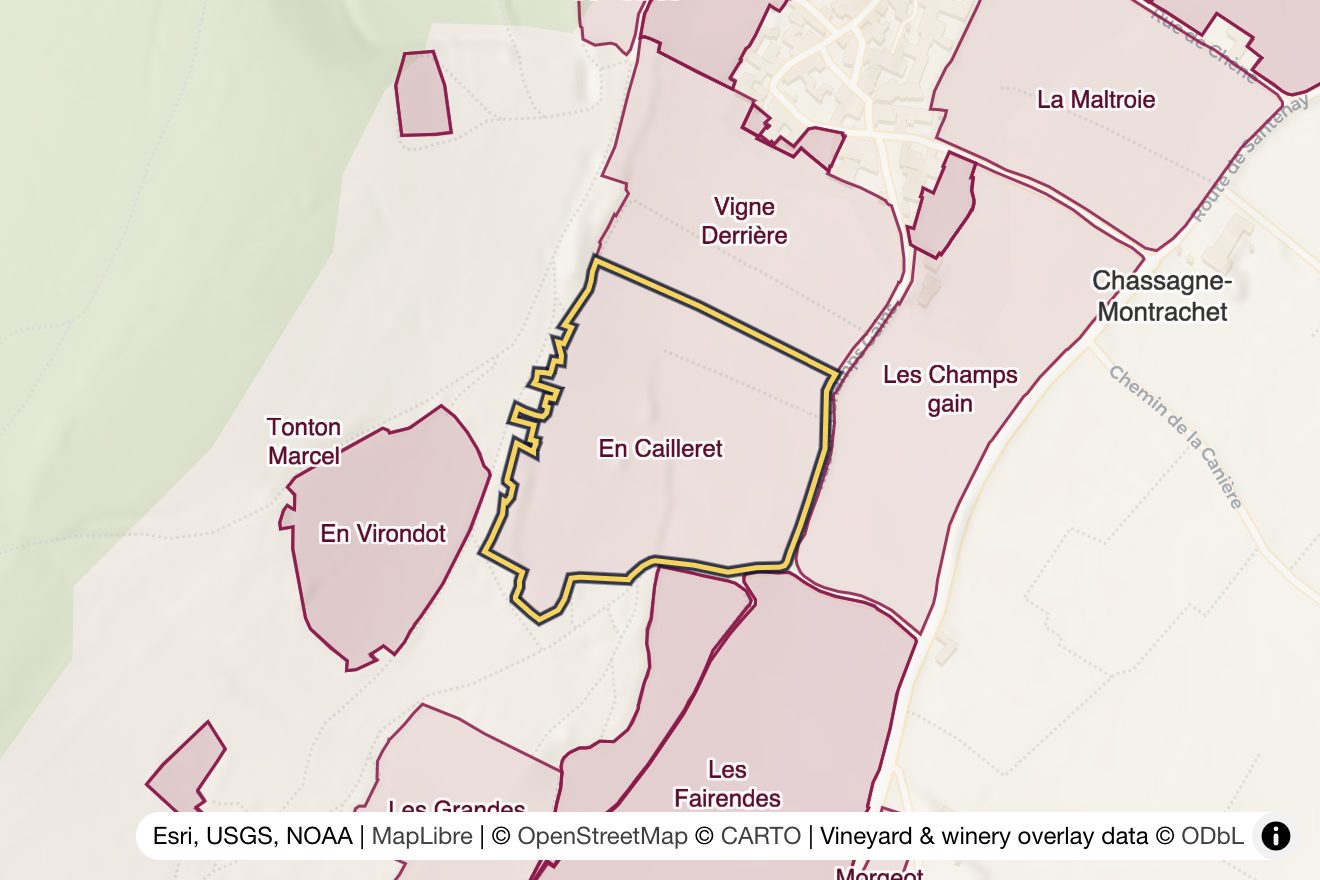
Overview & Location
The vineyard is strategically positioned on the mid-slope of the Côte de Beaune escarpment, nestled between the village of Chassagne-Montrachet proper and the boundary with Santenay to the south. En Cailleret's location places it within the heart of Chassagne-Montrachet's Premier Cru zone, where the interplay of geology, topography, and climate creates optimal conditions for viticulture.
Within the broader context of Burgundy's hierarchical classification system, En Cailleret occupies an important position as one of Chassagne-Montrachet's recognized Premier Cru climats. The vineyard's placement on the slope provides the essential drainage and sun exposure that distinguish Premier Cru sites from the village-level vineyards located on flatter terrain below and the less favorable sites on the plateau above.
The climat benefits from its proximity to other distinguished Premier Cru vineyards, including Clos Saint-Jean and Morgeot, creating a constellation of exceptional terroirs that define the character of southern Chassagne-Montrachet. This geographical positioning within one of Burgundy's most celebrated white wine communes establishes En Cailleret as a site capable of producing wines of considerable complexity and longevity.
Size
En Cailleret encompasses approximately 5.11 hectares (12.6 acres), making it a moderately sized climat within Chassagne-Montrachet's Premier Cru designation. This relatively modest scale is typical of Burgundy's fragmented vineyard landscape, where centuries of inheritance and division have created a mosaic of small, precisely defined parcels.
The vineyard's limited size contributes to its exclusivity and allows for intensive viticultural management. The compact nature of En Cailleret means that variations in soil composition, drainage, and microclimate across the site are relatively minimal, promoting consistency in grape quality and wine character. This homogeneity is prized by vignerons who can apply uniform viticultural practices across the entire climat with confidence in achieving consistent results.
This size allows for focused attention to detail while maintaining sufficient production volume to establish market presence and reputation over time.
Terroir & Geology
The geological foundation of En Cailleret reveals the complex interplay of limestone formations that characterize the Côte de Beaune's most prestigious vineyard sites. The vineyard sits upon Bathonian limestone from the Middle Jurassic period, overlaid with a mixture of clay, limestone debris, and fossilized marine deposits that create the distinctive soil profile essential to the site's character.
The soils are stony, with crinoidal limestone and fossiliferous marls. This clay component provides excellent water retention during dry periods while maintaining sufficient drainage to prevent waterlogging during heavy rainfall. The limestone bedrock beneath ensures proper drainage and contributes crucial mineral elements that influence both vine development and wine character.
En Cailleret's slope orientation faces predominantly southeast, providing generous sun exposure. The vineyard's elevation ranges from approximately 250 to just over 300 meters above sea level, positioning it in the ideal zone for balanced grape ripening. The gradient varies from 8 to 15 percent, creating natural drainage patterns while allowing mechanical cultivation where necessary.
The limestone soils are alkaline, which favors Chardonnay cultivation. The presence of fossilized marine elements, including ancient oyster shells and other calcified marine life, contributes trace minerals that enhance the wine's mineral complexity and aging potential.
Geological analysis reveals that En Cailleret's soils contain higher proportions of active limestone compared to some neighboring sites, resulting in wines with pronounced mineral character and excellent natural acidity. The combination of clay for richness and limestone for structure creates an ideal growing medium that produces wines of both power and elegance.
Climate & Microclimate
En Cailleret benefits from the continental climate characteristic of the Côte de Beaune, modified by local topographical influences that create a distinct mesoclimate within the vineyard. The site's southeast exposure ensures ample sunlight, promoting steady, even ripening throughout the growing season.
The vineyard's elevation and slope position create favorable air drainage patterns that reduce frost risk during spring and minimize humidity-related disease pressure during the growing season. Cold air naturally flows downslope during nighttime hours, preventing stagnation and maintaining the temperature fluctuations essential for complex flavor development in Chardonnay.
Annual precipitation in the En Cailleret area averages approximately 750-800 millimeters, with the majority falling during autumn and winter months. The vineyard's soil composition provides excellent water management, retaining sufficient moisture during dry summer periods while preventing waterlogging during periods of heavy rainfall.
Temperature patterns show significant diurnal variation, with warm days promoting photosynthesis and sugar development, while cool nights preserve natural acidity and aromatic compounds. This temperature modulation is enhanced by the vineyard's position on the slope, where elevation provides cooling influences while the southeast exposure brings early morning warmth.
Wind patterns generally flow from west to east across the slope, providing natural ventilation that reduces disease pressure and promotes healthy vine development. The vineyard's protected position within the Côte de Beaune escarpment shields it from harsh northern winds while allowing beneficial air movement throughout the growing season.
Viticulture
Chardonnay dominates the plantings in En Cailleret, representing essentially all of the vineyard area. The Chardonnay vines are typically planted to various clones selected for their adaptability to the site's specific soil and climate conditions, including clones 75, 76, 95, and 96, which are prized for their ability to produce wines of concentration and longevity.
Vine age across En Cailleret varies considerably among different parcels, with some sections containing vines over 40 years old while recent replantings have introduced younger vines. The average vine age approximates 25-30 years, providing the maturity necessary for complex wine production while maintaining healthy yields and vine vigor.
Planting density typically ranges from 10,000 to 12,000 vines per hectare, following Burgundian traditions that emphasize competition among vines to concentrate flavors and improve grape quality. The higher density plantings encourage root systems to penetrate deeply into the limestone subsoil, accessing mineral nutrients and water reserves that contribute to wine complexity.
Viticultural practices in En Cailleret emphasize sustainable approaches that preserve soil health and promote natural balance within the vineyard ecosystem. Many producers employ organic or biodynamic methods, reducing chemical inputs while enhancing soil biology through cover crops, composting, and natural pest management strategies.
Pruning follows the traditional Guyot system, with careful attention to bud selection and cane positioning to optimize sun exposure and air circulation within the vine canopy. Yield management through green harvesting and cluster thinning ensures that remaining grapes achieve full phenolic ripeness while maintaining the natural acidity essential to age-worthy Chardonnay.
The vineyard's slope and soil composition present specific challenges including erosion control and nutrient management. Producers employ various techniques including grass cover between rows, strategic placement of stakes and wires, and careful timing of soil cultivation to maintain vineyard stability while promoting vine health.
Wine Character & Style
Wines from En Cailleret exhibit a distinctive profile that combines mineral precision with rich textural complexity, reflecting the climat's unique terroir characteristics. The Chardonnay typically displays a pale gold color with hints of green in younger vintages, developing deeper golden hues with age while maintaining excellent clarity and brilliance.
The aromatic profile features primary notes of citrus fruits, particularly lemon zest and grapefruit, complemented by white stone fruits including peach and nectarine. Floral elements often include acacia, honeysuckle, and white flowers, while mineral notes reminiscent of wet limestone, chalk, and sea shells provide distinctive terroir expression. With age, the wines develop complex secondary aromas including honey, toasted nuts, and subtle spice notes.
On the palate, En Cailleret Chardonnay demonstrates excellent balance between richness and acidity, with a full-bodied texture that maintains elegance and finesse. The wine's structure is built upon vibrant natural acidity that provides backbone and aging potential, while the limestone-influenced mineral core creates a distinctive saline quality that enhances food compatibility.
Textural characteristics include a creamy, almost glycerol-rich mouthfeel that coats the palate while maintaining freshness and precision. The wine's length is typically exceptional, with mineral and citrus notes persisting well after swallowing, accompanied by a subtle saline finish that reflects the vineyard's geological composition.
The influence of oak aging, where employed, is typically well-integrated, adding subtle vanilla and spice notes without overwhelming the wine's inherent terroir characteristics. Many producers favor a restrained approach to oak, using a combination of new and used barrels to enhance texture while preserving the site's natural expression.
Temperature fluctuations during the growing season contribute to the wine's complexity, with the retention of natural acidity providing structure for long-term aging while allowing the full expression of fruit and mineral characteristics that define En Cailleret's distinctive style.
Comparison to Surrounding Crus
En Cailleret's wines display distinctive characteristics that differentiate them from neighboring Premier Cru climats within Chassagne-Montrachet. Compared to the more robust and powerful wines from Morgeot, En Cailleret typically shows greater elegance and mineral precision, with a more refined texture and enhanced aromatic complexity.
The wines contrast notably with those from Clos Saint-Jean, which tend toward greater richness and body due to different soil composition and slightly varied exposure. En Cailleret maintains superior natural acidity and displays more pronounced citrus characteristics, while Clos Saint-Jean often shows rounder, more tropical fruit expressions.
When compared to the Premier Cru Chenevottes, En Cailleret demonstrates greater mineral intensity and longer aging potential, though Chenevottes may show more immediate approachability in youth. The limestone influence in En Cailleret creates wines with more pronounced chalky mineral notes and enhanced structural backbone.
Les Vergers, another neighboring Premier Cru, typically produces wines with different aromatic profiles, showing more floral and spice characteristics compared to En Cailleret's citrus and mineral focus. En Cailleret generally displays superior concentration and complexity, reflecting its optimal slope position and soil composition.
Below the Grand Crus of Montrachet, Bâtard-Montrachet and Criots-Bâtard-Montrachet, En Cailleret ranks among Chassagne-Montrachet's finest Premier Crus. The wines show greater depth and aging potential than typical Premier Cru sites while maintaining the elegant style characteristic of the finest Chassagne-Montrachet productions.
The distinctive character of En Cailleret wines reflects the climat's specific geological and climatic conditions, creating a style that balances power with finesse and demonstrates the potential for extended aging that distinguishes Premier Cru sites from village-level productions.
Notable Producers
Several distinguished producers cultivate parcels within En Cailleret, each bringing their distinctive winemaking philosophy to express the terroir's potential. Domaine Ramonet holds one of the most significant parcels, approximately 0.35 hectares, and their interpretation emphasizes minimal intervention winemaking to showcase the vineyard's natural characteristics.
Domaine Marc-Antonin Blain works a smaller parcel of roughly 0.25 hectares, focusing on organic viticulture and natural fermentation techniques to produce wines of exceptional purity and mineral expression. Their approach emphasizes longer lees aging to enhance texture while preserving the site's inherent acidity and mineral character.
Domaine Paul Pillot maintains holdings of approximately 0.20 hectares within En Cailleret, employing traditional Burgundian techniques including wild yeast fermentation and judicious oak aging to create wines that balance modernity with classical expression. Their wines typically show excellent aging potential and distinctive terroir character.
Smaller holdings are distributed among various producers including local vignerons who sell their production to established négociant houses. These partnerships often result in distinctive bottlings that reflect both the grower's viticultural expertise and the négociant's winemaking style, contributing to the diversity of expressions from this climat.
The variation in winemaking approaches among producers creates interesting stylistic differences within En Cailleret wines, from those emphasizing immediate accessibility to others designed for extended aging. This diversity allows wine enthusiasts to explore different interpretations of the same terroir while maintaining recognition of the site's fundamental character.
Production volumes from En Cailleret remain limited due to the vineyard's modest size, with production limited by the vineyard's size and fragmented ownership.
Historical Background & Classification
En Cailleret's viticultural history extends back several centuries, with the site forming part of the long-established vineyard slopes of Chassagne-Montrachet. The climat's name derives from local dialect referring to the stony, limestone-rich soils that characterize the vineyard.
The formal recognition of En Cailleret as a Premier Cru followed the establishment of Burgundy's Appellation d'Origine Contrôlée system, which began in the 1930s, when authorities codified the hierarchical classification that had developed through centuries of empirical observation and market recognition.
Historical records indicate that En Cailleret wines commanded premium prices as early as the 18th century, reflecting recognition of the site's superior quality among merchants and consumers in Burgundy's traditional markets. The vineyard's reputation was enhanced by its inclusion in various estate holdings of prominent Burgundian families who prized the site for its consistent quality and aging potential.
The phylloxera crisis of the late 19th century necessitated complete replanting of En Cailleret, as with virtually all Burgundian vineyards. The reconstruction period allowed for improved vineyard layout and the introduction of American rootstocks that provided resistance to the phylloxera pest while maintaining wine quality.
During the 20th century, En Cailleret gained increasing recognition among international wine enthusiasts as Burgundy's reputation expanded beyond traditional European markets. The site's classification as Premier Cru was reaffirmed through various revisions of the AOC system, confirming its status among Chassagne-Montrachet's most distinguished climats.
Modern viticultural practices have enhanced the expression of En Cailleret's terroir while respecting traditional methods that proved successful over centuries. The combination of historical reputation and contemporary quality has established En Cailleret as one of Chassagne-Montrachet's reference sites for premium Chardonnay production.
Aging Potential & Quality Level
En Cailleret produces wines with exceptional aging potential, typically reaching optimal drinking condition between 5 and 8 years after vintage while maintaining quality for 15 to 20 years or more in favorable vintages. The wine's evolution follows a predictable pattern that reflects the site's terroir characteristics and the natural aging process of high-quality Chardonnay.
In youth, typically during the first 2-3 years after bottling, En Cailleret wines display vibrant acidity and primary fruit characteristics, with mineral notes providing structure and backbone. During this period, the wines may appear somewhat closed or austere, requiring time for integration of oak and development of secondary characteristics.
The optimal drinking window begins around year 4-5, when the wine's components achieve harmony and complexity emerges. During this phase, fruit characteristics mature from primary citrus and stone fruit notes toward more complex expressions including honey, nuts, and spice, while mineral elements become more integrated and sophisticated.
Peak maturity typically occurs between years 8-12, when En Cailleret reaches its full potential for complexity and harmony. At this stage, the wine displays seamless integration of all elements, with developed tertiary aromas and flavors while maintaining sufficient acidity for balance and freshness.
Extended aging beyond 15 years reveals the exceptional quality of En Cailleret's finest vintages, with wines developing profound complexity while retaining structural integrity. The limestone influence provides natural preservative qualities that support long-term aging, while the wine's inherent acidity prevents premature oxidation.
Quality consistency across vintages reflects En Cailleret's favorable terroir characteristics and the skill of its various producers. Even in challenging vintages, the site typically produces wines above average quality due to optimal drainage, favorable exposure, and soil composition that promotes consistent ripening.
The investment potential of En Cailleret wines is supported by their aging capability and increasing recognition among collectors. Limited production quantities and growing international demand contribute to price appreciation over time, particularly for wines from exceptional vintages and renowned producers.
Climate change impacts have generally favored En Cailleret's quality in recent decades, with warmer growing seasons enhancing ripeness while the site's natural acidity preservation prevents excessive maturation. This adaptation suggests continued excellence for future vintages while maintaining the classical style that defines the climat's character.