The Name and the Rock
The word repeats the length of the Côte, in Meursault, Pommard, Gevrey-Chambertin, Nuits-Saint-Georges and as far south as Pouilly-Fuissé, marking ground where the local limestone was good enough to be cut for walls, cabottes and cellar vaults instead of being left under vine. Beaune's version is literal: quarried faces of fine limestone still edge sections of the northern slope, and the climat took its name from the industry rather than from anything about the wine.
Geologically the site occupies the upper band of the Beaune hillside, where the Callovian limestones that floor the mid-slope give way to the marls and marly limestones of the Oxfordian above. What sits on top is thin, stony and poor, and the gradient keeps it that way; Domaine de Bellene records an 18 per cent slope on its parcel. Clay-limestone is the standard shorthand for the whole appellation, but at Perrières the balance runs heavily to stone, and the calcium load is high enough that most tasters reach for the word chalky before they reach for anything else.
Position and Parcels
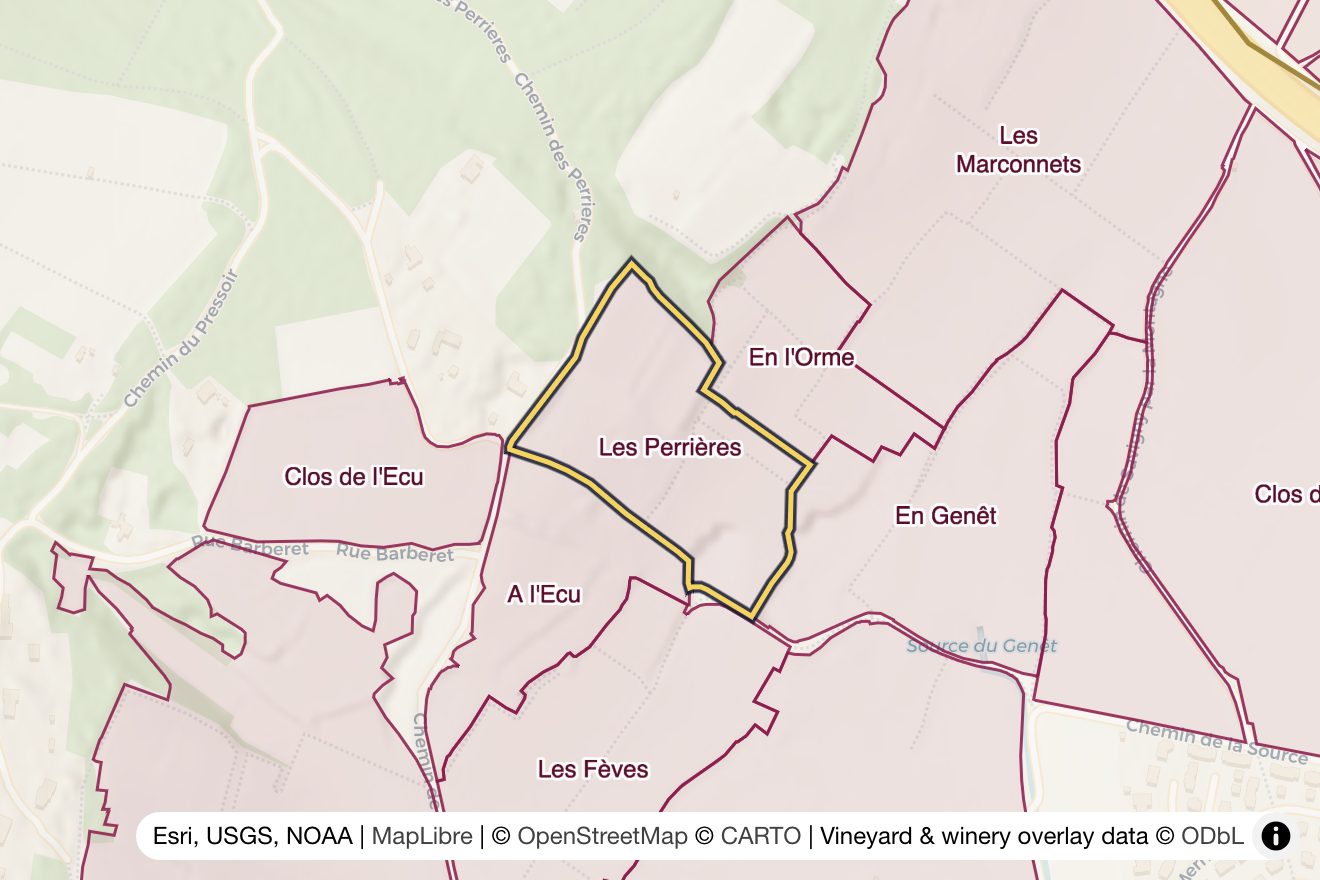
Measured geodesically from the delimitation mapped here, Les Perrières covers 3.20 hectares, centred at 4.8269 E, 47.0449 N. That agrees with the trade: Patriarche gives the climat as 3 hectares and 20 ares, and Berry Bros. & Rudd also gives 3.20 hectares (about 7.9 acres). Altitude runs roughly 250 to 300 metres, and the exposure is east.
The climat is recorded as three parcels, which overstates how broken up it is. A single block of 3.19 hectares accounts for essentially the entire site; the two remaining polygons are cadastral slivers of about half an are apiece, lying 127 and 150 metres from the main body. Perrières is, in practice, one steep rectangle. That makes it unusual in Beaune, where climats such as Les Teurons (fourteen parcels) and Les Grèves (ten) genuinely fracture across the slope.
Its immediate neighbours, read off the delimitation, are Clos de l'Écu upslope to the west, A l'Écu to the south-west, Les Fèves continuing the same band southwards, En Genêt directly downslope to the east, and En l'Orme and then Les Marconnets to the north-east. Patriarche's own list of adjoining climats (Les Fèves, En Genêt, A l'Écu) matches that reading. The commune boundary with Savigny-lès-Beaune lies a short distance north. Retail copy that situates Perrières among Les Cent Vignes and Les Bressandes is describing the northern sector loosely rather than the touching parcels.
Height, thin soil and east-facing exposure combine to make this a cooler address than the celebrated mid-slope crus below it, which is the point most frequently made about the site by the merchants who buy from it.
Who Owns It
For a climat of three hectares, ownership is unusually concentrated. Maison Louis Latour works 1.32 hectares, comfortably more than forty per cent of the surface, and its red bottling is the version most often encountered. Domaine de Montille farms a holding of markedly mixed age, with roughly half the vines past eighty years and individual plants approaching ninety, the remainder under forty. Domaine de Bellene holds 0.22 hectares that had been in Pinot Noir, replanted the plot to Chardonnay in 2013 and released a first white in 2017, on the judgement that the stone here favours white. Patriarche and the viticultural school at Beaune also bottle the climat.
Beaune premier cru admits both colours, so Perrières appears in red and, in small quantity, in white. The reds dominate.
In the Glass
The reds are built on structure rather than flesh. Latour's is deep in colour and runs to cherry and liquorice, picking up mocha and spice from an élevage of ten to twelve months with 35 per cent new oak, and closes with fine, powdery tannin. De Montille's, made with a substantial proportion of whole bunches, is lighter-framed and more aromatic, with lifted red cherry and flowers over a chalky, drying texture; Jasper Morris found poached plum and floral detail in the 2019.
What the owners share is the finish: linear, tense and stony rather than broad. Perrières does not deliver the plush middle of Les Grèves or Les Bressandes further down the slope, and it is not trying to. Ten years is a reasonable expectation, longer in structured vintages. The white, from Bellene's replanted corner, follows the same logic, showing stone fruit and white flowers with a salty, iodine-tinged close.