The Name and the Position
Cras belongs to a family of Burgundian place names (Cras, Crais, Crai, Crâs) that all point at the same physical fact, which is broken rock near the surface. Louis Latour traces the word back to C(a)racos, a pre-Latin term for a stony rise or a scree slope, and the same root reappears across the Côte: Les Cras in Chambolle-Musigny and in Meursault, Aux Cras in Nuits-Saint-Georges, Les Crâs in Vougeot. In Beaune the name is unusually literal.
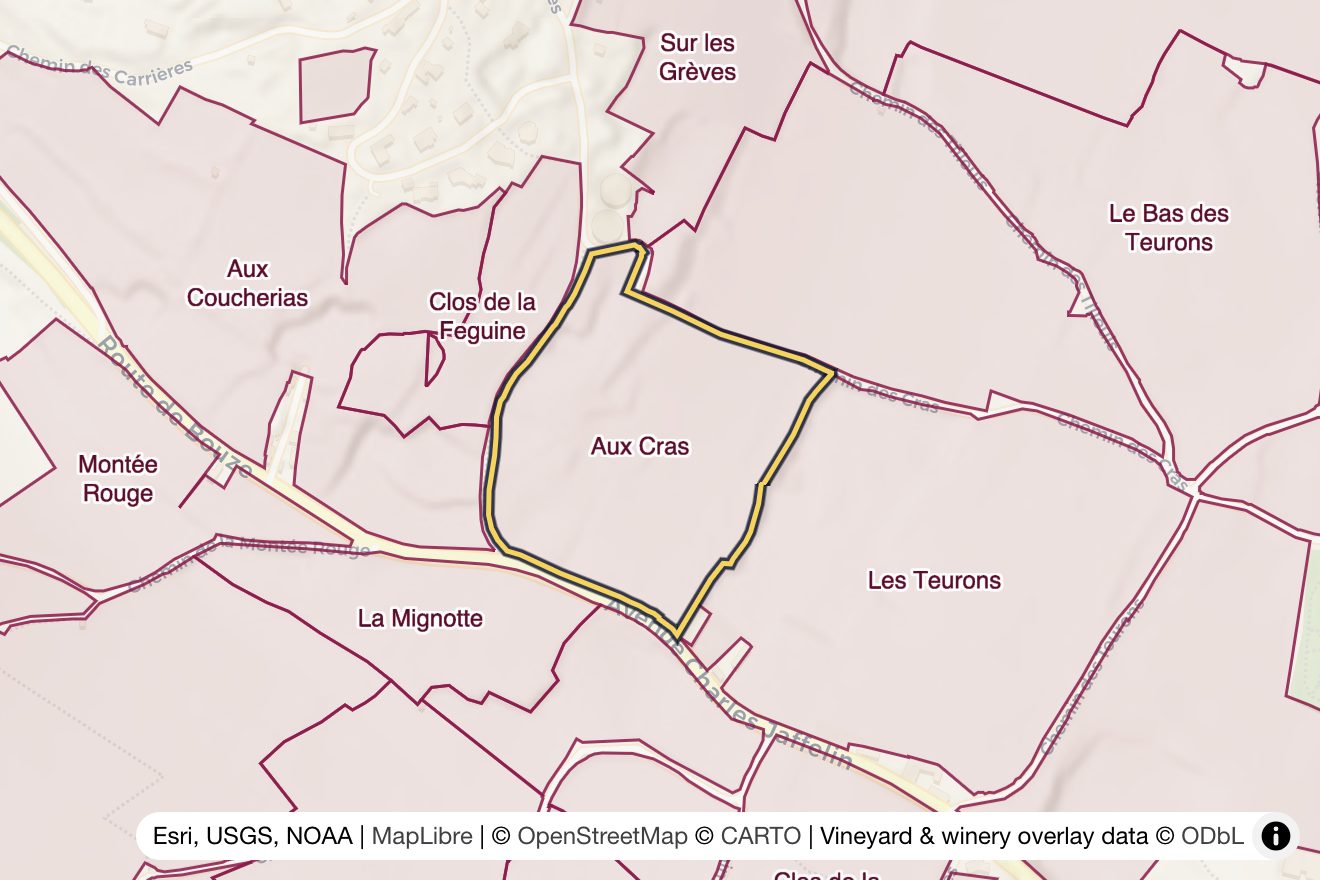
The climat lies north-west of the town, high on the flank of the Montagne de Beaune, at roughly 240 to 260 metres and facing east to south-east. Aux Coucherias and Montée Rouge sit above it to the west, Clos de la Feguine adjoins it, Les Teurons falls away below to the south-east, and the Grèves block begins to the north. That puts Aux Cras at the upper limit of the central run of premiers crus, above the mid-slope names that built the town's reputation with its négociants, and high enough that drainage and light do more of the work than depth of soil ever could.
Stone, Terraces and Reflected Light
The defining feature is the old quarry. Stone was cut out of this shoulder of hill, and when the ground was returned to vines it was rebuilt as a series of terraces held by limestone retaining walls, with the cut quarry faces still standing. Those pale walls throw light and stored heat back into the rows, and Louis Latour credits the light they reflect with promoting the early development of the vine and its grapes.
Underneath, the profile is thin and silica-rich rather than fat. Nanson describes a light topsoil full of rounded stones with plenty of silicate, over layers of stone that roots can penetrate, while Louis Latour and Drouhin describe the soil as clay and limestone. Working depth is on the order of forty to fifty centimetres before the vine is into rock. Yields come in low across every owner, which is a soil consequence rather than a house policy.
Parcel Structure and Who Bottles It
Measured on the delimitation, Aux Cras runs to 5 hectares, and Beaune's official figure of 4.99 hectares agrees to within a rounding error. The delimitation records three separate pieces, but the proportions matter more than the count: one block of just under 4.96 hectares carries essentially the whole climat, and the two remaining fragments, each under two hundredths of a hectare, are slivers on the northern edge. Unlike many Burgundian climats, which are genuinely scattered, Aux Cras is one coherent parcel with two offcuts. The internal division that counts is the terracing inside that single block, not the map.
Ownership is concentrated. Writing in 2010, Bill Nanson put roughly two-thirds of the climat in the hands of Joseph Drouhin and of Germain at the Domaine du Château de Chorey, with Camille Giroud farming vines then approaching ninety years old, and counted only about five bottlers in total. Louis Jadot releases it under its Domaine Gagey estate label, Louis Latour has a long run of vintages, and Champy bottles an organically farmed version. Château de Chorey's own Beaune Les Cras Vieilles Vignes is now a back-vintage proposition rather than a current one. Most of what reaches the market is red, but Louis Latour bottles a white Chardonnay Aux Cras.
The Wine
Aux Cras produces a Beaune that leans mineral rather than plush. Drouhin's notes run to blackcurrant and blackberry in youth, turning towards leather, truffle and spice with time in bottle, on tannins that are firm without being coarse; the house suggests a drinking window of eight to fifteen years, stretching to twenty in the right vintage. Tasters who follow the climat across producers describe a wine that can be broad and generous in body yet still finishes stony, with that mineral signature surviving warm years and cool ones alike.
Historically the site has been ranked among the very best of Beaune: Lavalle placed it in the top tête de cuvée tier in 1855. Camille Rodier, writing in 1920, picked Au Cras out as one of the exceptional premières cuvées of the commune, in company with Les Fèves, Les Grèves, Les Bressandes, Les Marconnets and Clos de la Mousse. A century later, with five hectares and five bottlers, it remains one of the most under-circulated of Beaune's genuinely serious climats.