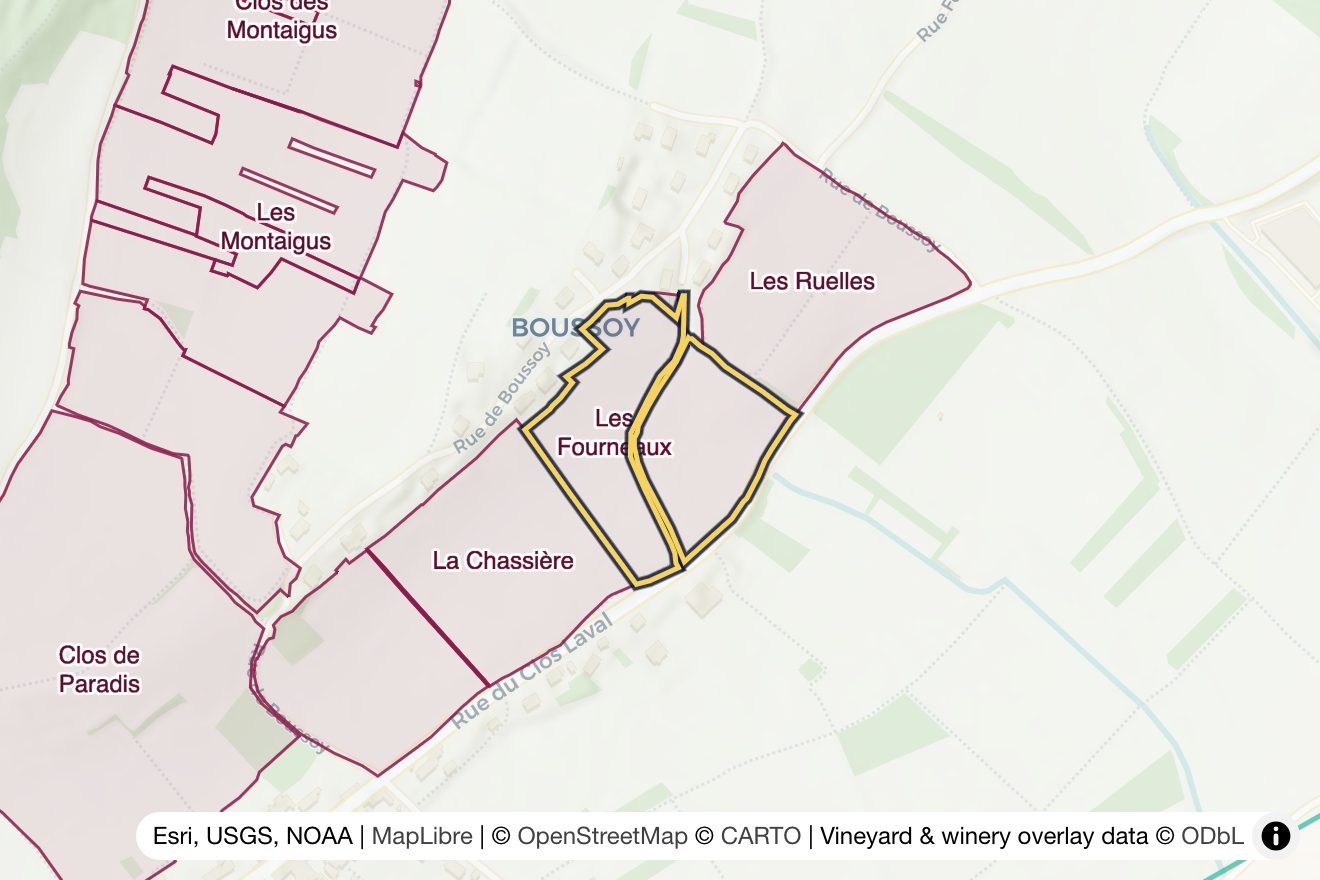
A climat in two pieces
Burgundian climats are cadastral inheritances rather than designed shapes. Boundaries follow what was planted, worked and named over centuries, and the pieces were separated by a track, an old wall, a change in soil depth, or a strip that went out of vine and was never replanted. When the INAO fixed premier cru limits it followed those existing lines instead of redrawing them. The figure of 2.8 hectares is therefore a sum, not an outline.
The practical consequences are real. A domaine can hold a meaningful share of Les Fourneaux and still count its plot in ares. Vines in one parcel need not ripen on the same schedule as vines in the other, since a few metres of elevation or a shift in soil depth changes the picture on ground this shallow. Anyone comparing bottles from this climat is comparing different pieces of it as much as different cellars.
Hard limestone and an eastern aspect
Mercurey's vineyard runs between roughly 230 and 320 metres. The BIVB divides its soils into three groups by area: hard limestone (around 244 hectares), marl (around 194 hectares) and stony colluvial deposits (around 102 hectares). The appellation's most serious reds tend to come off a good thickness of Oxfordian grey marl.
Les Fourneaux belongs at the harder, thinner end of that range. Domaine Dureault, which farms in the village, describes its parcel as fossil-bearing hard limestone with very little soil over the rock, oriented east to south-east and sheltered from wind. That orientation separates the Saint-Martin climats from Mercurey's main slope, which mostly looks south to south-southeast. Fruit here takes the morning sun and loses heat earlier in the afternoon, which favours acid retention; the shallow limestone leaves almost no water reserve, so drought is a greater threat than a failure to ripen.
Five clos, and the one that is not among them
The appellation dates from 1936, and five climats were promoted to premier cru in 1943. All five were walled: Clos du Roy, Clos Voyens, Clos Marcilly, Clos des Montaigus and Clos des Fourneaux. Les Fourneaux, without the article, was not one of them. It entered with the vineyard reorganisation of the mid to late 1980s that carried Mercurey to its present 32 premier cru climats.
The two remain separate registered climats, listed side by side in Saint-Martin-sous-Montaigu alongside Le Clos des Montaigus, Le Clos Paradis, La Chassière and Les Ruelles. Retail databases merge them routinely, filing Domaine du Four Bassot's Clos des Fourneaux monopole under the Les Fourneaux heading. A bottle labelled Clos des Fourneaux is not this site, and neither is Vincent Meunier's wine of the same name.
The confusion extends beyond Mercurey. Chablis has its own premier cru Les Fourneaux, 33 hectares of Kimmeridgian marl at Fleys, incorporating Morein and Côte des Prés Girots. Nothing written about that site transfers. The word itself descends from late Latin furnellus, a small oven; across Burgundy and the Morvan such toponyms usually record lime kilns, charcoal ovens or tile works rather than any claim about the warmth of the ground.
What actually gets bottled
Ownership is narrow and the wines are scarce. Domaine Dureault farms about 10 hectares, built up by Anne Duréault from 1.5 sharecropped hectares in the early 1990s and now worked with her husband Thierry and son Martin. Its Fourneaux is Pinot Noir on Guyot, half the vines around 20 years old and half around 60, fermented in concrete and raised 18 months in oak, with a stated window of 10 to 20 years. Guillaume Bouthenet, based at Couches, bottles both colours. Domaine de la Chapelle makes a white.
That white deserves attention. Across the whole of Mercurey, premier cru Chardonnay accounts for roughly 20 hectares against about 145 hectares of premier cru Pinot Noir, so a white from a 2.8-hectare climat is a rarity drawn from a rarity. The shallow limestone shows in it as white flowers, hazelnut and almond over a saline rather than a broad finish. The reds carry more structural grip than Mercurey's marl-grown premier crus, with dark fruit sitting behind the frame, and they reward patience.
No critic treats Les Fourneaux as a benchmark site, and the volumes are too small for a consensus to have formed. Judge these bottles by the hand that made them, and read the label closely enough to be sure which Fourneaux is in the glass.