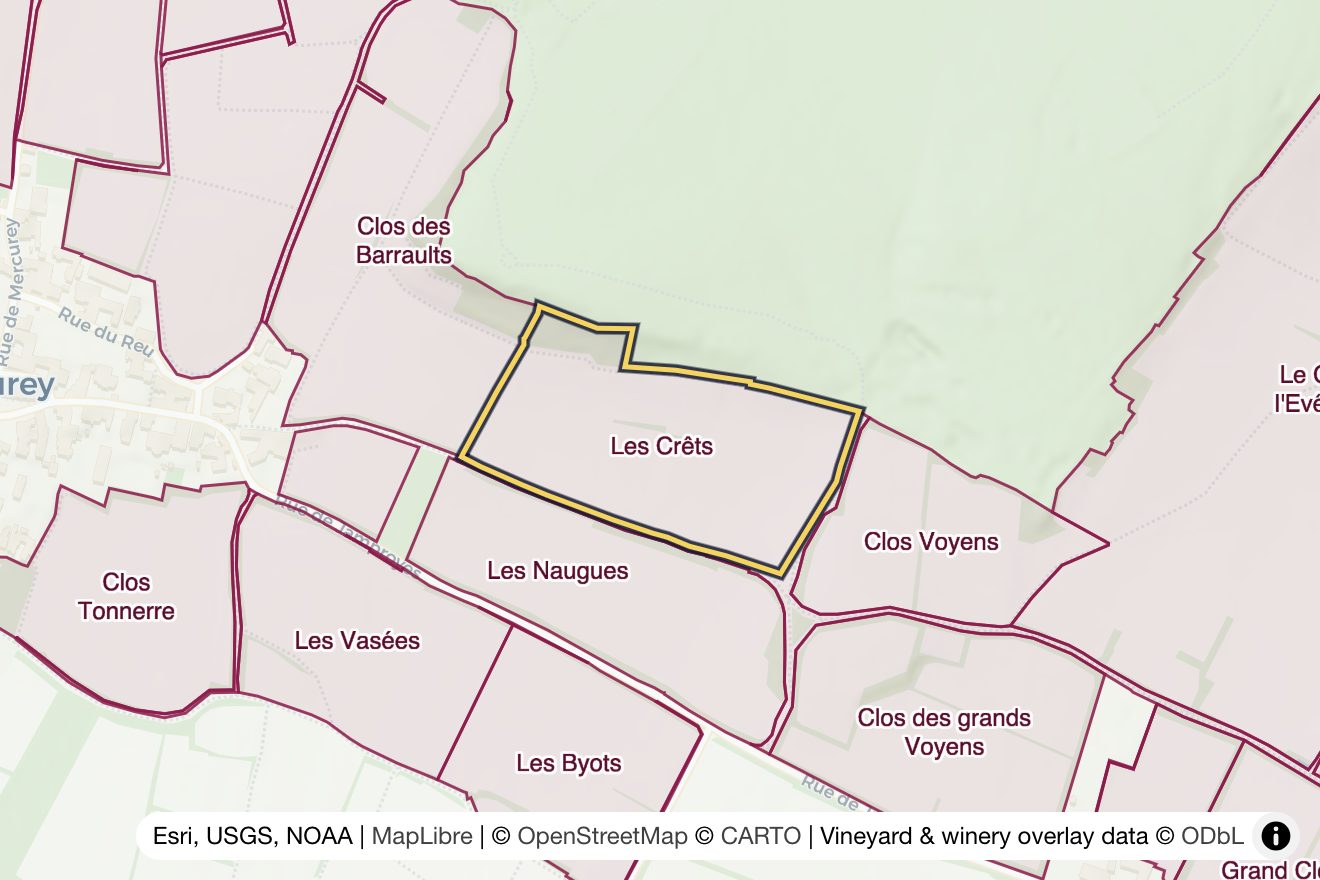
Overview & Location
Situated on the hillsides surrounding the village of Mercurey in Saône-et-Loire, Les Crêts benefits from the Côte Chalonnaise's characteristic geography of rolling hills and diverse expositions. The vineyard lies within the commune of Mercurey proper, positioned among a constellation of Premier Cru sites that have elevated this appellation's reputation significantly since the mid-20th century.
The Côte Chalonnaise itself represents a geographical and geological continuation of the Côte d'Or's limestone escarpment, though with notable differences in structure and orientation. Les Crêts occupies terrain that demonstrates both continuity with and distinction from its more famous northern neighbors, contributing to wines that display unmistakable Burgundian character while maintaining their own regional identity.
The climat's position within Mercurey places it in optimal relation to the broader terroir mosaic that makes this appellation unique within Burgundy. Unlike the more linear arrangement of vineyards in the Côte d'Or, Mercurey's Premier Crus are distributed across multiple hillsides and expositions, creating a complex patchwork of microclimates and soil conditions.
Size
Les Crêts is one of the 32 Premier Cru climats of the Mercurey appellation.
The vineyard's size allows for meaningful production volumes while maintaining the intimacy and terroir specificity that characterizes Burgundy's finest sites. The relatively compact nature of Les Crêts contributes to the homogeneity of its terroir expression, though subtle variations exist across different parcels within the climat's boundaries.
Terroir & Geology
The geological foundation of Les Crêts reveals the complex sedimentary history that underlies much of the Côte Chalonnaise. The vineyard sits on Jurassic limestone and marl, the typical substrate of Mercurey. This limestone base provides excellent drainage while maintaining sufficient water retention for vine health during dry periods.
The soil profile of Les Crêts displays characteristic Burgundian complexity, with a topsoil of brown clay-limestone. Its limestone content contributes to the mineral precision found in wines from this climat. The clay content provides water retention and contributes to the wines' structural backbone.
Beneath the topsoil lies a transition zone of weathered limestone mixed with marl, creating excellent drainage conditions while allowing roots to penetrate deeply into the bedrock. The limestone bedrock itself shows typical Burgundian characteristics, with a hard, compact structure interspersed with softer marl layers that provide nutrients and trace minerals essential to vine development.
The slope characteristics of Les Crêts are particularly favorable, with gradients ranging from 8-15% across most of the vineyard. This moderate slope ensures proper drainage without creating excessive erosion concerns, while the terrain's undulation creates subtle variations in mesoclimate across different sections of the climat.
Les Crêts enjoys a predominantly southeast to south exposure, optimal for Pinot Noir ripening in Burgundy's continental climate. This orientation provides morning sun exposure crucial for drying dew and preventing fungal diseases, while ensuring adequate afternoon warmth for phenolic development. The elevation ranges from approximately 280 to 320 meters above sea level, positioning the vineyard in an ideal thermal zone for premium grape production.
Climate & Microclimate
The climatic conditions at Les Crêts reflect the broader continental influences that shape the Côte Chalonnaise, while displaying specific microclimate characteristics that distinguish this site from surrounding areas. The region experiences a semi-continental climate with oceanic influences, creating conditions generally favorable for Pinot Noir and Chardonnay cultivation.
Annual precipitation averages approximately 750-800mm, distributed relatively evenly throughout the year with slight peaks during spring and autumn months. This precipitation pattern provides adequate water supply while allowing for dry periods during harvest that concentrate flavors and prevent dilution.
Temperature patterns at Les Crêts show typical Burgundian characteristics, with warm summers averaging 18-20°C and cold winters dropping below freezing regularly. The growing season typically extends from April through October, with budbreak occurring in early April and harvest usually taking place in mid-to-late September, depending on vintage conditions.
The southeast exposure of Les Crêts creates a particularly favorable mesoclimate characterized by excellent solar radiation during morning and midday hours, followed by some protection from the hottest afternoon sun. This exposure pattern promotes steady ripening while preserving the natural acidity essential to quality Burgundy wines.
Wind patterns play a crucial role in the climat's microclimate, with prevailing winds from the west and northwest providing beneficial air circulation that reduces humidity and disease pressure. The vineyard's position on the hillside ensures good air drainage, preventing cold air accumulation that could damage vines during critical periods.
Compared to neighboring sites, Les Crêts tends to ripen approximately 3-5 days earlier than vineyards with more northern exposures, while maintaining freshness better than sites with full south-facing orientations. This optimal ripening timeline contributes significantly to the climat's reputation for producing balanced, age-worthy wines.
Viticulture
Les Crêts is planted predominantly with Pinot Noir, with some Chardonnay. This distribution reflects both the site's particular suitability for red wine production and market demands for Mercurey rouge.
The average vine age across Les Crêts varies significantly among different producers, but generally ranges from 25-45 years, with some exceptional parcels containing vines planted in the 1960s and 1970s. These mature vines contribute complexity and depth to the wines while providing the deep root systems necessary for accessing the limestone bedrock's mineral resources.
Planting density typically ranges from 9,000 to 10,500 vines per hectare, following traditional Burgundian practices that balance vine competition with individual plant health. The higher density encourages root competition and limits individual vine vigor, contributing to fruit concentration and complexity.
Viticultural practices in Les Crêts generally follow sustainable or organic principles, with many producers transitioning to certified organic cultivation. Traditional Burgundian techniques predominate, including careful canopy management through leaf removal and green harvesting to optimize ripeness and prevent disease.
Pruning follows the Guyot system almost exclusively, with careful attention to maintaining proper wood balance and fruit load. Most producers practice selective harvesting, often requiring multiple passes through the vineyard to ensure optimal ripeness levels for different sections.
Site-specific challenges include the limestone soil's tendency to compact during wet periods, requiring careful soil management and cultivation timing. The climate's disease pressure necessitates vigilant monitoring and precise treatment timing, particularly for powdery mildew and downy mildew prevention.
Erosion management requires ongoing attention due to the sloped terrain, with many producers implementing cover crops and organic matter enhancement programs to maintain soil structure and fertility.
Wine Character & Style
Wines from Les Crêts display distinctive characteristics that reflect both the climat's specific terroir and its position within the broader Mercurey appellation. The red wines, predominantly Pinot Noir, show remarkable consistency in style while varying subtly based on producer philosophy and vintage conditions.
The aromatic profile of Les Crêts rouge typically features a complex bouquet combining red and dark fruit elements. Cherry notes predominate, ranging from bright red cherry in younger wines to deeper black cherry and cassis in more mature examples. These fruit characteristics are complemented by distinctive floral elements, particularly violet and rose petal notes that emerge with proper cellaring.
Mineral characteristics form a crucial component of Les Crêts' aromatic signature, displaying the limestone terroir through wet stone, chalk, and subtle saline notes. These mineral elements integrate seamlessly with the fruit profile, creating wines of notable complexity and terroir expression.
Secondary aromatic development in aged examples reveals earthy undertones including mushroom, forest floor, and dried herbs, while maintaining the primary fruit character that distinguishes quality Burgundy. Spice elements, particularly white pepper and subtle baking spices, add further complexity without overwhelming the wine's essential elegance.
Structurally, Les Crêts rouge demonstrates excellent balance between power and finesse. The tannin profile shows characteristic Mercurey strength and grip, with sufficient backbone for extended aging while remaining approachable in youth. These tannins derive primarily from the grape skins and seeds, enhanced by the limestone terroir's natural acidity preservation.
Acidity levels in Les Crêts wines consistently fall within optimal ranges for Pinot Noir, typically measuring 6.0-6.5 g/L total acidity. This natural acidity, preserved by the limestone soils and favorable microclimate, provides the structural foundation necessary for long-term aging while maintaining freshness and food compatibility.
Alcohol levels generally range from 12.5-13.5%, reflecting the climat's ability to achieve full phenolic ripeness without excessive sugar accumulation. This moderate alcohol range contributes to the wines' elegance and aging potential while allowing terroir characteristics to express themselves clearly.
The textural qualities of Les Crêts rouge show particular distinction, with a characteristic mineral tension that carries through from attack to finish. The wines display excellent mid-palate density without heaviness, culminating in persistent finishes that often reveal additional mineral and spice complexity.
Chardonnay from Les Crêts, while less common, displays equally impressive terroir expression with distinctive mineral character and excellent aging potential. These white wines show characteristic limestone precision with balanced oak integration and remarkable longevity.
Comparison to Surrounding Crus
Within the Mercurey appellation's Premier Cru hierarchy, Les Crêts occupies a distinctive position that sets it apart from neighboring climats while maintaining clear family resemblances. Compared to Clos du Roy, perhaps Mercurey's most prestigious Premier Cru, Les Crêts wines tend to display greater immediate accessibility while maintaining comparable aging potential.
The wines from Les Crêts show more overt fruit character in youth compared to the more mineral-driven Clos des Myglands, while developing similar complexity with extended cellaring.
The limestone influence appears more pronounced in Les Crêts than in some neighboring sites with higher clay content, resulting in wines with greater mineral precision and aging potential.
Against the broader context of Côte Chalonnaise Premier Crus, Les Crêts wines display characteristics that place them firmly within the upper quality tier. They show greater complexity and aging potential than most Rully Premier Crus while maintaining the accessibility that distinguishes Côte Chalonnaise wines from their Côte d'Or counterparts.
When compared to Côte d'Or appellations, Les Crêts produces wines that would be competitive with village-level wines from prestigious communes like Volnay or Chambolle-Musigny, while offering distinct regional character and generally superior value propositions.
Notable Producers
Several distinguished producers craft wines from Les Crêts, each bringing unique perspectives and techniques to this exceptional terroir.
Producers that have bottled Les Crêts include Domaine de Suremain, Domaine Corcia, Domaine Luc Brintet and Philippe Milan et Fils.
Historical Background & Classification
The history of Les Crêts as a distinguished vineyard site extends back several centuries, and the lieu-dit already appears, spelled "La Crée", on Mercurey's old cadastre. The climat's name, meaning "the crests" or "the ridges," refers to its elevated position on the hillsides surrounding Mercurey village.
Mercurey's appellation was created in 1936, as France's Appellation d'Origine Contrôlée system was being implemented, but its first premiers crus were only recognised in the 1940s, and the list has been expanded several times since. This classification recognized the climat's superior terroir characteristics and historical reputation for producing wines of exceptional quality.
The phylloxera crisis of the late 1800s significantly impacted the vineyard, as it did throughout Burgundy, but replanting efforts in the early 20th century maintained the site's viticultural continuity.
The post-World War II period marked significant development for Les Crêts, with improvements in viticulture and winemaking contributing to enhanced quality and recognition. The 1960s and 1970s saw substantial replanting efforts that established much of the current vine material, while the 1980s brought renewed focus on quality that elevated the climat's reputation.
Modern recognition of Les Crêts has grown steadily, with wine critics and collectors increasingly appreciating the distinctive character and aging potential of wines from this climat. This recognition has contributed to increased investment in vineyard improvement and winemaking excellence among producers working in Les Crêts.
Aging Potential & Quality Level
Les Crêts demonstrates remarkable aging potential that rivals many more famous Burgundy sites, with properly stored bottles developing complexity and tertiary character over extended periods. Red wines from exceptional vintages can age gracefully for 15-20 years, while maintaining their essential fruit character and developing profound complexity.
The evolution trajectory of Les Crêts rouge typically shows an initial phase of integration lasting 3-5 years, during which primary fruit characteristics meld with tannin structure and oak influences. This is followed by a plateau period of 5-12 years when the wines display optimal balance and complexity, before entering a mature phase where tertiary characteristics become prominent.
Quality consistency across vintages represents one of Les Crêts' most impressive characteristics, with the climat's favorable exposition and drainage ensuring successful ripening even in challenging weather conditions. While vintage variation certainly exists, the site's fundamental quality rarely disappoints, making it a reliable choice for collectors and enthusiasts.
The wines' structural components – acidity, tannins, and extract – integrate harmoniously during aging, creating bottles that remain vibrant and expressive even after extended cellaring. This balance ensures that Les Crêts wines age gracefully without losing their essential character or becoming overly mature prematurely.
Investment in vineyard management and winemaking technology among Les Crêts producers has contributed to steadily improving quality levels over the past two decades. This trend suggests that the climat's reputation and aging potential will continue to develop as current plantings reach full maturity and producers refine their approaches to this exceptional terroir.
The combination of distinctive terroir expression, aging potential, and consistent quality places Les Crêts firmly within the upper tier of Burgundy Premier Cru sites, offering both immediate pleasure and long-term collecting potential for discerning wine enthusiasts.