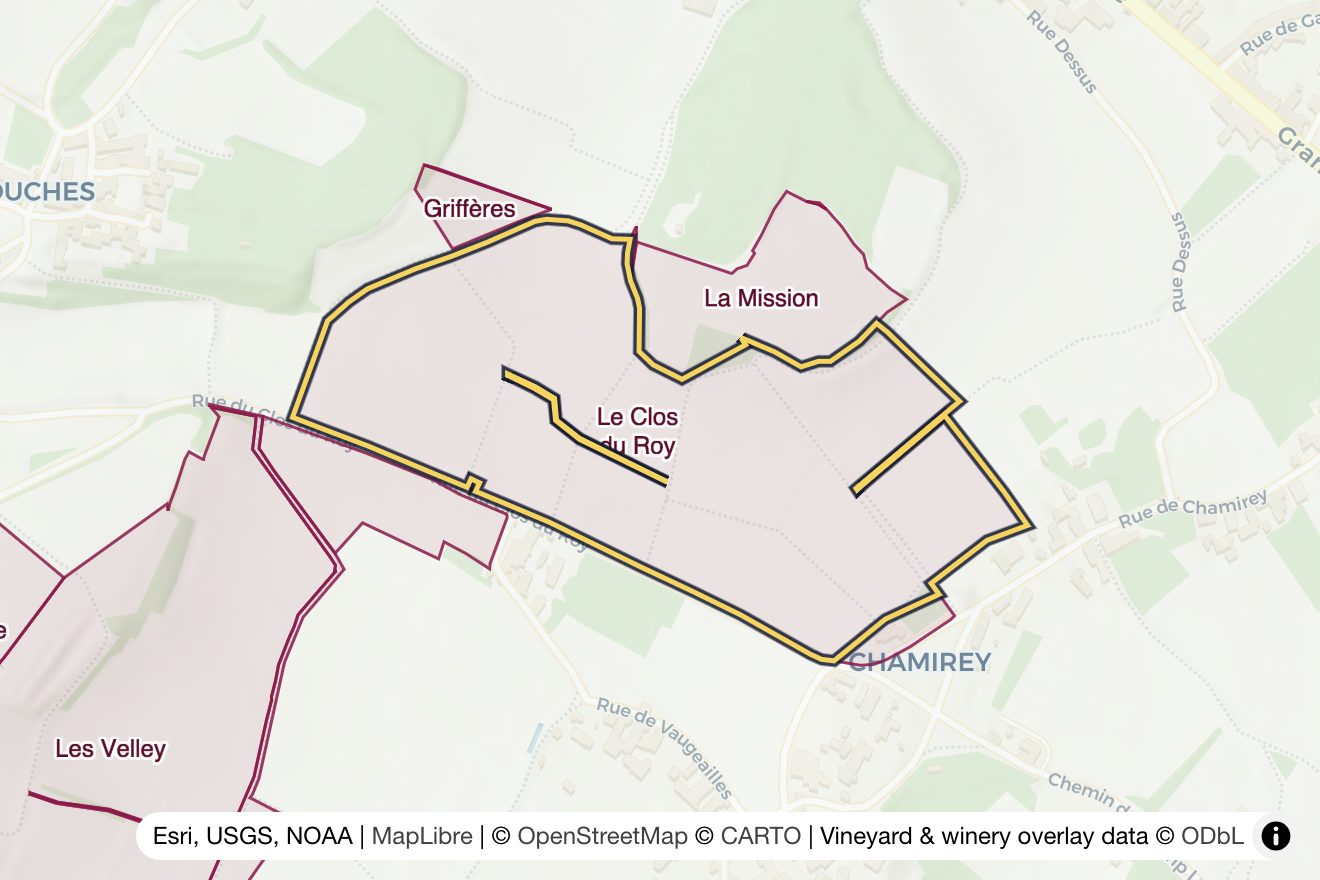
Almost every corner of Burgundy has a Clos du Roy or Clos du Roi, and almost none of them agree on which sovereign is meant. Mercurey's is no exception. Domaine Faiveley's account puts the parcel in the hands of the kings of France. The general Burgundian reading points to the dukes. Maison Chanzy states flatly that the site belonged to the du Montaigu family, whose name still attaches to two other Mercurey premier crus. The trade literature has never settled it, and no continuous wall now encloses the ground, so the word clos survives here as a title rather than a structure. What is not in dispute is the standing. When the appellation first singled out its best ground, Le Clos du Roy was in the founding group of five, alongside Clos Voyens, Clos Marcilly, Clos des Fourneaux and Clos des Montaigus. French appellation records date that recognition to 1943, seven years after the AOC decree; Domaine Michel Juillot's own account moves it back to 1936 and calls Clos du Roy the first premier cru named in the commune. The wider delimitation that produced today's 32 climats came later, extended in 1988.
The shape of the climat
Measured from the delimitation, Le Clos du Roy covers 10.84 hectares, which makes it the fifth largest of Mercurey's 32 named premier crus, behind Le Clos l'Evêque, Sazenay, Les Champs Martin and Les Velley. Its centre falls at roughly 46.8276 north, 4.7217 east, immediately above the built village of Mercurey, on the ground rising north out of the Giroux valley.
It is not one block. The delimitation is cut into three separate pieces: a main body of 9.86 hectares, a detached parcel of 0.94 hectares lying about 250 metres east-south-east on the Chamirey side, and a fragment of roughly 40 square metres, the sort of orphan left when a road, track or cadastral line is redrawn around it. This is the normal condition of a Burgundian climat rather than an oddity. The name describes a legal envelope agreed between growers, surveyors and the INAO, and envelopes acquire ragged edges. Griffères and Les Velley border it to the west and south-west, La Mission to the north-east, and village-level Mercurey takes over below on the valley side.
Relief here is nothing like the Côte d'Or. Terrain modelling across the climat gives a fall of about six percent, from around 265 metres along the north-western boundary down to roughly 239 metres at the eastern foot. Michel Juillot records its own vines at 249 metres, which sits neatly inside that band. The ground drops away to the south and to the east, so the site reads as a broadly south-facing bench with an easterly tilt. Faiveley calls the exposure south-south-west, Chanzy calls it south to south-east, and on a gradient this soft both can be true of different rows.
Ground
The Mercurey syndicat sorts its vineyard into five soil families, and Le Clos du Roy belongs to the third: 40 centimetres to two metres of stony cover over clay-bearing marl, a group running to about 190 hectares across Mercurey and Saint-Martin-sous-Montaigu. The base is Jurassic marine sediment, much of it Bathonian.
Growers fill in the detail and do not entirely agree, which is what ten hectares of Burgundy usually produces. Michel Juillot reports clay-limestone with marl, gravel and loose surface stones. Faiveley describes a cool, compact clay-limestone over white marl that warms quickly. Domaine Charton, farming 0.88 hectares, describes barely calcareous marl sitting on hard limestone carrying chailles, the silicified nodules it credits for a chalky cut in the finished wine. Clay is the constant, and clay drains slowly. That single fact does most of the explaining for the style: darker fruit and firmer tannin than the Côte Chalonnaise average.
Who has it, and what they make
For a Côte Chalonnaise premier cru the ownership list is unusually heavyweight. Château de Chamirey, the Devillard family's estate, holds around 3.3 hectares in four adjoining plots planted between 1970 and 2002, close to a third of the whole. Faiveley bought in during 1971 and farms 2.54 hectares planted in 1971 and 1982. Charton has 0.88 hectares. Michel Juillot works vines set in 1972, 1980 and 1995 and declares a production counted in a few hundred bottles plus magnums. Maison Chanzy bottles both colours. Publicly reported holdings alone account for roughly two thirds of the climat, and that concentration is why Le Clos du Roy reaches export markets far more reliably than most Mercurey premier crus.
Pinot Noir has most of the ground, but the appellation covers Le Clos du Roy in white as well, and Chardonnay versions from Chanzy and Charton are made in small quantity. Chanzy's is pressed slowly, fermented in 228-litre barrels, given ten months in wood and a further five in steel.
The reds are the reason the site is talked about. Compact clay, a gentle south-tilted bench and reliable warmth give a wine built on black fruit rather than red, with oak spice from the 20 to 35 percent new barrel most estates apply, and a tannic frame that reads as structural rather than merely grippy. Faiveley makes the boldest claim on the site's behalf, that the terroir yields tannins worthy of the great villages of the Côte de Nuits. Producers generally guide seven to ten years of cellaring, and the better bottles hold that line.