Reading the Name
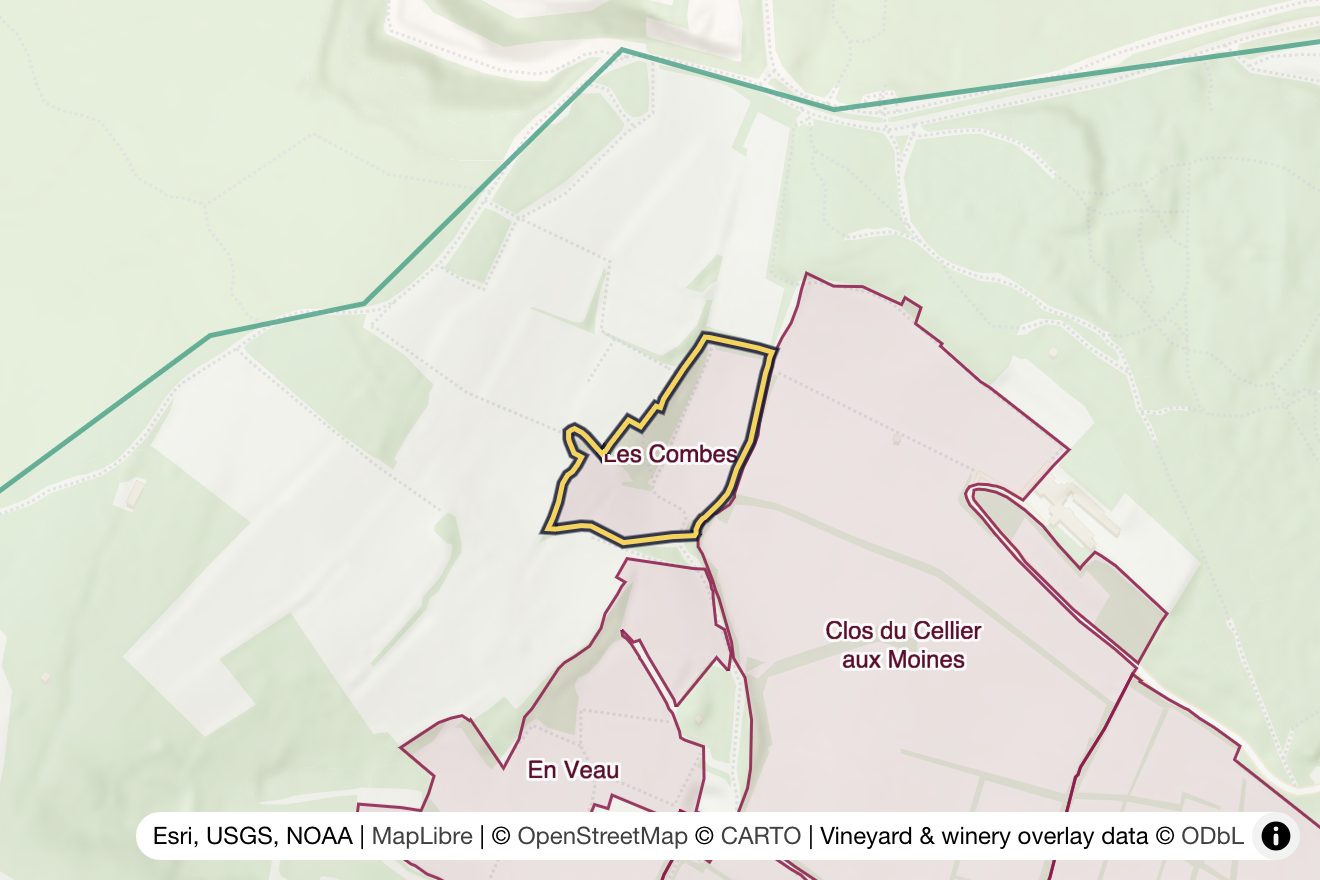
In Burgundian usage a combe is a short dry valley bitten back into the côte, and the plural here is descriptive rather than decorative. The ground around this climat is genuinely folded. The ridge immediately to the west stands above 350 metres; a hollow drops away to roughly 305 metres a few hundred metres to the north; the climat itself occupies the shoulder left between them, running from about 282 metres at its lower corner to about 326 metres at its upper one. The service track still carries both of the local names together: the Chemin de Servoisine et des Combes.
Position, Slope and Soil
Les Combes sits on the hillside above the hamlet of Varanges. Its neighbours are the best company this end of the appellation can offer. The Clos du Cellier aux Moines lies roughly 250 metres to the south-east and lower down the hill; En Veau is about 270 metres to the south-south-west; the Servoisine is some 570 metres to the south-east. Givry's vines run from around 220 metres to 370 metres in altitude, which puts Les Combes in the upper half of that band and above the Cistercian clos next door.
The fall is to the south-east, dropping about 44 metres across the 250 metres of the diagonal, a gradient close to 18 percent. Domaine Déliance, which farms here, records the exposure on its own technical sheet as south and east.
Underneath lies the standard Givry sequence: Upper Jurassic limestone, with Middle Jurassic beds and Liassic marl exposed wherever the small valleys have cut through, and working soils that are argilo-calcaire. The shape of this whole stretch of côte owes more to the fault system thrown up around the Mont-Saint-Vincent horst than to any simple tilted slab, which is why the slope breaks into shoulders and hollows instead of running smooth.
One Block, Few Hands
Les Combes measures 1.65 hectares and, unusually, arrives as a single unbroken block roughly 183 metres by 167 metres. That is worth pausing on. Most Burgundian climats reach the modern cadastre in pieces, and Givry's own Clos Jus is mapped in four; a premier cru that has stayed whole is the exception.
Ownership is correspondingly concentrated. Domaine Déliance, a third-generation family estate based at Dracy-le-Fort, works about a hectare of it, with vines given on its literature as 10 to 20 years old. The fruit is picked by hand, entirely destemmed, macerated according to the vintage, and raised for a year in barrel with a quarter new wood. The climat name also appears on bottles from Louis Baisinbert, so it is not the property of a single house, though the list of holders is short. Both red and white are registered with the INAO for Les Combes; what actually reaches the market is Pinot Noir.
The youth of the vines shows in the glass, and the estate says so plainly. The wine reads bright rather than dense: ruby, red and black fruit, a sharp freshness the domaine attributes directly to vine age, fine tannin, decent length. Set against the dark, iron-stained reds that come off the Clos Jus slope at the Dracy end of the appellation, this is Givry's lighter-footed side, closer in build to the perfumed wines of the Servoisine and Cellier aux Moines sector it belongs to than to the appellation's more structured crus.