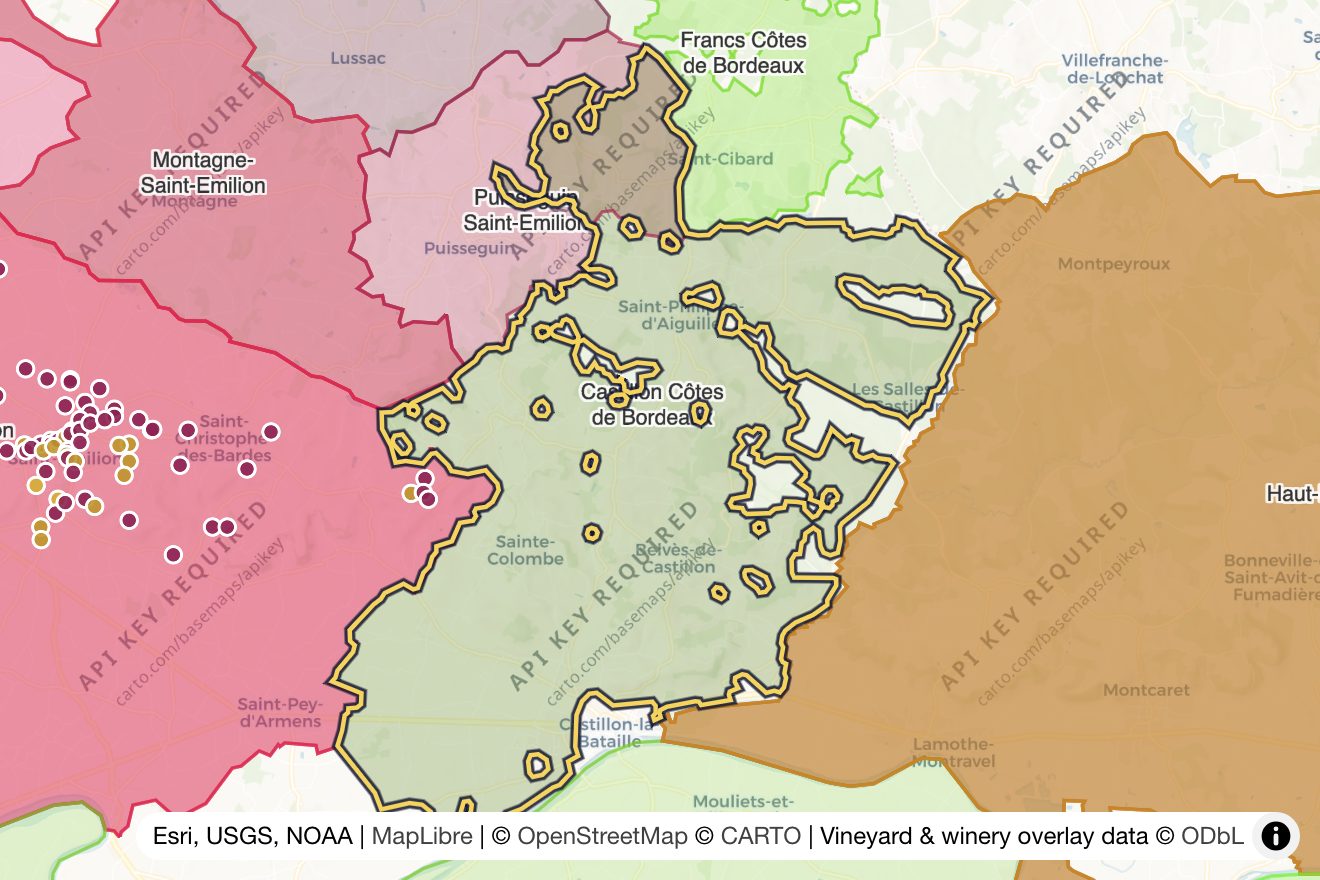
Overview
Castillon Côtes de Bordeaux covers roughly 2,300 hectares immediately east of Saint-Émilion, where the same limestone plateau and clay-limestone slopes continue across the appellation line. Merlot-led and long overshadowed, Castillon has become the right bank's most argued-for value zone: a place where Saint-Émilion winemakers, working identical geology at a fraction of the land price, produce wines that compete above their appellation.
History
The town of Castillon-la-Bataille takes its name from the 1453 battle fought on its plain, the engagement that ended the Hundred Years' War and returned Aquitaine to France. Its vineyards, part of the Libournais trade for centuries, carried the Côtes de Castillon name through the twentieth century before joining the collective Côtes de Bordeaux appellation in 2009 as its Castillon designation. The modern reputation dates from the 1990s and 2000s, when consultants and proprietors from Saint-Émilion, Stéphane Derenoncourt at Domaine de l'A and the d'Aiguilhe project among the first, demonstrated the plateau's potential.
Terroir & Climate
Castillon's geology is its argument: the Saint-Émilion limestone plateau and its clay-limestone côtes run directly into the appellation's western and northern sectors, with cooler clay and sand toward the Dordogne plain in the south. Elevation reaches above 100 metres on the plateau, high for the right bank, adding freshness that warm vintages have turned into an asset. The climate is the Libournais maritime pattern with a slightly more continental edge inland.
Grape Varieties & Wine Styles
Merlot dominates at around three-quarters of plantings, with Cabernet Franc the quality partner and Cabernet Sauvignon minor. Plateau and côtes wines are the appellation's face: dark cherry and plum over limestone freshness, mid- to full-bodied with fine tannin, ready at three to five years and holding a decade or more from the leading estates. The plain yields simpler, earlier wine that anchors the appellation's volume.
Notable Producers
Château d'Aiguilhe of the von Neipperg stable and Domaine de l'A lead the modern canon, with Clos Puy Arnaud's biodynamic plateau wines, Montlandrie of the Durantou family, Joanin Bécot, Cap de Faugères and Poupille among the appellation's strongest names; new Saint-Émilion investment continues to arrive.
What to Know
The appellation line between Saint-Émilion and Castillon is administrative, not geological, and the plateau estates trade on that fact. Producer selection matters, since the appellation spans plain and plateau under one name; the names above are the shortcut. Castillon remains one of Bordeaux's clearest expressions of the value gap between land classification and land itself.