What the Name Records
Spiegel is simply the German word for mirror, so the site is named for light rather than for a family, a chapel, or a landholder. What the mirror refers to is argued. The conservative reading treats it as shorthand for a well-lit hillside, an aspect that takes sun early and holds it. The version the appellation and its estates prefer is more literal: quartz sits in the sandstone pebbles scattered across the surface, and those crystals catch the rising sun and throw it back up into the fruit. That reading is unprovable and a little too neat, but it at least points at something physically present in the ground, which is more than most Alsatian vineyard names manage. The word is common enough in German-speaking wine country that unrelated Rieden carry it in Austria; the Alsace Grand Cru is one delimited site in the Haut-Rhin and shares nothing with them beyond the noun.
Position and Ground
The cru sits about 20 kilometres south-southwest of Colmar, centred near 7.2360 East, 47.9179 North, on the bench that runs along the faulted eastern margin of the Vosges where the range drops into the Rhine graben. Altitude runs from about 260 to 315 metres, a vertical span of only 55 metres, and the gradient is correspondingly mild. Nothing here approaches the punishing pitch of Kitterlé. Official records give the exposure as east, which is accurate for the delimitation as a whole but flattens the real variation across it: sections swing south-southeast, and individual parcels sit close to due south.
The geology explains why the site behaves better than its modest slope suggests. Two layers matter. The lower one is Oligocene, laid down in the Latdorfian that older French literature calls the Sannoisien: a conglomerate built mostly of sandstone pebbles, with marl beds running through it. Above that, shed from the higher ground behind and covering the bench only in patches, sits scree and colluvium off the Triassic Vosges sandstone. What the vine roots into is therefore a sand-and-clay blend, stony at the surface and quick to warm, but seated on a marl-rich base that holds water far better than the sandy top would imply. That pairing is the site's real asset: enough drainage and reflected warmth to ripen, enough reserve beneath to avoid hydric stress in dry summers. Kessler on its Vosges sandstone runs warmer and faster; Saering on its limestone drives more acid; Spiegel holds a middle line.
Three Parcels, and a Quarter of the Surface Claimed
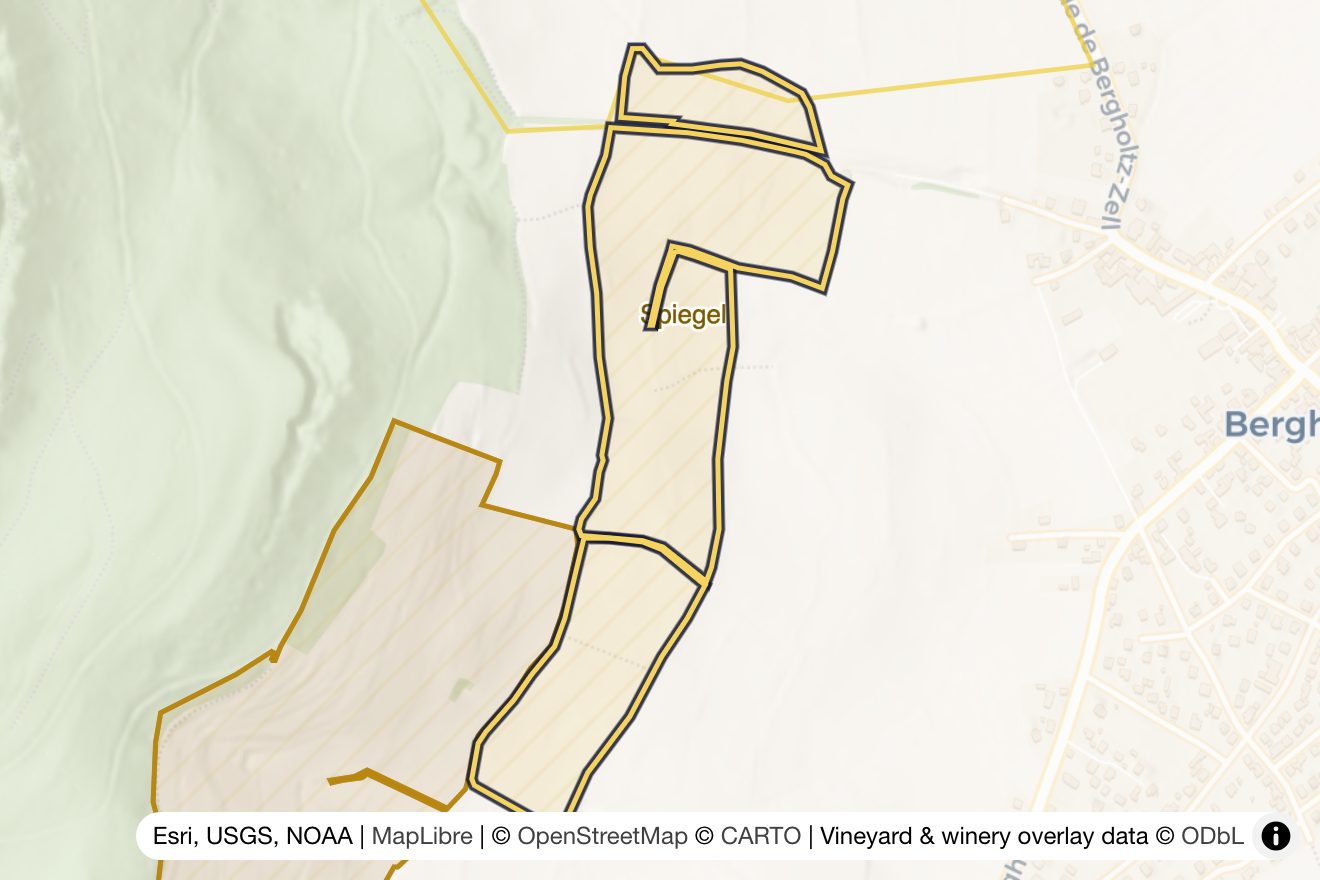
Measured geodesically from the official INAO parcel layer, the delimitation covers 17.4 hectares in three separate parcels. Published figures usually give 18.26 hectares, a difference that reflects what is being counted rather than any dispute over the boundary. The three-parcel shape is worth dwelling on, because it is characteristic of how Alsace Grand Cru lines were drawn. The committees traced vine-worthy ground, not tidy geometry, following the conglomerate bench where it carries good soil and cutting around the gullies, colluvial fans, flat valley floor, and built land that interrupt it. A Grand Cru boundary in Alsace is a geological judgement rendered as a cadastral outline, and Spiegel shows the seams.
Declared production tells a second story. Recent vintages have seen roughly 4.75 hectares actually harvested as Grand Cru, yielding around 227 hectolitres, which puts the working cru at about a quarter of its delimited surface. Much of the remainder is planted to varieties the appellation does not admit, or declared down to generic Alsace. Growers who do claim the name work to a ceiling of 50 hectolitres per hectare, 40 for Sélection de Grains Nobles, on vines planted at a minimum density of 4,500 to the hectare.
Varieties and Growers
Four varieties qualify: Riesling, Pinot Gris, Gewurztraminer, and Muscat, with Gewurztraminer the most widely planted. Placement follows a practical logic. Riesling and Muscat, which need ripening help and reward it with acid, take the parcels turned furthest south; Pinot Gris and Gewurztraminer ripen readily enough that exposure matters less to them.
Domaines Schlumberger is the largest holder with five hectares, and treats Pinot Gris as its flagship from the site. Domaine Dirler-Cadé, in Bergholtz and biodynamic across its whole estate since 1998, works one of the smallest plots in the appellation: 0.19 hectare of Muscat, nearly all of it Ottonel with a little Muscat d'Alsace, in the stony corner the village calls Stein. Three plantings once stood there. The oldest, Muscat d'Alsace put in during 1963, was pulled out in 2012, and what survives dates from the 1990s and the early 2000s. Domaine Loberger, also in Bergholtz, farms eight biodynamic hectares in total, holding parcels here alongside Kitterlé and Saering. Lucien Albrecht, founded in 1698, bottles both a Riesling and a Gewurztraminer from the cru, and the Wolfberger cooperative handles volume.
A Biodynamic Pioneer Farms Here
Domaines Schlumberger dates the first written mention of the site to the fifteenth century, but Spiegel's sharpest historical claim is recent. Domaine Eugène Meyer, in Bergholtz, turned to biodynamics in 1969 after pesticide poisoning paralysed Eugène Meyer's optic nerve, among the earliest estates in France to make that move. Classification came fourteen years after the conversion, in the decree of November 1983 that added twenty-four sites to Schlossberg and built out the Alsace Grand Cru appellation. On this hillside, the biodynamics arrived before the Grand Cru did.