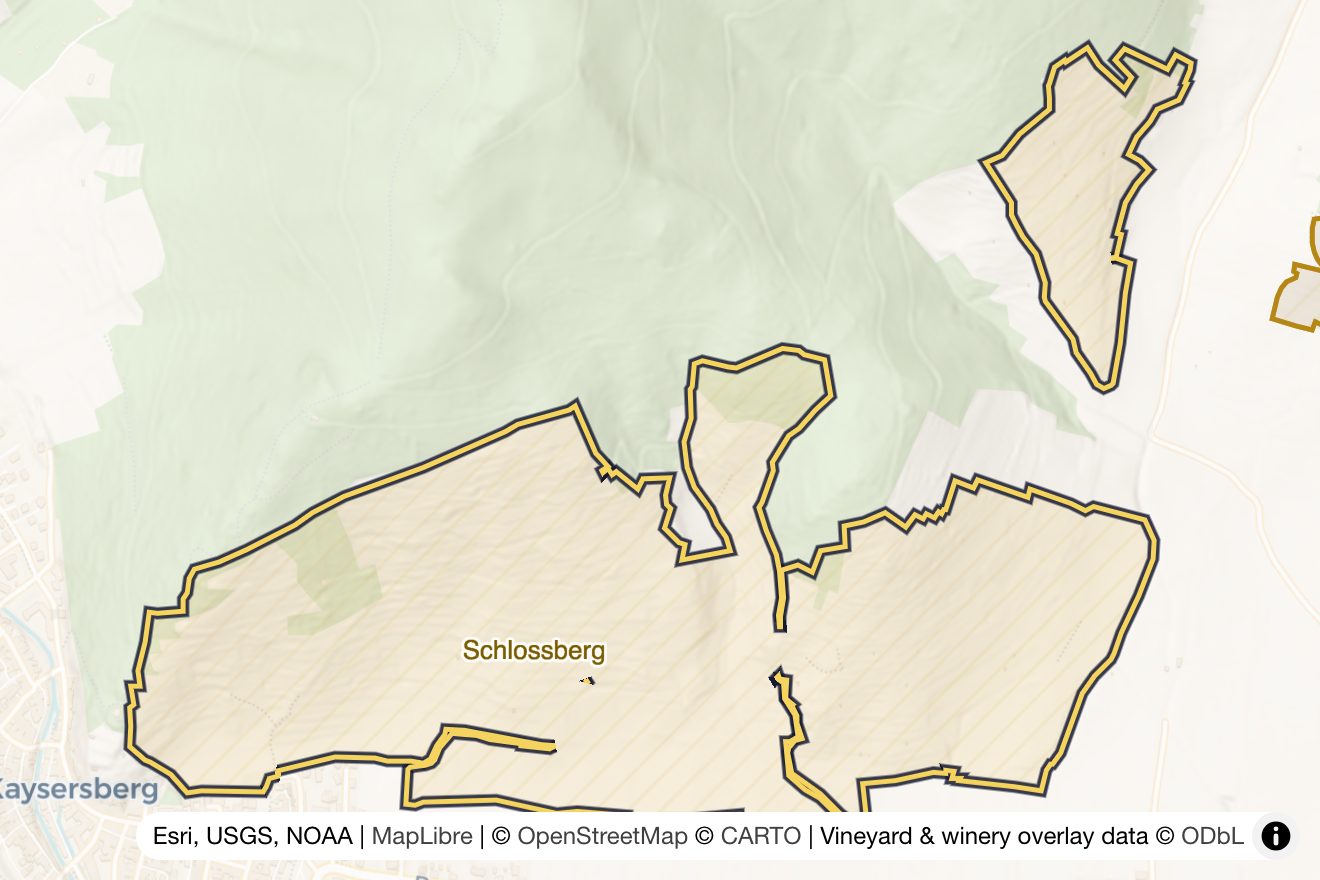
The Hill, the Name, the Exposure
The name is straightforward and literal: this is the hill with the castle on it. The ruined keep of Kaysersberg stands above the western end of the vineyard, and the lieu-dit attached to the ground beneath it was already being written down in the fourteenth century. The delimited ground lies on the territory of Kientzheim, which in 2016 was merged with Kaysersberg and Sigolsheim into the single commune of Kaysersberg Vignoble, and it faces the valley of the Weiss where that river leaves the Vosges for the Rhine plain. The centre of the delimitation falls near 48.140 N, 7.276 E.
Vine runs from roughly 230 metres at the base to about 400 metres at the top edge. The face is not uniform: Bixkoepfel carries the main body of the cru and takes the south and south-southeast, while a smaller detached block at Kirrenbourg, north of the Streibach valley, turns east and ripens on a different clock. The gradient across much of it is too severe for unterraced planting, and the hill carries more than a kilometre of dry-stone retaining wall holding the ground in courses. Much of that masonry is medieval in origin, and restoration continues today, and the terrace faces now function as a habitat corridor as much as a soil defence.
Rainfall here runs between 500 and 600 millimetres a year, among the lowest of any French viticultural zone, because the Vosges strip the westerlies before they arrive. Mean annual temperature clears 10°C, with the nearby Colmar station averaging 11.3°C over 1991 to 2020. Late in the season, cool air moving off the valley floor below Kaysersberg stretches out the final phase of ripening.
Granite That Weathers to Grit
The bedrock is the Kaysersberg migmatitic granite: a biotite-bearing rock with a metamorphic history, gneiss and granite interleaved rather than a clean plutonic mass, carrying enclaves of colourless amphibole and calcic pyroxene. What matters at root depth is what that rock becomes. It breaks down to arène, a coarse granitic grit, and the resulting profile is sandy and silty with a fine fraction too small to change its behaviour.
Depth follows the slope. At the upper terraces the working soil is 30 to 40 centimetres over rock; toward the base, where colluvium and alluvium have collected, it reaches 125 centimetres. The pH sits in a mildly acid band between 6.1 and 6.9. Potassium, magnesium, phosphorus and fluorine are all present in useful quantity; organic matter is not. Neither is water. The profile drains almost as fast as it receives, and reserves nothing.
That pairing, mineral wealth with no water buffer, is the whole argument for the site. It also separates Schlossberg cleanly from its immediate neighbours: Furstentum, Mambourg and Marckrain sit on the same chain of hills but on calcareous ground. Several producers farm both, which makes the granite signature legible in a way it rarely is elsewhere.
Not One Continuous Block
The measured delimitation covers 78.5 hectares. The figure published by the growers' body and used throughout the trade is 80.28 hectares, and both are correct in their own terms: one measures the decreed aire parcellaire geodesically, the other is the conventional administrative total. Planted vine in 2024 came to 43.35 hectares, barely more than half the delimitation, the balance being rock outcrop, terrace face, track and wood.
The fragmented shape of that delimitation deserves stating plainly, because it is normal for Alsace and misleading if unexplained. Grand Cru boundaries here were drawn around ground judged capable of the wine, not around a hill. The main body on the Bixkoepfel face excludes peripheral parcels to the east, north-east and south-east, and the eastern holding at Kirrenbourg sits apart from it entirely. Where granite gives way to valley-floor alluvium, where the gradient flattens, where woodland cuts the face, the line steps out and returns. The largest Grand Cru in Alsace is a set of qualifying fragments rather than a single sweep of slope.
Riesling, and Why It Holds the Ground
Plantings run 76 percent Riesling, 13 percent Gewurztraminer, 10 percent Pinot Gris and 1 percent Muscat; no other variety may carry the name. That Riesling share is not habit. On a fast-draining, heat-holding granite face, Riesling keeps its acid while reaching full ripeness, and the wines come out built narrow and long rather than broad, with the tension carried structurally rather than by residual sugar.
Minimum planting density is 4,500 vines per hectare, and growers on the terraces commonly plant tighter. Harvest must be by hand, enrichment of the must is prohibited, and the yield ceiling has been cut twice, from 70 to 55 hectolitres per hectare in 2001 and from 55 to 50 in 2022. The 2024 crop came in at 28 hectolitres per hectare, 1,206 hectolitres in total. Growers here agreed written harvest conventions among themselves in 1928, half a century ahead of the appellation, and Schlossberg wine was already going into bottle under its own name by the end of the nineteenth century.
The Growers
Domaine Weinbach works from the Clos des Capucins, a walled enclosure of seventeenth-century Capuchin origin at the foot of the hill, in Faller hands since 1898. The estate reads the slope vertically: the straight Riesling Schlossberg from the upper terraces and their shallow soils, Cuvée Sainte Catherine from old mid-slope vines, and L'Inédit from mid-slope vines of around sixty years. A Pinot Noir "S" comes from old mid-slope plantings, sold without the Grand Cru name since the variety is not admitted.
Paul Blanck, based in Kientzheim, traces its vines to Hans Blanck in 1610 and was constituted as an estate in 1921. Paul Blanck began pressing the case for Schlossberg with his neighbours in 1927, and his son Marcel led the growers' syndicate that carried the 1975 decree. Cousins Frédéric and Philippe now run it, farming without chemical inputs. Their Schlossberg sits alongside holdings in Furstentum, Mambourg, Sommerberg and Wineck-Schlossberg, a genuinely useful set of controls on both soil and granite type.
Albert Mann, from Wettolsheim, farms a parcel here biodynamically (practised since 1997, certified 2010) with vine ages spanning fifteen to over sixty years, bottled as a Schlossberg Riesling and as the sweet l'Épicentre.
Trimbach came late, buying about two hectares of terraced ground below the castle in 2012 and releasing a first vintage in 2014. Marcel Deiss works a single hectare on his co-planted model, Riesling with the other permitted varieties interspersed. Joseph Fritsch, a Kientzheim family on the wine since 1703, holds Schlossberg alongside Furstentum, and the Bestheim cooperative bottles the site at volume. Schlossberg can therefore be met at almost any price point without leaving the hill.