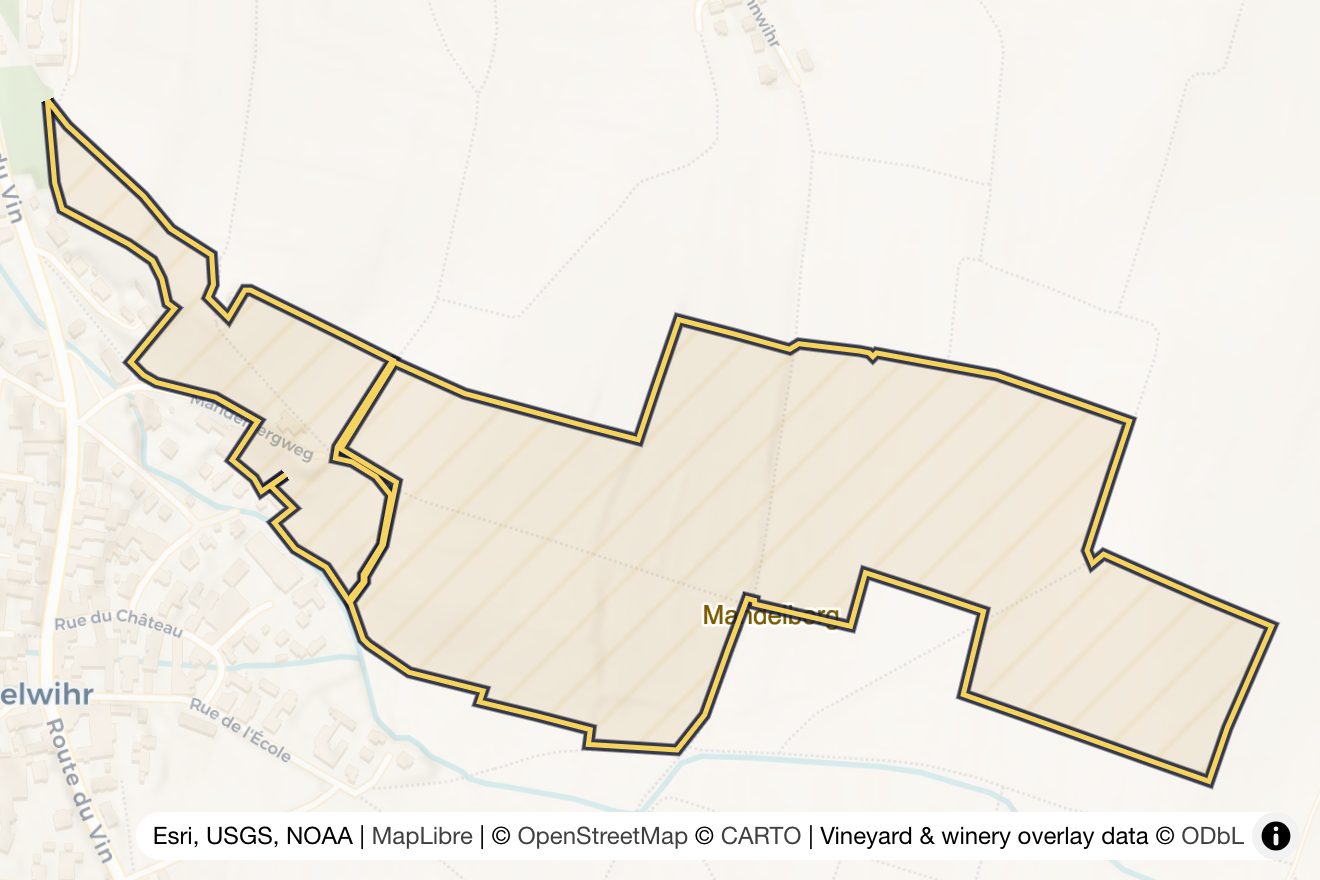
Mandelberg is the almond hill: Mandel for the nut, Berg for the rise it grows on. The tree is not decoration. Almonds need a frost-poor spring and a long warm autumn, and their persistence on this slope, at a latitude and altitude where they have no business thriving, is the oldest surviving evidence of what the site does. Growers here read the almond as an instrument. Local tradition ties the trees to Charlemagne, who is said to have halted at Mittelwihr, eaten almonds, and left the shells behind for the hillside to germinate. That is legend rather than record. The vineyard itself is another matter: it was worked in the Gallo-Roman period, and through the Middle Ages the abbeys of Saint-Dié, Ebersmunster and Murbach held ground here alongside the Frankish and later noble lords. The name reached wine labels in 1925, some sixty-seven years before the decree of 17 December 1992 raised the slope to grand cru in the tranche that roughly doubled the size of the Alsace classification.
Position, Relief and the Vosges Gap
The cru sits between two villages, immediately north of Mittelwihr and south of Beblenheim, on the last swell of hillside before Alsace flattens into the Rhine plain. Elevation runs from about 205 metres to 256 metres, a band of barely fifty metres. The relief is not uniform across that band. Nearest the village the ground steepens where the Sembach stream, draining the Riquewihr depression, cut into the flank; Bott-Geyl records a 15 to 25 percent gradient on its parcel. Toward the top the slope eases into a plateau. Mandelberg earns its classification through aspect and shelter rather than through the vertigo of a Rangen or a Schlossberg.
Exposure is dominantly south, swinging southeast toward the plain and southwest at the margins. Two things sharpen this. The Vosges stand only two to three kilometres west, close enough to cast a hard rain shadow yet angled such that the slope keeps late afternoon and evening light rather than losing it to the ridgeline. That plateau at the top, meanwhile, does defensive work: it faces north and takes the cold air before it can settle on the vines below. The combination produces a site that ripens early and reliably, which is precisely the condition the almond trees advertise.
Oligocene Conglomerate and Dolomitic Stone
The bedrock is the reason Mandelberg behaves as it does. When the Rhine graben pulled apart during the Oligocene, the rising Vosges shed coarse debris eastward along the fault margin, and that debris cemented into conglomerate: a matrix of marl and limestone packed with pebbles, some rounded by transport, others angular and barely travelled. Weathering has turned the surface into a brown calcareous soil that is stony throughout rather than stony only at the top.
Two consequences follow. Stone that size drains fast and heats fast, which is half the early-ripening story. The other half is buried: below the pebble layer, marl and clay bank enough moisture that a dry August does not shut ripening down, the failure mode of thinner limestone slopes nearby. Many of the conglomerate clasts are dolomitic, and the appellation literature describes the marl-limestone soils as enriched with magnesian dolomite. Bott-Geyl classifies its holding outright as sol brun calcimagnésien, brown calcimagnesian soil. That magnesium alongside the expected calcium is an unusual signature among the Alsace crus, and growers here consistently invoke it to explain the saline, slightly bitter grip on the finish of the best bottles.
This puts Mandelberg in useful contrast with its neighbours. Sporen and Schoenenbourg at Riquewihr sit on far heavier marl and gypsum-bearing clay, and give broader, slower, more brooding wines. Sonnenglanz at Beblenheim shares the marl-limestone family but with less stone and more mass. Mandelberg is the leaner, quicker, more transparent expression of that geology.
A Delimitation in Four Parcels
Mandelberg is not one continuous block. The appellation is drawn across four named parcels of ground, and the shape follows vine-worthy soil rather than the outline a walker would trace on the hill. One parcel is the Mandelberg proper, in Mittelwihr, with built-up ground and the southeastern fringe excluded. The other three lie in Beblenheim under their own cadastral names: Bennwihrerweg on its southern flank, Haering to the southeast, and Neustatt to the south. Ground that failed the geological and exposure tests was cut out, leaving gaps in the middle of what looks from the road like a single slope.
The area figures need care, because three different numbers are all defensible and they measure different things. The CIVA publishes 20 hectares; 22 hectares circulates just as widely in reference works. Measured geodesically from the official INAO parcel layer, the delimited polygons total 12.1 hectares. Declared production area, the acid test of what is actually in vine and actually claimed, runs lower again: 10.01 hectares in 2022, 9.9 in 2023, 8.79 in 2024, with yields of 38 to 42 hectolitres per hectare. The ceiling itself tightened in that window. The arrêté of 9 May 2022 cut the maximum for the fifty-one Alsace grand crus from 55 to 50 hl/ha, with the butoir dropping from 66 to 60 and Sélection de Grains Nobles held at 40. Read together, the numbers describe a small cru whose working footprint is under ten hectares, whichever delimitation figure you start from.
Varieties, Vine Age and Growers
By the CIVA's accounting, Gewurztraminer leads the plantings at about 54 percent, Riesling follows near 39 percent, and Pinot Gris takes most of the remaining 7 percent; Muscat is permitted and scarce. Other references give a flatter split, but the ranking is stable. The logic holds either way: warm, magnesium-rich, calcareous stone gives Gewurztraminer aromatic lift without the heaviness it acquires on deeper marl, while Riesling finds enough limestone tension here to stay upright in a warm site.
Trimbach works a hectare in the Mittelwihr section, in the house's hands since the mid-1990s. Trimbach itself describes the vines as over sixty years old; its American importer averages the parcel at forty-five-plus, which suggests a spread rather than a single planting. Some trade listings put the holding nearer 1.6 hectares. The house bottled the fruit as Cuvée M for two decades before finally accepting the grand cru name from the 2016 vintage, a notable concession from a producer long sceptical of the classification. Bott-Geyl, based in Beblenheim, organic from 2000 and biodynamic since 2002, draws Riesling off the southeast-facing calcimagnesian ground and treats the site as a purity exercise. Frédéric Mallo et Fils of Hunawihr, now farmed organically, holds parcels alongside its better-known Rosacker. Edgard Schaller et Fils and Burghart-Spettel are Mittelwihr addresses; the Mauler estate farms vineyards across several villages, including grand cru parcels in Mandelberg and Schoenenbourg; Baumann-Zirgel bottles a Demeter-certified Riesling from the site. The Cave de Beblenheim, along with Meyer-Fonné, Jean Huttard and Wolfberger, account for much of the rest.
Vine age across the cru is younger than its antiquity suggests. Mittelwihr was largely destroyed in the fighting of winter 1944 to 1945, and the replanting that followed reset much of the slope.