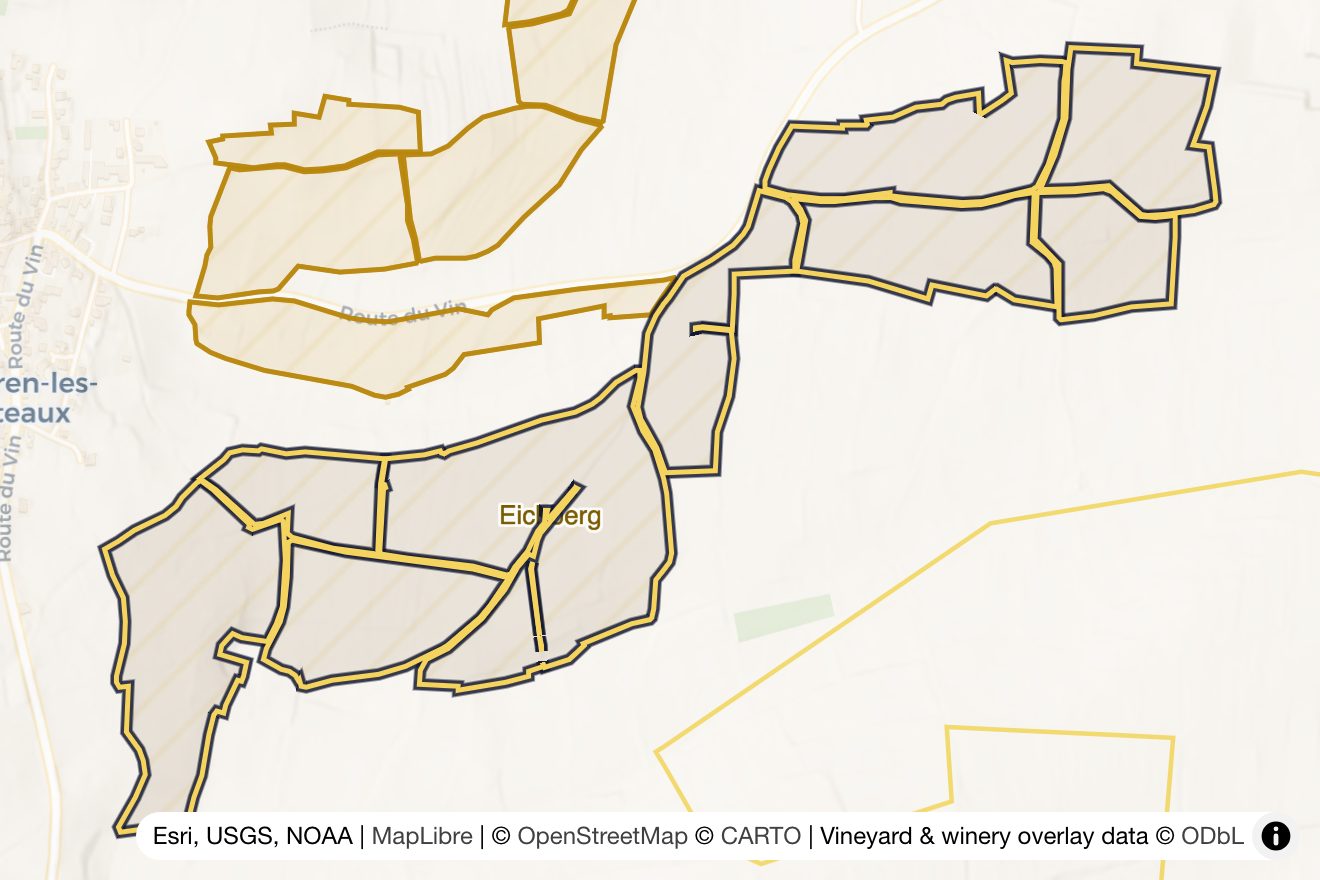
Position, Slope, and Thirteen Parcels
The cru lies wholly within the commune of Eguisheim in the Haut-Rhin, some six kilometres southwest of Colmar, climbing toward Husseren-les-Châteaux and the three ruined keeps that stand on the ridge above. Its centre falls near 48.0334 north, 7.2944 east. The delimited area is 57.62 hectares, of which only part is planted and declared as grand cru in any given year.
That delimitation is not a single block. It comes in thirteen separate parcels, and the fragmentation is the point: the boundary was drawn tightly around the soil and aspect that earn the classification, then made to skirt everything that does not. Farm tracks, hollows that trap cold air, wooded gullies, alluvial fans of the wrong composition, and stretches of thin or waterlogged ground all fall outside the line. A reader looking at the cadastre sees a scatter rather than a shape, which is an accurate picture of how the hill actually varies.
Altitude runs from about 220 metres to about 340 metres across two adjoining flanks: a lower eastern slope below Eguisheim, roughly 220 to 260 metres, and a higher western flank east of Husseren that climbs from around 260 metres, reaching about 340 metres at the top. Exposure is south to southeast, within the broader east-to-southwest band that the appellation text uses to describe the well-exposed sub-Vosges hillsides it delimits.
What separates Eichberg from the region's more theatrical sites is not angle but depth. Where the Rangen or the Mosel's terraces leave vines little beyond fractured rock, Eichberg carries a thick, clay-heavy profile above its bedrock, and that reserve of soil is precisely what the site trades on.
Oligocene Marl and Conglomerate
The substrate is Oligocene, laid down some thirty million years ago as the Rhine graben dropped and the rising Vosges shed their debris eastward. Marl provides the fine fraction; calcareous conglomerate provides the coarse, its pebbles a mixed inventory of limestone, Vosges sandstone, granite, and quartz. At the foot of the hillside the same materials have been reworked into colluvium, and the scree within it does not rest straight on the conglomerate: a bed of yellow clay of uneven thickness holds the two apart.
The two hillsides differ. On the eastern slope the working soils are developed on Oligocene calcareous conglomerate and marl, with colluvium of the same nature at the foot of the hill. The western flank carries leached alluvio-colluvial soils, stony and calcic in places, sitting on the Oligocene marl and conglomerate. Either way the result is a heavy soil threaded with stone: siliceous pebbles and rolled gravel through the upper horizons, calcareous material increasing with depth.
The climate completes the mechanism. The Vosges foothills take the weather off this corner of the côte, which posts the smallest annual rainfall totals recorded anywhere around Colmar, and the mesoclimate is warm as well as dry. Clay stores what little rain arrives; the stone sheds any excess and radiates heat back into the fruit. Ripeness without desiccation is the site's characteristic outcome, and it is why the wines come out weighted rather than merely ripe.
Varieties Matched to a Heavy Soil
The decree admits Riesling, Pinot Gris, Gewurztraminer, and the muscats (blanc à petits grains, rose à petits grains, and Ottonel). In practice Riesling, Gewurztraminer, and Pinot Gris account for effectively all of the planted area. Harvest is manual, minimum planting density is 4,500 vines per hectare, and yields for the still whites are capped at 50 hectolitres per hectare with a ceiling of 60; late-harvest wines are held to 50 and sélection de grains nobles to 40, both requiring at least eighteen months of élevage.
Clay is the reason for the match. Gewurztraminer, prone to flabbiness on generous ground, gains frame and spice here rather than losing them, and shows white pepper, ginger, and clove in ripe years. Riesling gains volume it rarely finds on limestone, and because Eichberg ripens slightly later than neighbouring Pfersigberg, acidity survives the extra breadth. Pinot Gris tends toward the mineral rather than the plush. Across all three, the pattern is broad at the entry and narrowing on the finish, and the wines close up for several years before they are worth opening.
Growers and Classification
Emile Beyer has farmed in Eguisheim since 1580 and bought into the Eichberg in the eighteenth century; the estate works 17 hectares across some 80 parcels, with two plots in this cru, and Eichberg together with Pfersigberg accounts for about a third of its plantings. Christian Beyer has run it since 1997 and gives his Eichberg over to Riesling. Paul Ginglinger, thirteen generations in the village since 1610 and certified organic across roughly twelve to thirteen hectares, bottles Eichberg Riesling, Gewurztraminer and Pinot Gris. Eich, Stribicher, Bodenacker, Obergrot and Alter Garten are among the lieux-dits the delimitation takes in, wholly or in part. Kuentz-Bas, Demeter-certified from the 2008 vintage, holds around ten hectares of biodynamic vines aged roughly 25 to 45 years and issues its Eichberg Riesling under the Trois Châteaux banner it reserves for single-vineyard and grand cru bottlings, the name taken from the keeps above Husseren. Charles Baur farms several parcels in the cru across Muscat, Riesling, Pinot Gris, and Gewurztraminer. Bruno Sorg, Léon Baur, and Gérard Schueller also bottle from the hill.
Eguisheim sent its wine down the Ill from Colmar and then the Rhine from Strasbourg to the courts of northern Europe in the fifteenth century, and the village gave the Church Pope Leo IX, born here in 1002. Eichberg was recognised by the decree of 23 November 1983, among the twenty-four lieux-dits that joined Schlossberg, classified alone in 1975, and it became a standalone appellation in 2011.