Overview
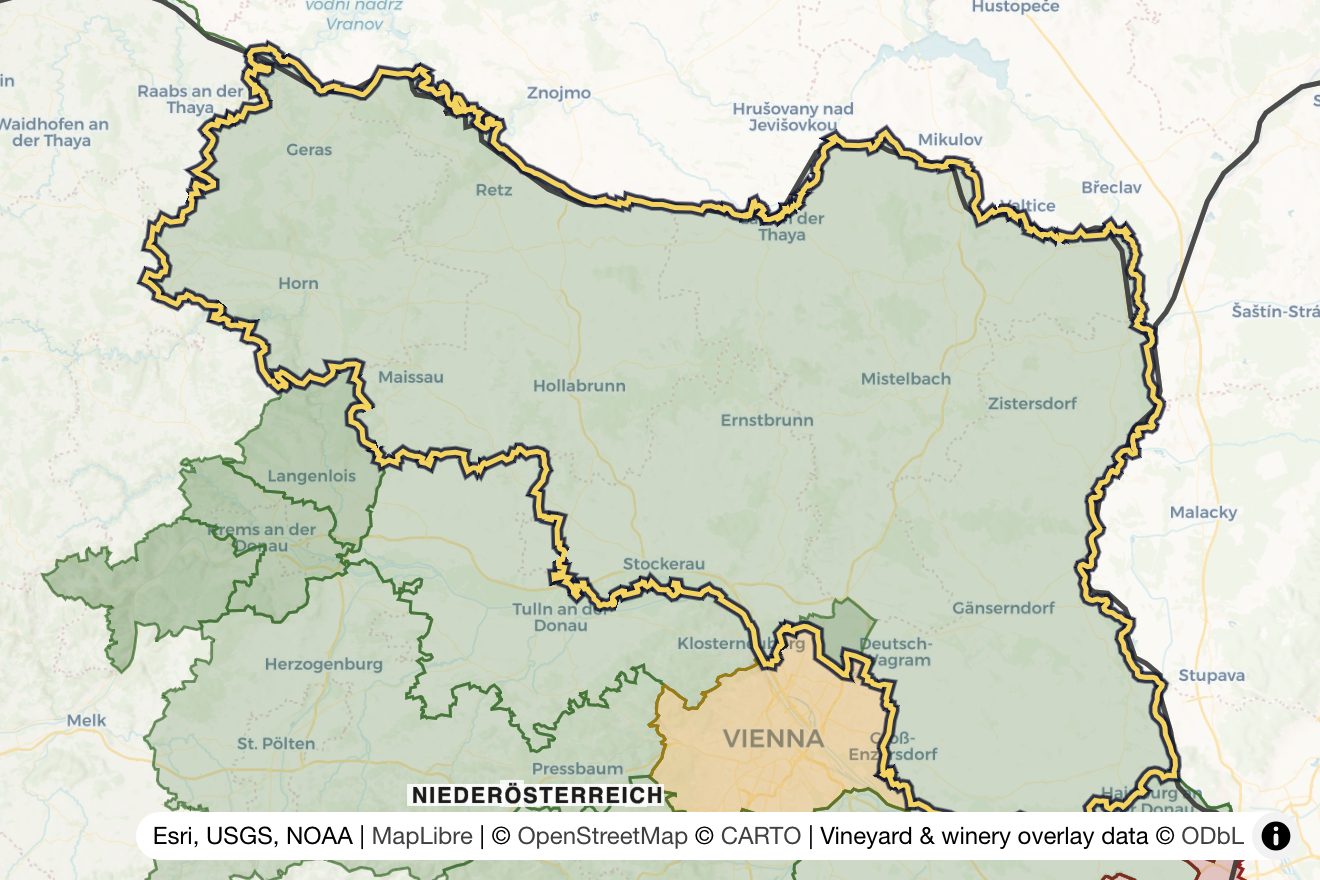
The Weinviertel, the "wine quarter" of Lower Austria stretching from the Danube north to the Czech border, is Austria's largest wine region at roughly 13,000 hectares, and the historical proving ground of its appellation system: Weinviertel DAC, created with the 2002 vintage, was the country's first. The DAC is reserved for Grüner Veltliner, and the region's rolling loess country produces the definitive peppery, everyday-to-serious expression of Austria's flagship grape.
History
The region's cellar lanes, the Kellergassen whose hundreds of wine-press alleys thread its villages, testify to centuries of smallholder viticulture serving Vienna and Moravia. Long a bulk source, the Weinviertel was chosen to pioneer the DAC concept precisely to convert quantity into recognizable identity: the 2002 designation defined a protective style, dry, unoaked, peppery Grüner, and a Reserve tier followed in 2009 for riper, more ambitious bottlings. A generation of estates has since raised the region's ceiling well above its jug-wine past.
Terroir & Climate
The Weinviertel is a broad plateau of loess, loam and scattered primary-rock and limestone outcrops, from the Danube's northern terraces to the Falkenstein and Retz hills. The climate is dry and continental, the Pannonian east warmer, the northwest around Retz nearly steppe-dry, with cold winters and pronounced day-night shifts that fix the region's aromatic snap. Deep loess and the cool northerly airflow together shape the classic profile.
Grape Varieties & Wine Styles
Grüner Veltliner occupies roughly half the vineyard and the whole of the DAC: the classic wine is light- to medium-bodied, dry and unmistakably peppery, the Pfefferl of the region's marketing, with green apple, citrus and lentil-savory notes; Reserve wines add body, ripeness and cellar span. Outside the DAC the region grows Riesling, Welschriesling, Pinot Blanc and, in its warmer pockets, Zweigelt and Blauer Portugieser, along with a substantial Sekt base-wine industry.
Notable Producers
Ebner-Ebenauer and Herbert Zillinger have carried the region into fine wine conversation; Pfaffl at Stetten is its largest quality house; Graf Hardegg, Setzer, Taubenschuss and Prechtl anchor the established tier, with cooperatives and negociants handling the broad base.
What to Know
Weinviertel DAC means Grüner Veltliner and nothing else; other varieties carry regional designations. The region is Austria's reliable value floor for the grape, and its Reserve and single-Ried bottlings from the leading estates now compete with the Danube regions at half the price. The pepper is varietal signature, not flaw, and most pronounced in the classic tier.