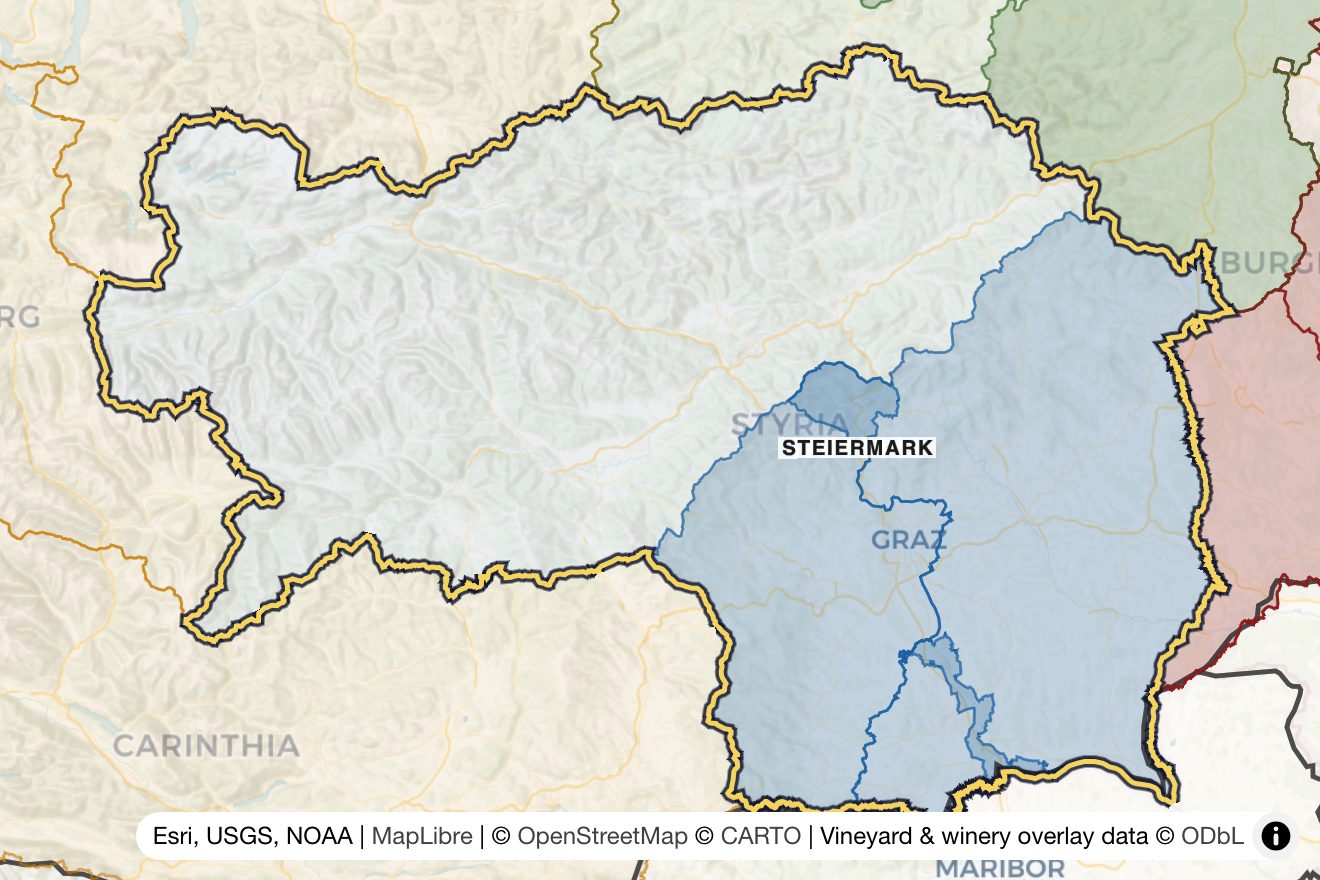
Overview
Steiermark, Styria, is Austria's southeastern wine country, a landscape of strikingly steep green hills along the Slovenian border, and the republic's white wine antipode to the Danube regions: its signature is Sauvignon Blanc, grown here to a standard that places the region among the variety's world benchmarks. Since 2018 its three DACs, Südsteiermark, Vulkanland Steiermark and Weststeiermark, organize roughly 5,000 hectares under a shared three-tier system of regional, village and single-Ried wines.
History
Styrian viticulture is ancient, but the modern region was effectively rebuilt after the 1985 wine scandal, which touched Styria little but reset Austrian wine wholesale; a generation of family estates, led by names like Tement and Sattlerhof, chose low yields and dry precision, and by the 2000s Styrian Sauvignon had entered international blind-tasting canon. The 2018 DAC framework codified the region's origin pyramid, attaching the famous Ried names, Zieregg, Nussberg, Hochgrassnitzberg among them, to the top tier.
Terroir & Climate
The hills are extreme by white wine standards, with gradients that demand hand work on slopes rising to 600 metres. Südsteiermark works limestone, marl and sand over opok, the region's clayey marl; Vulkanland's scattered volcanic cones give basalt and tuff; Weststeiermark's schist and gneiss host its rosé specialty. The climate is Illyrian, warm Adriatic-influenced days with cool alpine nights and generous rain, yielding aromatic intensity with structural acidity.
Grape Varieties & Wine Styles
Sauvignon Blanc leads: taut, saline, precise at village level, and in the great Rieds a full-bodied, mineral, age-worthy expression distinct from both the Loire and Marlborough. Welschriesling, Morillon, the local name for Chardonnay, Gelber Muskateller, Pinot Blanc and Traminer complete the white roster. Weststeiermark's identity is Schilcher, the sharp, vivid rosé of the native Blauer Wildbacher. Junge, fresh regional wines release early; Ried bottlings are held longer by rule and built for five to fifteen years.
Notable Producers
Tement at Berghausen is the region's international flagship, with Sattlerhof, Gross, Polz, Lackner-Tinnacher and Wohlmuth defining Südsteiermark; Neumeister and Winkler-Hermaden lead Vulkanland; Langmann and Strohmeier, the latter also a natural-wine reference, carry Weststeiermark.
What to Know
Styria is dry white country: no Prädikat sweetness tradition of note, no red ambition beyond the local. The DAC pyramid makes labels legible, with Ried names the collector's tier. Styrian Sauvignon's combination of ripeness and cut is the region's argument, and its best bottles age far better than the variety's reputation suggests.