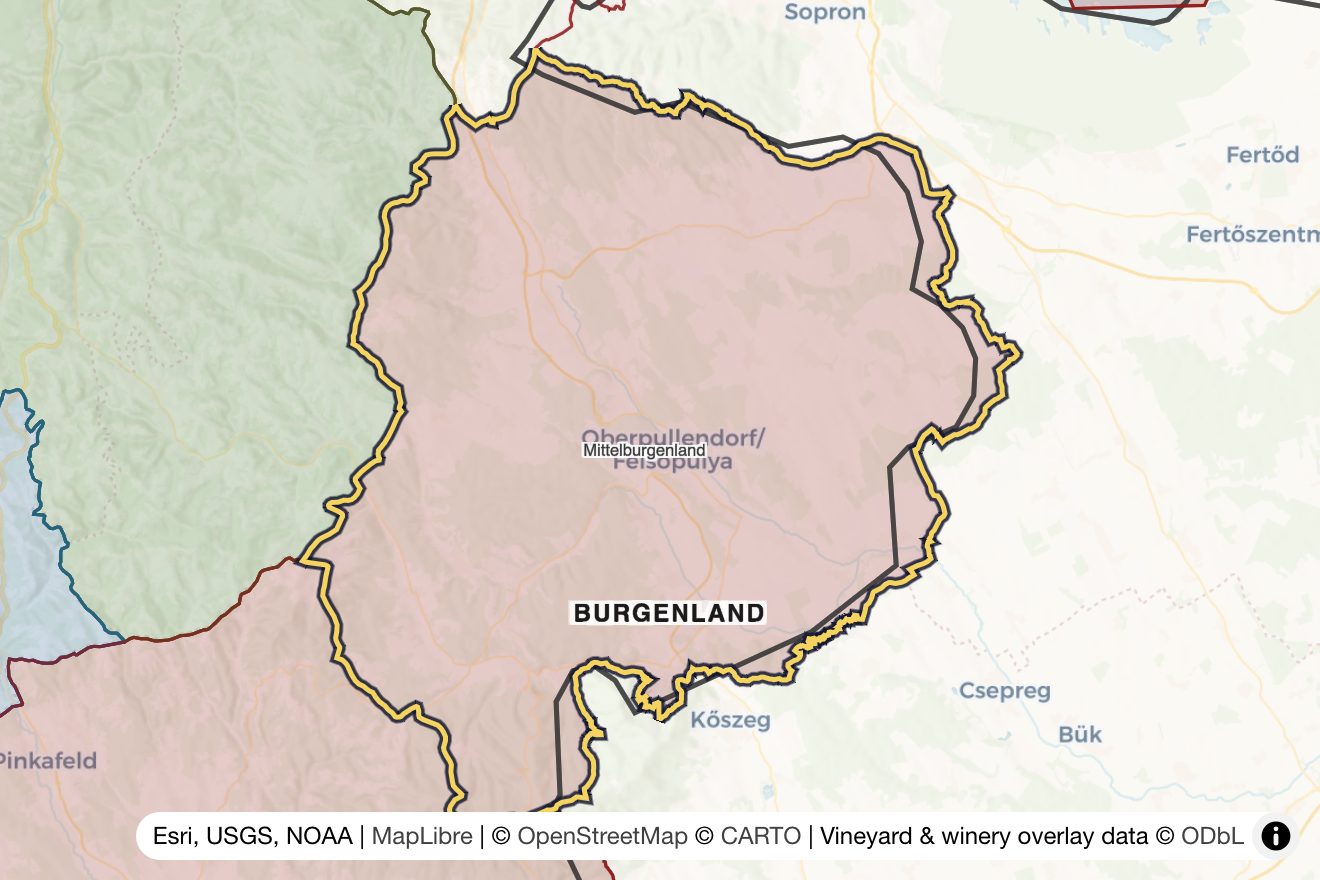
Overview
Mittelburgenland is Austria's red wine heartland, the district south of Lake Neusiedl's plain known plainly as Blaufränkischland: roughly 2,000 hectares in which Blaufränkisch accounts for over half the vineyard, concentrated in the four villages of Deutschkreutz, Horitschon, Neckenmarkt and Lutzmannsburg. Its DAC, established in 2005, was Austria's first for red wine and remains the defining appellation for the country's leading dark grape.
History
The district's Blaufränkisch tradition runs deep along the old Hungarian border, its vineyards continuous with Sopron's across the line. Modern ambition arrived in the 1980s and 1990s as growers traded volume for extraction and oak, and matured in the 2000s into the current idiom of site transparency; Roland Velich's Moric project, built on old vines at Neckenmarkt and Lutzmannsburg from 2001, recast the grape internationally as Austria's answer to fine Nebbiolo or Burgundy and pulled the district's style with it. The DAC of 2005 codified three tiers from classic through Reserve.
Terroir & Climate
The district is a bowl opened to the east, sheltered by hills on three sides and exposed to the full Pannonian warmth; it is among Austria's most reliably ripe red wine zones. Soils are deep, lime-poor clay and loam with schist at the margins, holding water through dry summers, a match for Blaufränkisch's late cycle. Village differences, Neckenmarkt's slopes and schist against Deutschkreutz's deeper loams, frame the internal range.
Grape Varieties & Wine Styles
Mittelburgenland DAC is Blaufränkisch, minimum 85 percent, from classic village level through Reserve. The district style is the grape's fullest: dark cherry and blackberry, peppery spice, firm acidity and substantial structure, oak-raised at the upper tiers and age-worthy over one to two decades. Old-vine and single-Ried bottlings, many outside the DAC by producer choice, occupy the summit. Zweigelt, Merlot and Cabernet play supporting roles in blends and regional wines.
Notable Producers
Moric is the district's international flagship. Albert Gesellmann, Paul Kerschbaum, Hans Igler, Kirnbauer and Juliana Wieder lead Deutschkreutz, Horitschon and Neckenmarkt, Weninger farms biodynamically across the Hungarian border at Horitschon and Sopron alike, and the district's cooperative and mid-size cellars supply the broad base.
What to Know
Blaufränkischland is the fullest-bodied corner of Austrian red wine; drinkers should expect weight that Leithaberg and Eisenberg deliberately avoid. The DAC's tiers order ripeness and aging, while several top growers label their finest wines under Burgenland to escape stylistic prescription, Moric among them. The grape rewards cellaring everywhere in the district.