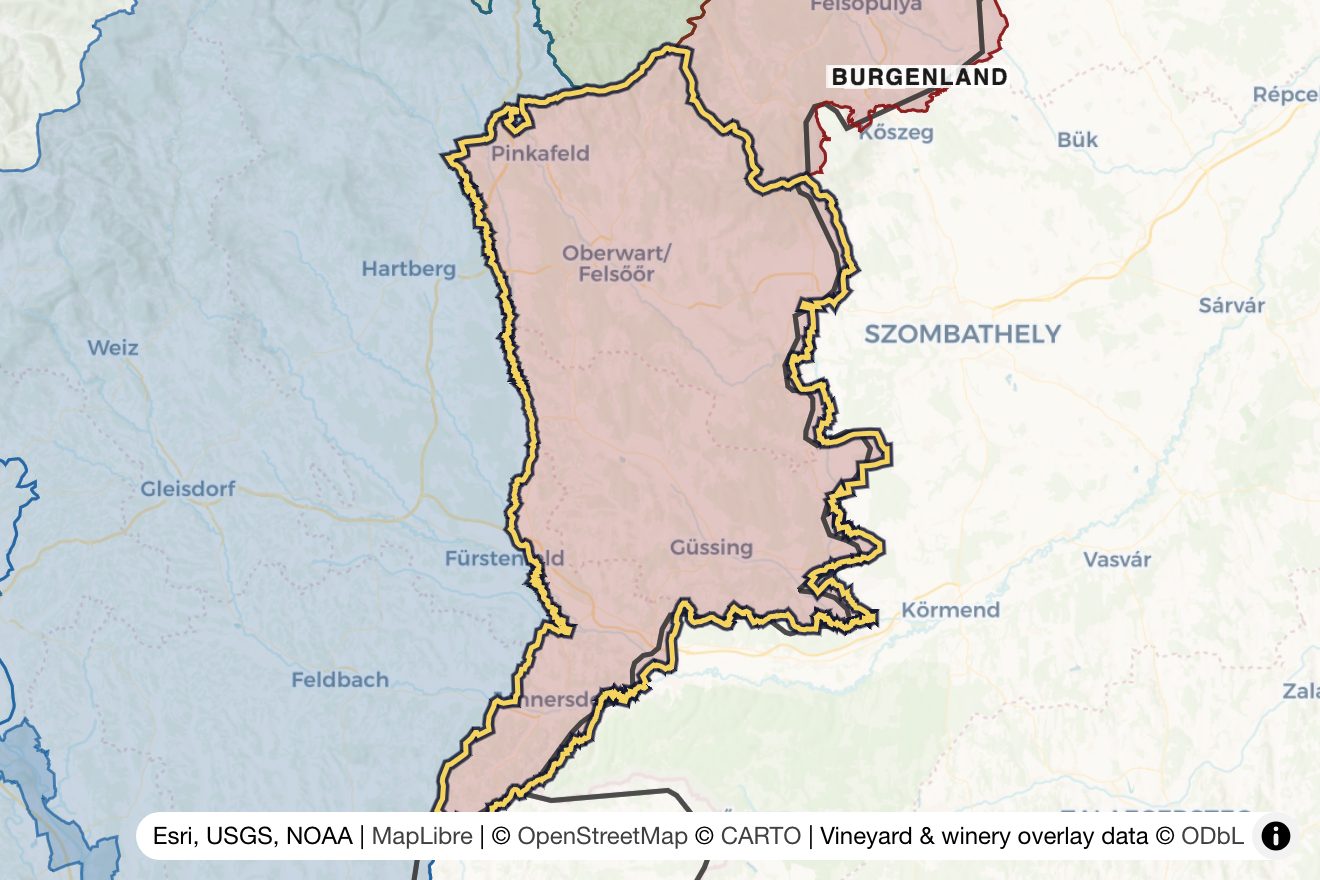
Overview
Eisenberg is the DAC of Südburgenland, Austria's smallest and southernmost Burgenland district: barely 500 hectares of vineyard scattered through green border hills, with the Eisenberg itself, the "iron mountain" above Deutsch Schützen, its defining site. The appellation, legally established in 2010 (first vintage 2009, with Reserve from 2008), is Blaufränkisch country of a particular cut: the grape at its most mineral, drawn taut by the district's iron-rich schist.
History
The district's vineyards are old peasant terraces along the Hungarian border, complete with the thatched Kellerstöckl cellar huts that dot the hills; iron was mined here from antiquity, giving the mountain its name and the soils their signature. Long a rustic local wine area, Südburgenland entered fine wine consciousness in the 1990s and 2000s through a handful of growers, Uwe Schiefer and the Krutzler family foremost, whose single-site Blaufränkisch demonstrated that the schist could stand with Austria's best. The Eisenberg DAC followed in 2010, covering Blaufränkisch.
Terroir & Climate
The hills are green schist and slate laced with iron oxide, thin-soiled on the slopes with loam and clay below. The climate crosses Pannonian warmth with moist, cooler air from the Styrian hills to the west, making the district marginally cooler and fresher than the Blaufränkisch zones to the north. Small parcels, steep pitches and mixed farming keep the landscape closer to garden than monoculture.
Grape Varieties & Wine Styles
Eisenberg DAC is Blaufränkisch, now with Welschriesling also permitted for village and single-vineyard wines, in regional, village and single-vineyard tiers. The district signature is aromatic lift and mineral edge: red and dark berries, blood-orange acidity, white pepper and a ferrous, stony finish, with less flesh than Mittelburgenland and more perfume, aging gracefully over a decade and more. Zweigelt and other whites travel under regional designations (Welschriesling now also qualifies as Eisenberg DAC at village and single-vineyard level), and the rare Uhudler wines, made from American direct-producer vines, persist in the district's folklore corner.
Notable Producers
Krutzler at Deutsch Schützen, whose Perwolff is the district's most celebrated wine, and Uwe Schiefer, whose Reihburg and Szapary bottlings mapped the Eisenberg's sites, lead the appellation. Wachter-Wiesler and Kopfensteiner carry the next tier, with Groszer Wein among newer investments in the hills.
What to Know
Eisenberg completes Austria's Blaufränkisch triptych: Mittelburgenland for power, Leithaberg for limestone tension, Eisenberg for iron and perfume. Production is small and grower-scale throughout, so the leading names are effectively the appellation. The wines' freshness makes them the most Burgundian-mannered of Austria's reds, and prices remain gentle for the quality.