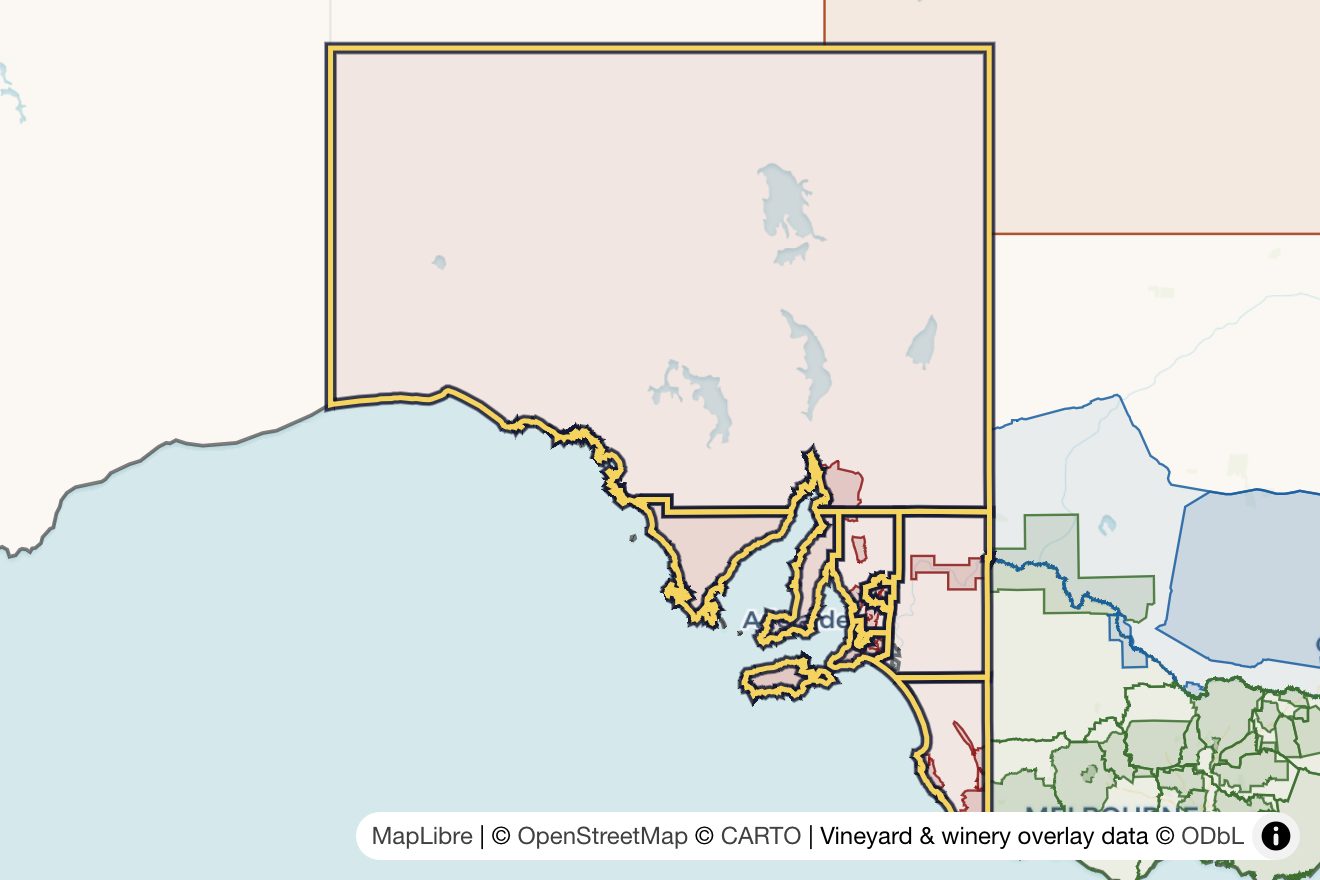
Overview
South Australia is the engine of Australian wine, responsible for roughly half the national crush and home to its most famous regions: the Barossa Valley and McLaren Vale for Shiraz and Grenache, Eden Valley and Clare Valley for Riesling, the Adelaide Hills for cool-climate whites, Coonawarra for Cabernet Sauvignon, and the Riverland for volume. The state has never had phylloxera, and its unbroken plantings include some of the oldest producing Shiraz, Grenache and Mourvèdre vines in the world.
History
Vineyards followed the colony's founding in 1836, with Silesian and English settlers planting the Barossa and surrounding districts in the 1840s; houses such as Penfolds, Yalumba, Seppeltsfield and Henschke date from that first generation. Strict quarantine kept phylloxera out, preserving nineteenth-century vine material through the fortified era that dominated until the mid-twentieth century. The table wine turn produced the state's defining bottles, Penfolds Grange from 1951 and Henschke Hill of Grace from 1958, and the modern era added Coonawarra's Cabernet ascendancy, Adelaide Hills' cool-climate rise and McLaren Vale's Grenache revival.
Terroir & Climate
The settled southeast of the state is Mediterranean in climate, moderated variously by the Gulf St Vincent, the Southern Ocean and altitude. The Barossa floor is warm and dry with old alluvial and clay soils; Eden and Clare valleys trade heat for elevation, preserving Riesling acidity; the Adelaide Hills climb into genuinely cool country above 400 metres; McLaren Vale spreads over an unusually diverse geology beside the gulf; and Coonawarra's terra rossa, a narrow strip of red loam over limestone, is Australia's most famous single soil. The Riverland's irrigated Murray flats are hot and productive.
Grape Varieties & Wine Styles
Shiraz is the state's core, from Barossa's dense, dark benchmark through McLaren Vale's chocolate-and-earth register to cooler Hills expressions. Old-vine Grenache, long undervalued as fortified stock, now yields some of the country's most fashionable reds. Riesling divides between Clare's lime-and-slate austerity and Eden's floral fineness, both dry and long-lived. Coonawarra Cabernet contributes the blackcurrant-and-eucalypt classic, the Hills lead Chardonnay, Sauvignon Blanc and sparkling, and fortified traditions persist at Seppeltsfield and Rutherglen-rivaling age.
Notable Producers
Penfolds, Henschke, Yalumba, Torbreck and Rockford in and around the Barossa and Eden; Grosset and Jim Barry in Clare; d'Arenberg, Wirra Wirra and the Grenache specialists of McLaren Vale; Shaw + Smith in the Adelaide Hills; Wynns, the reference of Coonawarra. The state also hosts the country's largest corporate wine operations and its research heart at the Waite campus.
What to Know
South Australia's regional names carry the information; the state designation appears mostly on cross-regional blends. The absence of phylloxera is not trivia but the foundation of its old-vine patrimony, protected by quarantine rules visitors encounter at the border. Its regional pages hold the detail for each district.